With the devastating statement: “Stop all this talk about monsters, Michele. Monsters don’t exist… It’s men you should be afraid of,” Italian author Niccolò Ammaniti set the tone for his most famous novel: Io Non Ho Paura (translated into English as I’m Not Scared and into Spanish as No Tengo Miedo). Since its publication in 2001, the work has become one of the leading examples of “cannibal narrative,” a label coined to group together raw realism. In addition to winning the prestigious Viareggio-Rèpaci Prize and being translated into more than thirty languages, the story was quickly adapted for the big screen in 2003 under the sensitive direction of Gabriele Salvatores.
More than twenty years after its publication, this unsettling contemporary classic is brought to life once again in the Mexican series No Tengo Miedo, produced by Netflix and Alebrije Cine y Video. With a directing team led by Ernesto Contreras, in collaboration with Álex Zuno and Alba Gil, this reimagining skillfully transposes the original story to the social context of 1980s Mexico. Through a blend of its rural setting, suspense, and coming-of-age themes, the plot delves into complex issues such as structural poverty and the inevitable clash between the innocence of childhood and adult society’s moral fractures.
What Is No Tengo Miedo About?
While Ammaniti’s original novel and Salvatores’s famous film are set in the Italian countryside of the 1970s – a turbulent era marked by political terrorism and a wave of mass kidnappings – Contreras’s adaptation recontextualizes the story in rural Veracruz in 1986. In this setting, a devastating agricultural plague has driven the small community to desperate measures, destroying not only their coffee crops but also their moral compass.
At the forefront is Miguel (Aldo Navarro), a 10-year-old boy who is resourceful, brave, and unwaveringly noble. He spends his summer days outdoors with his sister María and the other children in the village. They don’t have much to do, focusing on riding their bikes and the 1986 World Cup, which is on Mexican soil for the second time. Their innocently monotonous routine is shattered when “El Calavera” – the oldest and most brazen of the group – forces Miguel to venture alone into a dilapidated property to complete a wild challenge.
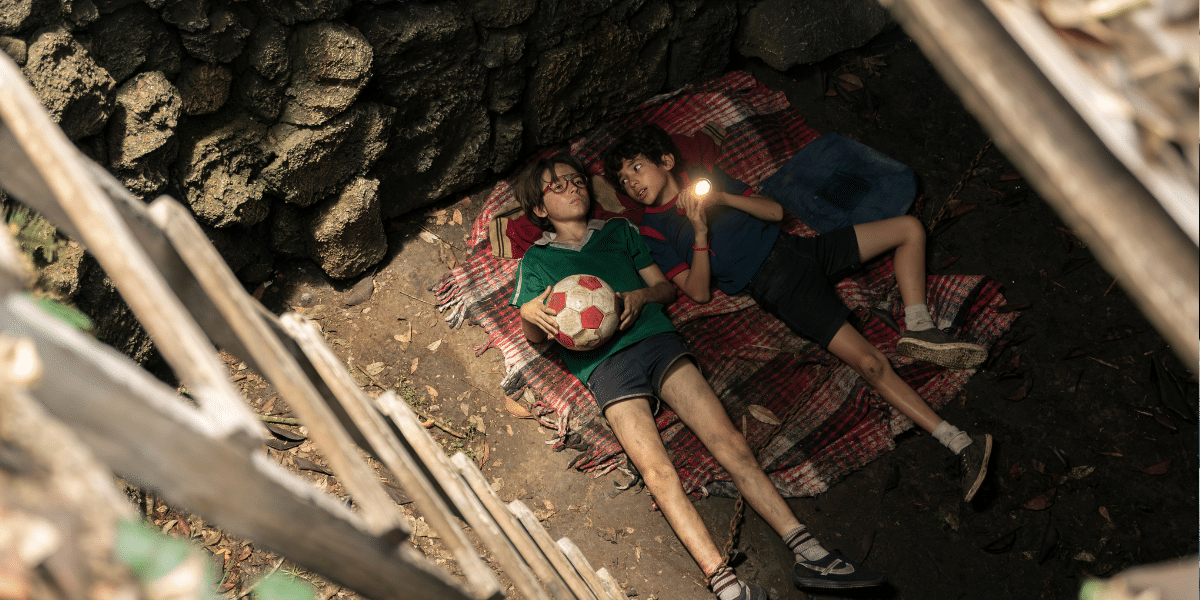
Far from his friends, Miguel soon discovers a hidden pit and stumbles upon a delicate truth: the chained and wounded body of Felipe (Yago Andreu), a boy his own age trapped in a state of shock so deep he believes he is dead. Although Miguel’s first impulse is to flee in terror and keep what he has seen a secret, his kind heart compels him to return and care for the captive in secret. As they get to know each other and grow closer, the boy begins to suspect that the adults around him – those he loves and trusts – are involved in one way or another with the kidnapping.
The End of Innocence in the Face of Adult Corruption
Thematically, the true genius of No Tengo Miedo, both in its original conception and in this adaptation, lies in its ability to portray the premature loss of innocence in the face of adults’ corruption. As Ammaniti explained to the Italian publication Famiglia Cristiana, the core of everything is “the transition from childhood to adulthood, a phase of mental and physical change that creates a conflict between the education received and one’s own ability to interpret the world.”
At first, Miguel and his friends are afraid of imaginary creatures, local legends, and the dark. However, little by little, they discover that the real dangers aren’t hiding in the closets, but in the real world. After seeing Felipe in the pit and realizing the magnitude of this crime, Miguel is abruptly torn from his childhood. His home is no longer a refuge, and he is forced to navigate a world where adults are no longer synonymous with protection or guidance. Against the backdrop of this devastating sense of abandonment, the miniseries’ title becomes a psychological shield, a powerful mantra for survival: it is not just any phrase, but the motto that drives the young hero to listen to his conscience and do the right thing.
Giving this conflict greater weight, Netflix’s reinterpretation moves away from traditional Manichaeism and reflects on systemic inequalities and how harsh conditions can turn ordinary people into accomplices with atrocities. When the mother pleads, “Promise me that when you grow up, you’ll leave here,” the series highlights the town’s suffocating atmosphere – a place that devours opportunities and pushes its inhabitants down.
Through Miguel’s painful awakening, No Tengo Miedo reminds us that true courage is not the absence of fear, but the ability to act with compassion and justice, even when the people we love choose the wrong path. In the end, our protagonist walks toward adulthood guided by a moral integrity that far surpasses that of those around him.
Mexican Flavor and Mature Performances
Judging by the first few episodes, the adaptation of No Tengo Miedo is a powerful work that does justice to the source material. Its screenwriters deserve high praise for their ability to give the story a distinctly Mexican flavor, taking care with even the smallest details to translate Italian folk customs into its rural Veracruz setting. This production respects its source material’s origin yet is capable of reinventing itself and forging its own path.
The casting is likewise strong, thanks to Luis Rivera’s meticulous eye. Navarro’s debut in a leading role is a true revelation. The young actor projects a moving wisdom, firmly embodying the abrupt end of childhood and the birth of an unfamiliar courage. For his part, Andreu masterfully absorbs every inch of captivity. His Felipe powerfully shifts between defensive hostility and extreme vulnerability. Without a doubt, the miniseries reaches its most moving and memorable moments whenever the camera focuses on these unlikely friends.
Should I Watch No Tengo Miedo?
If you love social dramas and psychological thrillers, don’t hesitate to hit play. Unlike the 2003 film, this episodic version simmers slowly and keeps you glued to the screen as it contrasts the courageous wisdom of children with the moral failings of adults. Its eight episodes are proof that Ammaniti’s work remains as relevant, uncomfortable, and shattering as ever.
