“I was raised to be the perfect wife.” This poignant voiceover opens Mistura as an idyllic childhood flashes across the screen – a dapperly dressed, cigar-smoking white man seated at a poolside table while children frolic in the water. Surrounded by women and other men at the Country Club, the French Ambassador to Perú enjoys a lavish lifestyle meant only for people like him.
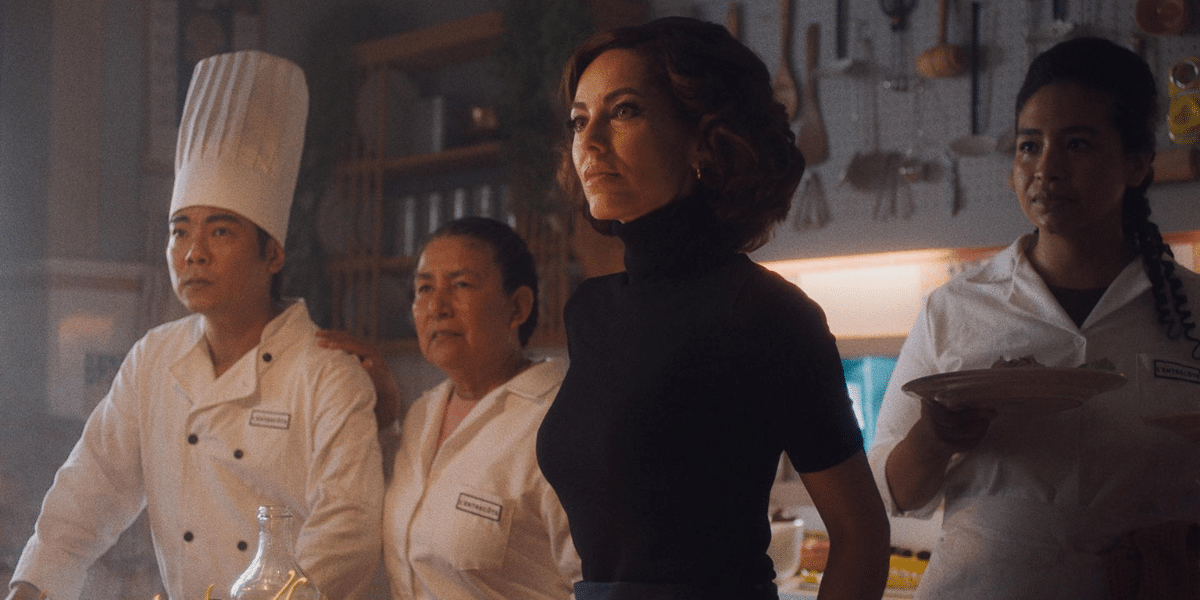
Mistura is a gastronomic journey of feminist reinvention. The film follows the transformation of Norma Piet (Bárbara Mori), a once-privileged Franco-Limeña housewife-turned-culinary entrepreneur after her philandering husband leaves her for a younger woman.
Stripped of her trophy-wife status, scorned by their former elite circle, she’s left facing financial ruin – until Óscar (César Pudy Ballumbrosio), her loyal, Afro-Peruvian chauffeur, convinces Norma to convert her home into a bistro. Because, yes, apparently, for rich folks, going broke doesn’t mean forgoing a private driver. But never mind my working-class-ass-with real-life-money-issues getting frustrated at one of the movie’s main subplots.
Reluctantly, Norma slowly begins to entertain Óscar’s idea. After all, she inherited her father’s passion for cooking, even kept books filled with notes on his favorite French recipes. Plus, preparing food allows Norma to build a business rooted in family legacy and distract her from the pain of her husband’s abandonment.
Initially, Norma is adamant about the bistro being all things French, from the silverware to the menu ingredients. But when her bank account can’t accommodate her exclusive taste buds, she agrees to accompany Óscar to El Gran Mercado. Stepping into the vast marketplace – where working-class locals source native potatoes, quinoa, and various ajíes – she is forced to confront her elitist prejudices. There, Óscar introduces her to the extensive biodiversity of his beloved country, opening a new world of scents and sensibilities.
But can someone as racially prejudiced and elitist as Norma really change? I cringed several times during the film at her callousness toward her staff – the Indigenous maid/cook she falsely accuses of stealing (cheese!), then subsequently fires. The many times she speaks condescendingly to Óscar, who is the real hero of the movie, guiding Norma along her journey. How she berates her son’s appearance when he makes a surprise visit from Paris. In my experience, people like Norma rarely reject their evil ways.
It’s just this cynicism that writer/director Ricardo de Montreuil addresses in an interview with Cocalecas. Referencing how tired he is of the global political rhetoric that aims to divide us, he says he wanted to “tell a story proving a country’s diversity can improve it.” Mistura reminds us that a pueblo’s power lies in cultural richness, where the meshing of many refuses to dilute any one. However implausible, Norma learns this lesson. And considering the continued chaos coming out of Washington, I wish more of our politicians would do the same.
Navigating away from her former French bougieness, Norma’s appearance and wardrobe demonstrate her transformation. She goes from flawlessly coiffed, high-end European fashion to disheveled and wrinkled clothing to eventually slim-fitting, ankle-revealing pants and loafers. All of this is meant to soften her, to make her more likeable. As if to say she is just like the rest of us. Because maybe circumstances and food can transform a person.
Peru’s diverse culinary heritage is the breakout star of the film, with Mistura showcasing how the cuisine blends Nikkei (Japanese-Peruvian), Chifa (Chinese-Peruvian), African, and Incan traditions.
Nicolás Wong Díaz of La Llorona fame, not only captures the vibrantly varied influences behind Peru’s 500-year history, but also used the camera as a sensory aphrodisiac. Interweaving slow-motion shots of sizzling garlic and spices with dramatic close-ups of searing flames, the film created a heightened sense of anticipation for the memorable meal ahead.
One of my favorite food scenes in the film is when the restaurant’s sous chef, Raúl (played by the real-life Peruvian chef, Tomás “Toshi” Matsufuji), prepares estiradito, his version of ceviche. He bathes thin strips of fish in a leche de tigre, ginger, and chili marinade before stretching them on the plate, garnished with finely minced red onion and microgreens. It is pure art.
At its heart, Mistura is a story about cultural pride, memory, and connection. It’s a reminder that food serves as a bridge for our shared humanity, nourishing us mind, body, and soul.
