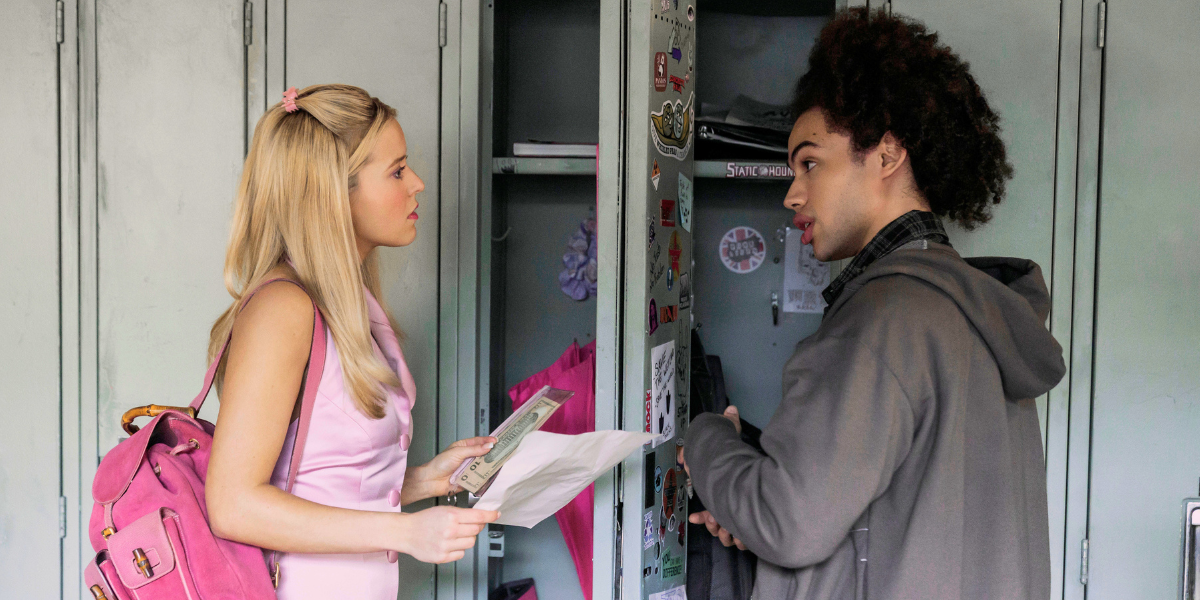
Repeat after me: not every beloved film needs to become a multi-installment franchise. It’s exhausting, and honestly, the sequels, prequels, and remakes never quite live up to the OG’s spark. It pains me to say this, but Elle, Prime Video’s new prequel to Legally Blonde, is just another example.
The show follows 15-year-old Elle Woods and her (seemingly) pink-and-perfect life in sunny Los Angeles, CA. When her plastic surgeon dad gets canceled for botching a client’s nose job, the Woods move to gray, rainy Seattle to avoid becoming social pariahs. In Seattle, Elle’s surprised to find herself in a place with different values and aesthetics than hers. It’s gray instead of pink, plaid instead of sparkles, scowls instead of smiles, and rain instead of sunshine. A grungy, social-justice enthusiast even replaces her Ken-Doll crush. Sound familiar?
I was originally excited to find out who Elle Woods was before Warren, Harvard Law, and the infallible Bend-and-Snap move. I wanted to see what her passions and motivations were, find out why she became the lawyer we all fell in love with. Instead, Elle feels like a lazily written, poorly styled, reheated teen version of the original movie, just set in the 90s instead of the 00s.
Look, I won’t say it’s not a fun watch. Sometimes we need a fun, easy show to have on in the background. And I will absolutely be tuning in to the show’s second season (yes, it was renewed for a new season ahead of its premiere). But Elle doesn’t add anything new to Woods’ lore. This show is between the nostalgia-core we’re seeing everywhere (and getting tired of) and a half-assed origin story. The issue is that the Elle from Elle is not the same character as the one from Legally Blonde.
Young Elle, in 1995, goes through the same journey that 24-year-old Elle goes through, which makes no sense for an undergrad who’s seemingly never left her SoCal bubble. How is it that twenty-five years after the original film came out, we have nothing new to say from a character that quite literally broke the mold? Where other prequel shows and movies – like Rise of the Pink Ladies, which adds legitimate context to an already rich universe (and shouldn’t have been canceled) – Elle is just a cash grab.
In contrast, Legally Blonde is a groundbreaking feminist masterpiece, redefining who a “professional” is. Through her journey of self-discovery, she allows her (and us!) to embrace our true selves to make our mark on the world. The film demands that we look at professional women and judge them by their character and skills rather than their gender, their favorite color, or how quickly they can identify last season’s Prada loafers. At the time, most narratives pushed women into neat little boxes – you were either smart, quiet, and modest, or ultra-feminine and dumb. No middle ground, no space for nuance.
Elle had so much potential. But instead of being a worthy prequel to two films that became pop-culture phenomena, it tries to emulate the original’s formula. But it falls flat, unable to speak to the 90s, the 2000s, or today. Nothing about the prequel makes sense – not the storylines, not the big cliffhanger (the Elle Woods we know and love would never make the big “what happens now” moment about two boys when it’s her show)… Not even the styling, which one would expect to be curated to perfection, since Elle Woods is a known fashion enthusiast, but no.
The one saving grace is the casting, especially Lexi Minetree, who plays young Elle. When she was announced last year, I wasn’t expecting much. But I was pleasantly surprised to find out she embodied Elle in a way I thought only Reese Witherspoon could. Minetree’s performance – along with that of June Diane Raphael, Tom Everett Scott, and James Van Der Beek – makes the show slightly easier to enjoy. Still, sadly, no amount of talent can overcome lazy writing, incoherent storylines, and Shein-level styling.
But I stand strong in my belief that not every beloved movie, show, or book needs to become a media franchise. I’s okay to let a good movie be a really good standalone movie (I’m looking at you, Mean Girls, Shrek, and Toy Story). I promise, nothing bad will happen if we just learn to enjoy older stories without turning them into a shell of themselves just for a few extra bucks.
