There are movies that arrive with billion-dollar marketing campaigns, endless TikTok edits, and celebrities whose outfits somehow become more important than the stories they’re trying to tell. Then there are films like Smile… the Worst is Yet to Come.
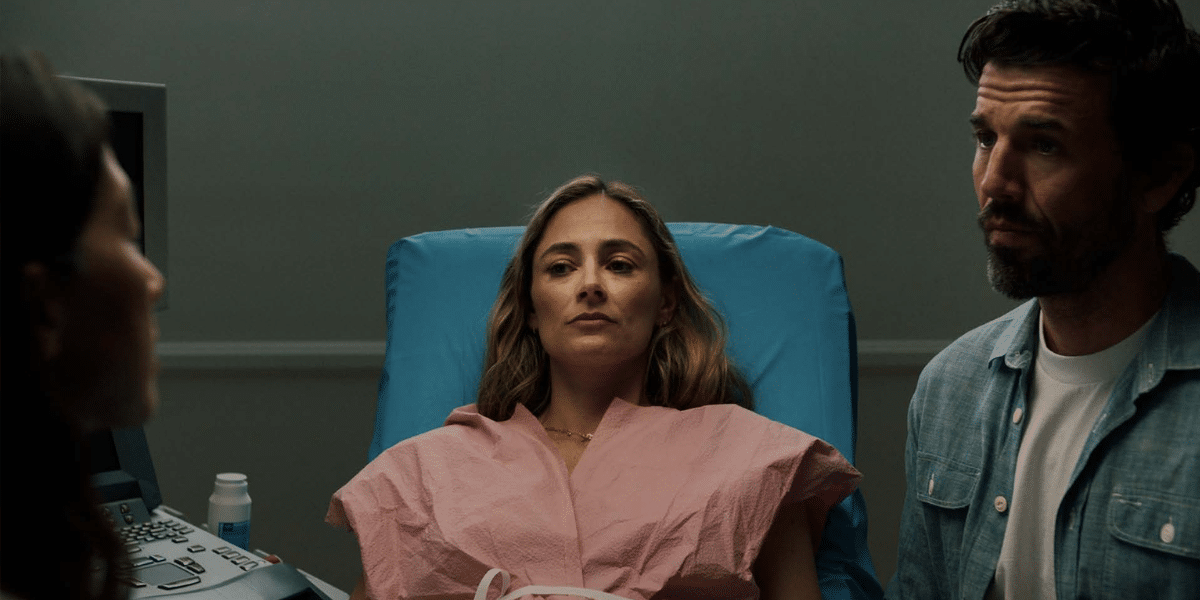
Directed by Chloe Lenihan, the film follows Ben (Joseph Mancuso) and Birdie (Elizabeth Masucci), a Los Angeles couple navigating multiple rounds of IVF, financial stress, and the slow erosion of unspoken disappointment. While stories about fertility often center exclusively on women, Smile… the Worst is Yet to Come quietly acknowledges that male infertility accounts for nearly half of cases. That simple shift broadens the emotional landscape, making this less a story about blame and more one about shared grief.
Ben, 42, is trying to rediscover who he is after closing his bar and surviving a health scare that forces him to reconsider his life. Birdie, 37, works as a nurse to keep them financially afloat while quietly mourning the photography career she put aside years ago. After another failed IVF attempt, they retreat to a cabin in Big Bear Lake, hoping to reconnect.
Instead, they find themselves confronted by January (Krystina Alabado) and Jerek (Ethan Jones Romero), a pair of Gen Z influencers turning everything around them into content. What begins as an awkward generational collision slowly becomes something much deeper after an evening of drinking leads everyone to share deep. Secrets surface. Walls begin to crack. The carefully curated versions of themselves become impossible to maintain.
The emotional terrain here is so recognizable. I’m in my early 40s, on my second marriage, and still attempting to let go of my elder-millennial emo phase. So, watching Ben and Birdie felt less like watching fictional characters and more like recognizing conversations that happen inside long-term relationships, but rarely out loud.
The film reminds me that we often hurt the people we love the most. Not because we love them less, but because they’re close enough to absorb the parts of ourselves we don’t know how to carry. Even after years together, there is almost always a corner of ourselves we keep locked away. Sometimes it’s because we don’t want to burden the people we love. Sometimes it’s because we haven’t figured out the words ourselves. And sometimes vulnerability feels far more frightening than silence.
Smile… the Worst is Yet to Come understands that intimacy isn’t measured by how long you’ve been together. It’s measured by how willing you are to keep introducing yourself as life changes you.
And the soundtrack backs up that understanding. Music arrives at exactly the right emotional moments without announcing itself. It becomes another character in the room, quietly carrying feelings that the dialogue wisely leaves unsaid.
For a film built around infertility, it ends up being about something much larger. It’s about purpose. It’s about creativity. It’s about the strange grief that comes from realizing you’ve quietly abandoned parts of yourself while trying to become the responsible adult everyone needs you to be.
Every major character in this film is an artist in some form. Birdie longs to return to photography. January and Jerek create through digital media. Even Ben’s identity as a former bar owner reflects someone who once built spaces for connection and community.
Art becomes more than a profession. It’s an extension of identity. A reflection of how we interpret the world rather than simply exist. That thread gives the film a resonance that extends well beyond its romantic comedy framework.
There’s plenty of humor here, too. The generational divide between exhausted elder millennials and endlessly online Gen Z characters creates some genuinely funny moments without reducing either generation to caricature. The younger characters aren’t simply punchlines about influencers, and the older characters aren’t reduced to “kids these days” complaints.
Instead, both generations expose each other’s blind spots. The younger pair forces Ben and Birdie to confront how carefully they’ve hidden their lives behind respectability and routine. Ben and Birdie, in turn, reveal that not every meaningful experience needs to become content to matter. It’s a surprisingly compassionate conversation between generations.
One of the film’s greatest strengths is that the dialogue feels lived in. The women especially feel like actual people instead of romantic comedy archetypes assembled from recycled screenwriting templates.
Knowing that the cast and creative team include a plethora of strong women makes perfect sense once you watch it. There are conversations here that feel observed rather than manufactured. The emotional beats land because they don’t sound like someone guessing how women might speak under pressure. They simply sound human. That shouldn’t be remarkable. Yet somehow it still is.
There is a tremendous amount of heart inside Smile… the Worst is Yet to Come. It isn’t trying to solve infertility. It isn’t trying to hand audiences neat answers about marriage, purpose, or happiness. Instead, it asks better questions. When did you stop creating? When did survival quietly replace living? When did success become someone else’s definition instead of your own?
And perhaps the hardest question of all:
Who stayed beside you while you were trying to figure that out?
Those questions linger. So, if you’re willing to spend an evening with characters who feel wonderfully imperfect, who carry grief with humor and who remind us that love is less about grand gestures than the courage to finally say the thing you’ve been carrying alone, Smile… the Worst is Yet to Come is well worth finding.
Sometimes the best films aren’t the loudest ones. Sometimes they’re simply the ones that quietly remind us who we used to be before life convinced us to stop telling the truth.
