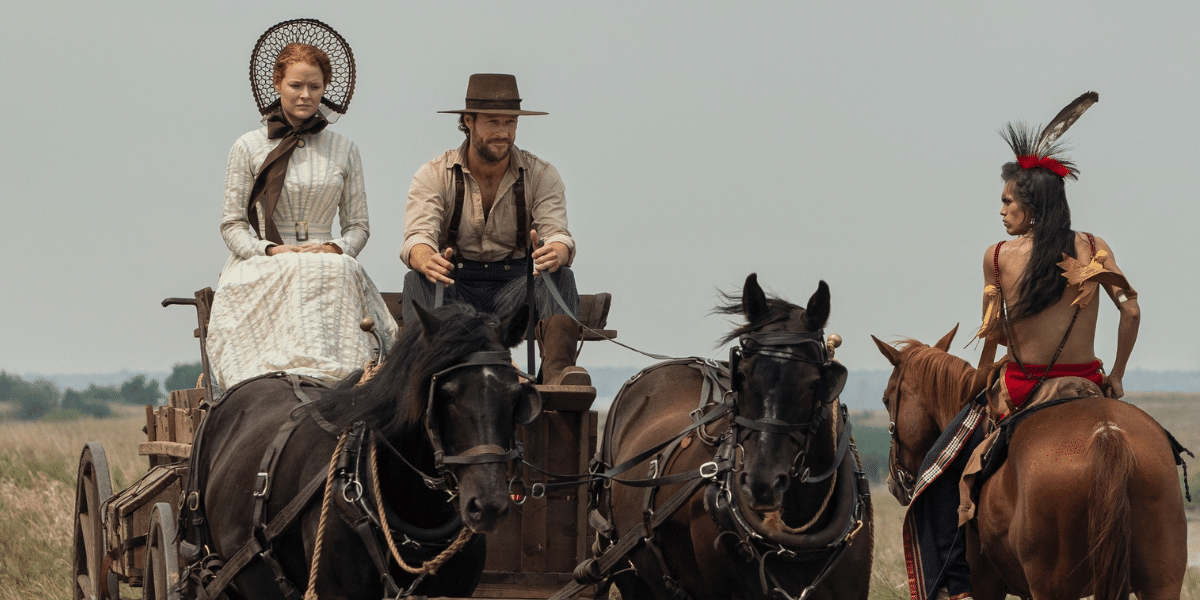
Netflix’s Little House on the Prairie tells the story of a family of squatters and land grabbers.
The prairie belongs to the Osage Native Americans, who the show (and books) portrays as savages who break into the poor squatters’ houses to take their food, completely ignoring the first crime of the settlers building on stolen land.
U.S. mythmaking does this, portraying Indigenous people as violent savages for protecting their land and resources. The Osage Tribe has less than 25,000 people in 1.5 million acres of land. Their history of the last few centuries is one of perseverance, being cast as the villain, and paying for it. In that, the Osage share much with the other Indigenous tribes of the Americas, including the Tainos.
Puerto Ricans are mixed breeds, satos. My grandma looked like a Taino woman with her high cheekbones, skin color, very beautiful black hair, and elegant posture. I used to imagine her in a previous life making cassava in her bohio. When I met her, she already had the short hair older women in the 80s wore, but I am sure the long hair of her youth must have been magnificent.
I remember the first time I read about Tainos in elementary school. I was in a Christian school. I had to ask my mom what a sexually transmitted disease was. It was the 80s, and no one was PC. I can still smell the cigarettes from adults smoking over us. In my school books, the lazy and ignorant Tainos tried to revolt.
My mom, who was a proud Nuyorican, told me that stereotype was not true. She spoke about all the Taino words that American culture adapted, like hurricane, hammock, and barbecue. Taino bathed twice a day, unlike the dirty Europeans of the time. Taino families had healthy dynamics, where smart women were valued and abortion was valid. Taino women raped by colonizers would hit their bellies against trees to lose the fruit of the aggression or use herbal remedies to control their reproductive rights.
My mother told me we were a peaceful culture that would have flourished if the colonizers respected us instead of destroying our establishments.
In Little House on the Prairie, there is this Native character who wants to protect his people by mediating between the squatters and the tribe. He wants peace and fair compensation, but he doesn’t get any of it – instead, he aids the abuser, proving Simone de Beauvoir right, when she wrote, “the oppressor would not be so strong if he did not have accomplices among the oppressed.”
The reality of colonization is not a pretty picture – it’s abuse, gun violence, and resource exploitation. If the colonizer did not have guns, their lies would have failed. They are not smart or righteous after all. And Puerto Rico is still a colony of the free United States of America.
Here, we have The Legend of Diego Salcedo (I love how history that makes us Natives look good is a “legend”). It goes like this – an arrogant Spanish colonizer told Tainos he was a god and they drowned him to prove it. They observed his body for three days to make sure the Catholic lies were not true, and he wouldn’t come back to life. Then Agueybana II revolted in the Battle of Yagüecas (I don’t understand how it’s called a “revolt” when it was their home, but that’s how the story goes).
I love this African proverb: “Until the lions have their own historians, the history of the hunt will always glorify the hunter.” In the case of colonized people, until we tell our stories, we will always be the savages. Native communities from the inland prairies to the islands lost the fight, but they fought it. Today, Puerto Ricans in and out of the Archipelago fight for our agency, our nation, and our peace. We don’t believe the falsehood that “progress” is making our home unaffordable, even if the Puerto Rican government has name-tagged the land grab “strategic.” Like we don’t know what that really means exploitation, money for the raiders, and ravishing a beautiful and protected piece of land.
We don’t want to give anyone our prairie – our nation is not for sale. We have the spirit of strong, smart, rich mestizo culture supported by our ancestors and leaders, Agueybana II, Agueybana, Roberto Clemente, Eugenio María de Hostos, Luis Pales Matos, Lolita Lebron, Julia de Burgos, Celestina Cordero, Yolanda Arroyo Pizarro, Sonia Sotomayor, and other heroes of our nation flowing in our veins that will support this fight. They can pretend that Little House on the Prairie tells an inevitable, righteous story, but we know better.
We are P FKN R, and we will stand!
