For too long, Hollywood treated Afro-Latino identity as invisible, a box that didn’t fit neatly into the Black narrative or the Latino one. Y’lan Noel is one of the men helping to end that era.
Born in Brooklyn and of Afro-Panamanian descent, Noel is part of a generation of Afro-Latino men arriving in Hollywood not at the margins but at the center. He first captured our attention on Insecure as Daniel King, Issa’s magnetic, complicated love interest. Then, he proved his range, leading The First Purge as Dmitri Cimber, anchoring a franchise built on social commentary and action in equal measure.
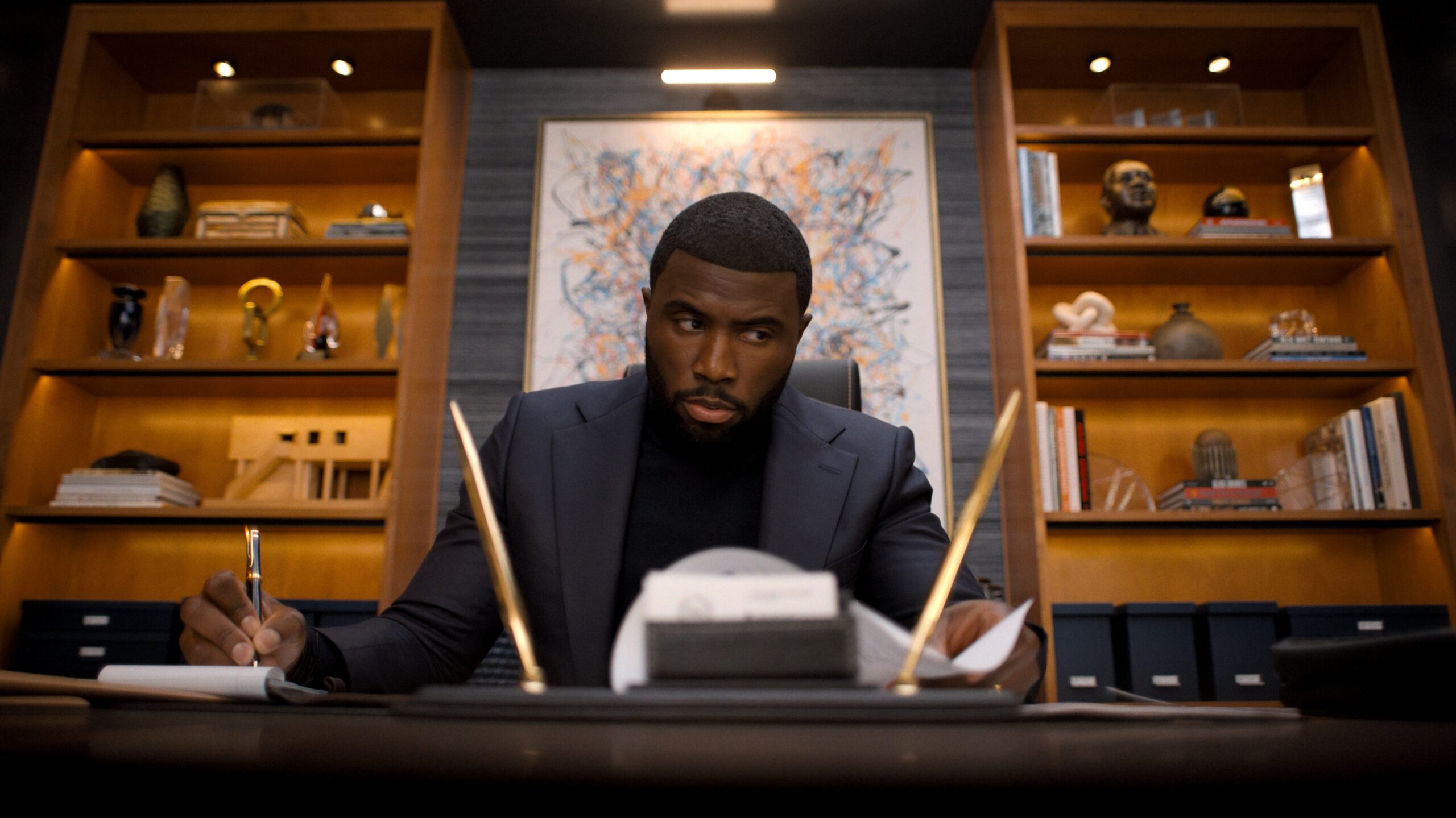
Now, he’s headlining one of Netflix’s biggest crime dramas. In Nemesis, Noel plays Coltrane Wilder, a real estate mogul and the secret mastermind behind a string of multimillion-dollar heists. Series creator Courtney A. Kemp cast him first, describing Coltrane as a character with “a great moral center” who required a masculinity and depth she could only imagine Noel delivering.
Y’lan Noel is drawn to the show’s central tension: the idea that most of us carry contradictions within ourselves, even if our double lives aren’t quite so high-stakes.
“A lot of us have that duality, hopefully not as criminals moonlighting as real estate moguls,” he tells Latina Media Co with a grin. “But there are noble qualities in unsavory people, and some rather sour qualities in people we consider good. That’s one of the overarching themes of the show. As far as Coltrane’s hypocrisy, it’s 100% there.”
He laughs when the character’s name comes up. “Coltrane, you have to really earn that name. That’s probably the dopest character name I’ve ever had.”
He’s equally thoughtful about where the character’s drive becomes his undoing. “Obsession can be a very positive thing. A few things you obsess over – your partner, your craft, your family, and your business are positive. It becomes a flaw when, if you don’t obtain what you want, everything unravels. A degree of narcissism and ego activate Coltrane’s tragic flaw.”
“What would it be like to be somebody who is not only certain in that way of thinking but so certain that people would literally risk their lives letting him lead them?” Noel asks when describing how he found a “way in” to playing this character. “When it comes to his business, his relationships, and his underground activities, there are life-and-death stakes in all of it. I was daydreaming about what it’s like to earn those shoes.”
One of the most compelling dynamics in Nemesis is the relationship between Coltrane and Isaiah, the detective on his trail. Noel sees them as mirror images of each other. “Isaiah, you’re just the same person with a badge,” he says plainly. “You’re out here breaking the same rules.”
The show doesn’t let Coltrane’s armor stay fully intact, either. His wife Ebony, played by Cleopatra Coleman, is grieving alongside him after the loss of their child, and it’s the one wound Coltrane can’t strategize his way out of.
“His profession, his mastermind activities… what would he be like without the thing he’s wrapped his complete identity around?” Noel says quietly. “Being a family man is the most uncertain thing about him as much as he loves everything, as much as he wants to be a good father. His father was great, and he wants to be better. There’s this uncertainty of what a man like him does when he can’t control the outcome. I think that frightens him more than anything.”
Asked what it means to lead a series not only as a Black man but also as an Afro-Latino at a moment when Latin representation in Hollywood remains painfully scarce, Noel doesn’t reach for easy answers. “Nipsey said that to inspire is one of the noblest acts of mankind,” he begins. “I’m not completely aware of how it affects other people. I just know that authentically, it is what it is – that’s what I am. So I want to be as much of myself as I can be, at all times.”
His family story is layered, carrying generations of migration and cultural mixing. His mother was born in Panama, but her great-great-grandparents were Jamaican – people who relocated to help build the Panama Canal and, over generations, became Spanish-speaking. They eventually moved to New York, making Noel a first-generation American on that side. His father’s family traces back to Alabama and Philadelphia.
“I believe it’s crucial to demonstrate that Black people are not a monolithic group, but rather a diverse community with various shapes, sizes, creeds, and backgrounds,” he states. “And as an actor, to arrive as a fully fleshed human being, not only in the characters I play but personally as well – that’s what I’m after.”
Off-screen, his presence is equally impactful. His Insecure castmate Sarunas Jackson, also of Panamanian heritage, has spoken about how having two Afro-Latino actors on such a prominent platform helped audiences see the full diversity of Latin America and the Black diaspora. That visibility doesn’t happen by accident – it happens because actors like Y’lan Noel keep showing up, going deeper, and demanding that their full identity be seen.
Whether he’s Coltrane Wilder engineering an empire in the shadows or Daniel King making us feel things we didn’t plan on, one thing is certain: Y’lan Noel is here to stay.
