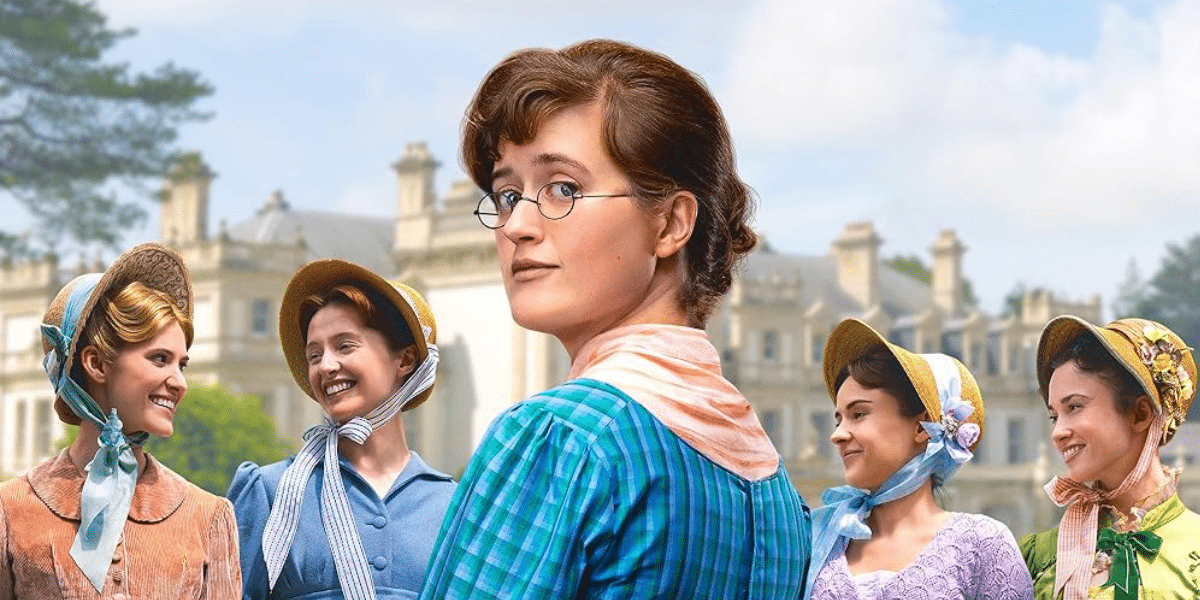
I love a good Pride and Prejudice reimagining as much as the next Jane Austen fan. Every time someone has swapped a character’s gender, culture, or race, I end up only appreciating Austen’s work that much more. Same goes for focusing on a character’s perspective outside of Elizabeth Bennet. There’s a reason this novel has resonated with readers for more than 200 years. Which is why I was so delighted to watch the TV adaptation of Janice Hadlow’s The Other Bennet Sister, premiering in the U.S. two months after the original UK release in March.
Following Elizabeth’s younger sister Mary, the series explores her trials and tribulations as the third and “forgotten Bennet sister.” The one known for her less-than-ideal looks, stiff piano playing, uppity attitude, religious uprightness, and fondness for reading over conversation – or at least that’s Elizabeth’s perspective.
In Mary’s head, we see her mother constantly measuring her against both her older and younger sisters – and she always comes up as lacking. Mary gets little emotional support from any of her family, except Elizabeth every now and then, and she’s stuck dealing with their cruelty and neglect.
While I’ll always love Pride and Prejudice, watching Mary re-tell the story from her point of view in the first few episodes of The Other Bennet Sister is nothing short of heart-wrenching. I found myself replaying the 2005 film version in my head, realizing every moment where Mary is portrayed as embarrassing for being herself. Or the shots where the camera would land on her, only to swivel elsewhere for someone more interesting, like her younger and louder sisters, Lydia and Kitty.
Ultimately, Mary’s role in the original story is to showcase the wide class differences between Elizabeth and Mr. Darcy. Which leads him to believe that Elizabeth, in all her low upbringing, home, and family, is beneath him. And all that happens without a thought of how Mary sees or understands herself.
The Other Bennet Sister, then, acts as an undoing and reclamation of who Mary is and what she wants from life. To everyone’s surprise, including admittedly my own, she attracts the attention of a suitor within the very first episode, and another by the third. After a family tragedy, she escapes the bubble of her beautiful sisters and heads to London, where she proves herself capable of shining on her own. Discovering her love for teaching with her aunt and uncle’s children, she realizes she can showcase her intelligence and knowledge, including her special interests in geology and history, without offending or embarrassing anyone.
Of course, like all romantic escapades, it doesn’t all go as smoothly as she planned. We see the return of old villains from Pride and Prejudice who threaten to get in Mary’s way, including the overbearing and irritating Mrs. Bennet. But there are so many moments throughout the ten episodes that made me squeal and blush with delight, such as when she finally finds a true friend in local Londoner Ann Baxter. Beautiful but kind, Ann charms me by being exactly the kind of confidante Mary needs in a new city. Not to mention her aunt, Mrs. Gardiner, who in many ways becomes Mary’s surrogate mother because of her willingness to listen, praise, encourage, and push without being unkind. Even Elizabeth steps up, realizing the harm she unknowingly contributed to, and becomes the sister Mary wants her to be.
Watching this series made me feel just as I did when I saw the 1995 TV adaptation of Pride and Prejudice for the first time. Moving, cozy, and sweet, this series showcases the very best of the UK in its actors, writing, and settings, from the gorgeous homes to the natural summits and gardens.
Though this is a very different version of Mary from all the depictions we’ve seen before, actress Ella Bruccoleri beautifully captures her character in all of her awkwardness, brilliance, and earnestness. She’s not the stiff and uptight girl the original novel depicts her to be, nor is she her sisters. Mary’s her own person, and it’s refreshing to see her blossom and reclaim her narrative. It sounds cliché to say that she becomes beautiful in her own way, but she does, making The Other Bennett Sister a delightful continuation of a classic story. And it proves that everyone, regardless of who they are in someone else’s story, can get their own happy ending.
