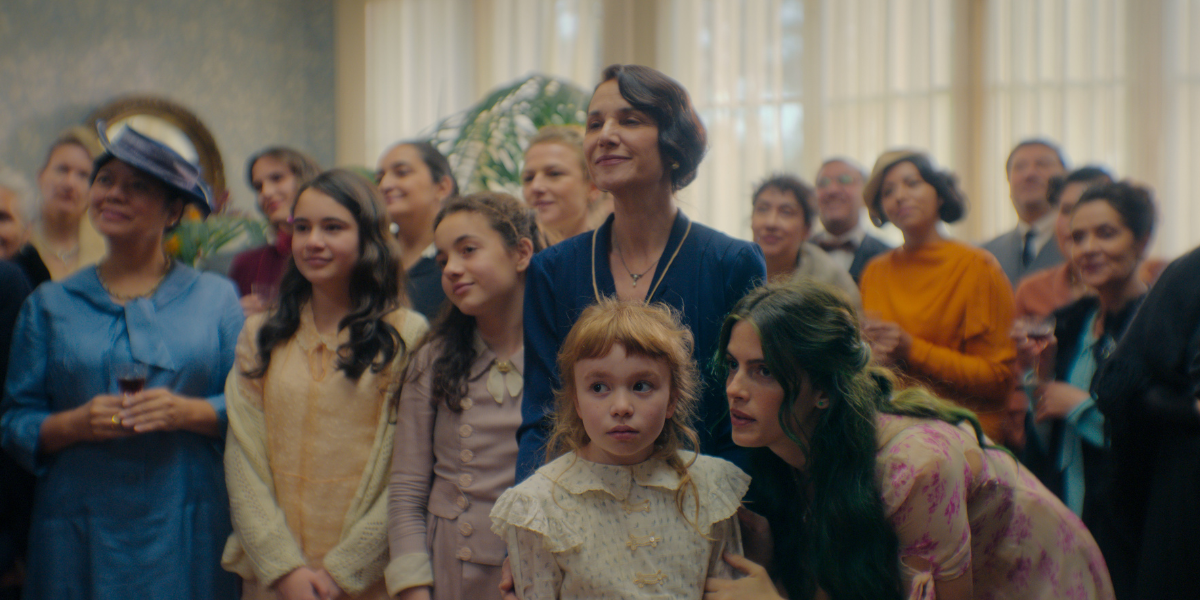
Isabel Allende’s books have been among my favorite reads since adolescence. Being able to watch The House of the Spirits on TV entirely in Spanish is a genuine pleasure, allowing me to experience the story in its full authenticity. The new Amazon Prime version, premiering on April 29, succeeds in transporting us into Allende’s universe, where magical realism intertwines with the darker aspects of human nature.
Back in 1993, the novel made it to the big screen with an all-star cast – Meryl Streep, Jeremy Irons, Glenn Close, Antonio Banderas, and Winona Ryder – but, obviously, creators, actors, and producers from Latin America and Chile are more able to fully explore and capture the region’s identity. Thankfully, the rise of streaming has made that possible by opening the door to productions in other languages and proven, through hard numbers, that non-English content can succeed in the marketplace.
The House of the Spirits follows four generations of strong women, silenced, oppressed, or vindicated according to her historical moment. Instead of glorifying them, it portrays real women facing real struggles – from those who fought for equality and freedom to those who lived in gray areas, still bound by the belief that a husband or brother should hold authority over them.
The story also explores family, loss, and death. Familial bonds can be a refuge or a space in need of healing where unhealthy patterns repeat. In this tale, death not definitive – for Allende, the dead remain among the living, a persistent reminder of a life shaped by love.
Like the book, the series begins with a narrative that blurs the line between reality and a dreamscape. Some characters possess psychic abilities and certain creatures – such as pets that arrive from the sea – take on almost mythological qualities. With and beyond this blending of worlds, the story gradually moves into more complex territory, forefronting themes like violence against women and politically driven torture.
Politically, the story carries significant weight, as it did in Allende’s own life. The author drew inspiration from Chile’s devastating dictatorship, which she fled in the 1970s. From Venezuela, she began writing The House of the Spirits, initially as a letter to her dying grandfather, whom she would never see again.
Allende understands firsthand what it means to live under authoritarian rule: torture, death, repression, and the kind of exile that fractures families. She experienced it personally, as well as through the stories that reached her from afar. Her work reflects that awareness, showing that abuse of power does not belong to a single ideology but can emerge from any side. Even so, she maintains that historical cycles shift, and that even after the darkest periods, rebuilding is possible. She witnessed a devastated Chile recover and saw a once-prosperous Venezuela collapse.
Writing from this depth of experience has allowed Allende to transcend cultures and borders, turning The House of the Spirits into one of the most influential Latin American works of the 20th century, with more than 70 million copies sold. Although its television adaptation could have arrived earlier, 2026 feels like the right moment for this production, alongside other high-quality adaptations gaining ground, such as One Hundred Years of Solitude (Netflix) and Like Water for Chocolate (HBO Max). Together, these projects confirm that Latin America has a powerful and increasingly visible voice in the global audiovisual landscape.
One aspect that particularly stands out to me in the Prime production is the strength of the performances. Through an ensemble cast, the series captures the passage of time across generations with remarkable ease. Although not all the actors are Chilean, the story is carefully placed there, evident in details like the accent — one of the most difficult to replicate in Spanish. These nuances, even if not flawless, create a sense of authenticity that truly comes through on screen.
Watching The House of the Spirits means moving through a range of emotional states. At first, magic and a sense of not quite belonging take center stage. By the end, chaos prevails as the prelude to a new order. Yet the thread that ties everything together is family – a source of support, but also a place where shadows surface unexpectedly, reminding that, in the end, everything is cyclical.
