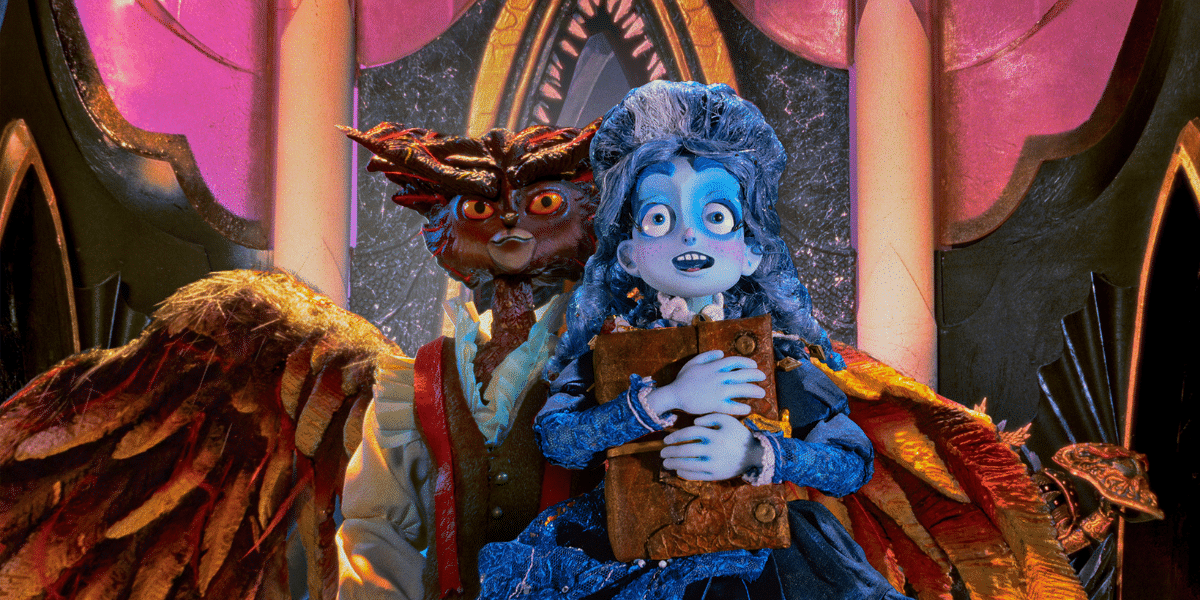
“What you imagine has long been imagining you.” Under this evocative premise unfolds Soy Frankelda (I am Frankelda), the first stop-motion animated feature film in Mexico’s history, coming to Netflix on June 12. Written and directed by brothers Roy and Arturo Ambriz, and mentored by award-winning filmmaker Guillermo del Toro, this gothic musical fantasy is a dazzling love letter to the craft of storytelling and to the two-way, transformative relationship between the creator and their work.
The production serves as a monumental prequel to the television series Los Sustos Ocultos de Frankelda (Frankelda’s Book of Spooks), expanding Frankelda’s universe to explore her past and the origins of the enigmatic Topus Terrentus. For the uninitiated, this story has no connection whatsoever to Frankenstein, but rather to its author, Mary Shelley, and to the countless female writers who, throughout history, have been rendered invisible. Loosely inspired by this underpinning, the film chronicles the journey of a young artist determined to defy her era and claim her voice, both in the real world and in her own fiction.
Soy Frankelda is a true masterpiece of technical engineering and artistic resilience that required years of meticulous preparation. Through an intricate combination of techniques – blending 2D textures, cardboard cutouts, and more than 180 hand-sculpted puppets with complex articulated skeletons – the film is both incredibly detailed and majestic.
What Is Soy Frankelda About?
In the misty town of Real del Monte, Hidalgo, in 1866, the young Francisca (Mireya Mendoza) writes horror stories to cope with the unexpected loss of her mother. But the Mexico of her era has no interest in hearing from a woman who creates frightening monsters. After enduring years of rejection from her peers and publishers, Francisca is ready to abandon writing. Fortunately, fate, ever wise, has other plans.
What she doesn’t know is that her words have taken on a life of their own in Topus Terrentus (The Land of Spooks), an alternate dimension that acts as a mirror of her own mind. In this gloomy yet vibrant realm, monsters live in an organized society that relies on human fears as the sole source of energy to sustain its ecosystem. Crown Prince Herneval (Arturo Mercado Jr.) ensures that fear flows freely to keep everything he knows and loves safe.
However, the balance of his kingdom has become increasingly fragile. Since the nightmares of Topus Terrentus have faltered and humans have lost their fearful nature, vital energy is in short supply and creatures are in danger of fading away. Faced with this crisis, Herneval, the author’s most intimate creation, crosses the dimensional veil to offer her a pact – does she want to leave her world behind and move to the other plane as her official nightmare writer?
Side by side with her own character, Francisca begins a race against time to defeat the sinister Procustes (Luis Leonardo Suárez), who has disrupted the flow of terror and is plotting to dominate both worlds. Throughout this journey, we follow as the innocent Francisca transforms into the mythical and powerful Frankelda.
Visual Power and Orchestral Power
A visually hypnotic film, Soy Frankelda is brimming with imagination and craftsmanship – and it’s hard to believe that every element is built by hand. The Topus Terrentus unfolds on screen as a riot of surrealism, dark fantasy, and folklore. To bring it to life, the Ambriz brothers wove together two major influences: the solemnity of Gustave Doré’s illustrations and the rich folklore of Mexico.
Far from digital perfection, this land of spooks possesses an imperfect beauty, with scenes full of eloquent details. Its curious inhabitants – ranging from arachnid-like creatures to winged beings – demonstrate the filmmaker’s almost obsessive devotion. This rich cosmology, which includes references to the aluxes – tiny guardian sprites from Mayan mythology – the mystique of the ceiba tree, and a depiction of the dictator Porfirio Díaz, pays homage to Mexican identity.
The film also stands out for its impeccable sound design. Composed by Mexican Kevin Smithers, the soundtrack is already nominated for the prestigious International Sound & Film Music Festival. It draws on classical opera and Gothic romanticism to heighten the mystery and organically guide the story. Through piano and string arrangements, the score lends the production a remarkable theatrical and emotional dimension that humanizes the creatures and delves deeper into the author’s psychological journey. Musical numbers such as El Príncipe de los Sustos and Tu Alma es Tinta stand out in particular, pieces of magnetic authenticity that linger in the memory.
Art as a Two-Way Mirror
Thematically, Soy Frankelda reflects on the creative calling, artistic resilience in the face of rejection, and literature as salvation and solace. This Gothic fantasy argues that art is a mystical two-way street in which the artist and the art shape one another.
At the outset, our protagonist exercises absolute control over her literary work. However, as her creative process progresses and the characters take on a symbolic identity of their own, her work begins to demand its own answers. The film explores this profound symbiosis and suggests that the act of creation is not a one-way street, but a two-way mirror. As the Ambriz brothers themselves explained in a press statement, “At the heart of the film is the relationship between Frankelda and Herneval: creator and creation, voice and echo.”
As she delves into Topus Terrentus, Francisca discovers that her stories no longer belong entirely to her. The kingdom’s collapse forces her to mature, fight for her voice as an author, and find hidden inner strengths. Through this process, the film demonstrates that the literary process is a constant exchange: while the writer gives birth to and shapes the realm, her creatures in turn shape her.
Should I Watch it?
Soy Frankelda is proof that handcrafted cinema doesn’t have to be perfect to be extraordinary. The feature film possesses that electric, inimitable energy that only emerges when artists truly care about their work – and if that isn’t beautiful and captivating, then I don’t know what is. A project with this level of detail, folklore, and artistic sensitivity not only deserves to be seen but celebrated and shared. That said, it’s worth noting that some images may be disturbing to young children.
