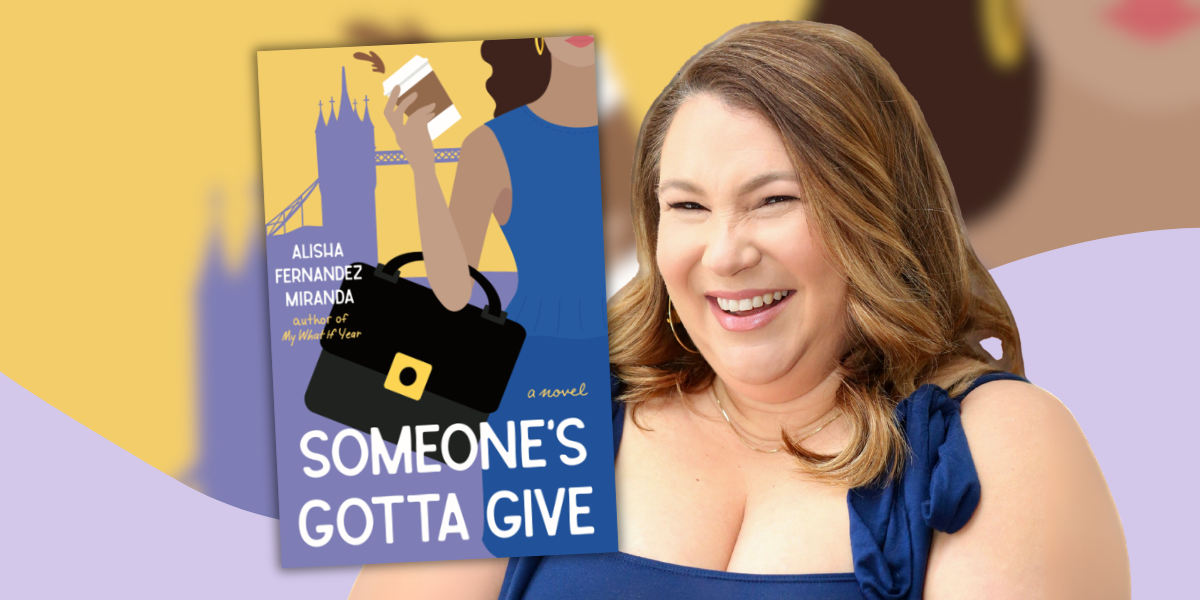
Early in my novel, Someone’s Gotta Give, my protagonist Lucia, a Venezuelan-American transplant to the UK, is interviewing for a high-powered job at a posh London private bank. She’s prepped within an inch of her life, she’s wearing her “hell yes” dress, and she takes the best temporary ID photo of her life. She’s ready.
And then, she promptly runs face-first into a glass elevator door, nearly breaking her nose. She’s mortified. She’s a bit of a hot mess. But she gets the job.
Lucia isn’t me (although, I too once had an embarrassing run-in with a glass barrier when interviewing for a job at a bank) – she’s a work of fiction. I’ve written her as she appeared in my head: ambitious but sometimes clumsy, a great mom and wife who has her moments of selfishness, an immigrant dedicated to supporting other immigrants… who also owns the latest season Balenciaga bag.
Writing a fictional Latina heroine who is “all the things” – including the messy things – shouldn’t feel like a revolutionary act. But these days it does. When I watch the videos on my social media feed of a flower seller being wrestled to the ground by ICE agents or children screaming in agony as their parents are attacked in their homes and churches, my heart cracks open. As the daughter of a Cuban immigrant, I often think, “There but for the grace of God go I.”
We need to see these painful stories, to tell them, and share them. They’re urgent and vital, and in our fast-paced, click-driven media environment, it is important that we keep highlighting them. We cannot look away.
At the same time, Latinas are far from a monolith. Our experiences are vast and deep and nuanced. We are farmworkers and factory workers and Catholics, and also lawyers and doctors and atheists. And yes, we’re also complex and not-always-together women in middle age trying to figure out how to adapt to a new culture, a marriage, or motherhood.
We can be all the things, and we deserve the space to be all the things.
Publishing doesn’t always allow us that kind of space. My first book, My What If Year, was a memoir. I was the messy Latina heroine in it, leaving my job as CEO to try out internships at the dream industries of my childhood. For a year, I worked on Broadway, as an art dealer, in a Scottish hotel, and as a retro dance instructor. Proud of my fun, funny, but poignant coming-of-middle-age story, I started querying for representation and was delighted to get a response from a well-respected man at a large literary agency.
“It’s good,” he told me over the phone. “But do you have any more trauma to add into your story?”
“Umm, no,” I told him. Sure, my family lore is complete with plenty of heart-wrenching experiences: my grandparents, escaping the Castro regime in secret with five children. My dad being teased on the playground for his accent and his name. But I was born a US citizen and have been luckier than most. I grew up in a middle-class suburban household in Miami with loving parents and a public school education good enough to get me into Harvard. Whatever trauma he thought I was supposed to have because of my origins, I didn’t.
“Yeah…” he let his voice trail off. “Well, let me know if you decide to change anything about the story. People tend to prefer ‘own voices’ stories with trauma.”
When I set out to write, I knew I wanted to craft the kinds of stories that I love to read: entertaining, joyful, transporting novels about women, maybe with a love story, always with a happy ending. And I wanted to see myself in those stories, something that I haven’t always found. I’ve been an avid reader since childhood, a deep devotee of The Babysitters Club and Sweet Valley High. I loved and still love those books, but I never could see myself in them. The closest I came was Lila, Jessica Wakefield’s frenemy – and that was only because she had brown hair.
When I write, I can’t help but put bits of myself into my protagonists. They are mothers and wives. They are older than an ingenue but still feel in the prime of their lives. They are successful and ambitious and have access to the highest corridors of power. And they are also the children of refugees with their own, sometimes traumatic, first-generation immigrant tales. They are Latina. They sometimes struggle to eat a donut without spilling crumbs on themselves.
The stories in my books only represent tiny slices of a vastly diverse, wide-ranging Latina experience. Someone’s Gotta Give shouldn’t exist at the expense of harrowing border-crossing narratives or poignant retellings of ostracization in a new country. Indeed, we should be proud of all these stories, whether they’re being told in a bookstore, a boardroom, or your neighborhood taco cart. We should be able to tell all of those stories, because they are all our stories. And we have plenty more to tell.
Storytelling is one of the most powerful forms of resistance. We need more Latina voices full stop – and I’m here to tell you that the silly, joyful, messy ones like Lucia’s in Someone’s Gotta Give are vital for making sure that we have the space to be “all the things,” help others, and in turn, feel seen. Crumbs and all.

Someone’s Gotta Give is available online and in bookstores nationwide.
