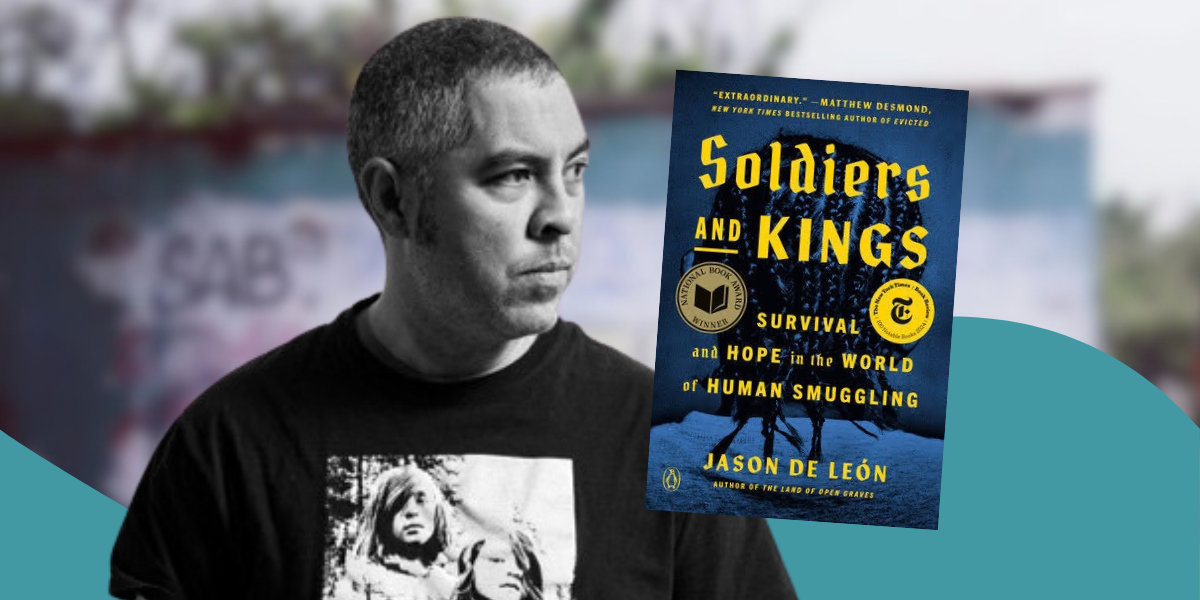
“We’re bombarded by migration stories on both sides of the political spectrum, and I feel like, a lot of times, there’s not much nuance in either one,” said Jason De León, author of Soldiers and Kings. To write this book, the anthropologist spent years embedded with smugglers who move migrants north across Mexico.
The National Book Award-winning nonfiction has since taken him on what he describes as a three-year book tour, including a stop at the Santa Fe International Literary Festival. Along the way, he found himself explaining, “People who come here don’t want to come here to be American. They’re coming here because they’re either escaping a thing that’s often created by the United States, or they want to come here to make enough money so they can go back to the place where they actually feel at home.”
Soldiers and Kings works so well because De León is unflinchingly honest. He’s not afraid to show readers “When I’ve messed up, when I’m in shock, when I’m not sure what to do, because I think that that helps the reader to go, ‘Okay, well, should I be in shock too?’” Often, in Soldiers and Kings, the answer is yes.
In a candid conversation with Latina Media Co, De León shared some of his own history as a survivor of sexual violence and how that experience helped him connect and feel at ease with the group of smugglers he writes about.
“I’m working with a bunch of incredibly damaged men, young men, older, middle-aged men. And we are all working through trauma. We are all just like none of us are flinching because we’re all super fucked up,” he shared. “I was working with these smugglers, and it felt very easy. I was just with them – and we’re hanging out, we’re listening to music and drinking beer, and we’re talking shit. Everybody’s real scary, kind of rough, and oftentimes insane. For me, it was like, ‘this feels really strangely familiar.’ I’m totally fine in this kind of environment.”
This closeness gives the UCLA professor rare insight into these men – and they are mostly men, partly because that’s who he’s most comfortable with – including their histories of violence and how those histories play out today. Soldiers and Kings also shows their humor, vulnerability, and their thirst for something different.
It’s an important read and an artfully constructed one, too. De León is a character throughout, letting us see his subjects through his eyes. He does this in part because, “we’ve come to the conclusion [in anthropology] that there is no such thing as objectivity,” he told us, and honestly, we’re jealous. That framework allows him to share his own perspectives and background, letting the reader, then, take the author’s identity into account, rather than accepting a pretense of an impartial starting point.
Further recognizing how perspective can color the reader’s experience, De León doesn’t mention the racial identities of his subjects until about halfway through the book. At that point, he begins discussing directly the differences between Black and mestizo migrants and smugglers, revealing the racial identity of his subjects.
“As a writer with a book-length thing, you do have the luxury to mess with the reader. You can take things out of sequential order. You can hold off on certain information and then bring it back at a time when it’s going to be more effective,” he said of this choice. “I’m trying to give people enough information to feel like they get to know someone, hopefully to begin to like them, or to have conflicted feelings about them, and then to introduce something else in there that completely kind of rattles them.”
Even for people close to the experience, Soldiers and Kings offers new insight, thanks to De León’s seven years researching the book. And why did he do it? As he writes in the introduction, he’s not trying to humanize his subjects. He believes their humanity (and all of ours) is self-evident. He begins with “the seemingly radical proposition that those who try to make a living guiding people across hardening geopolitical boundaries are themselves human.” And he builds from there.
