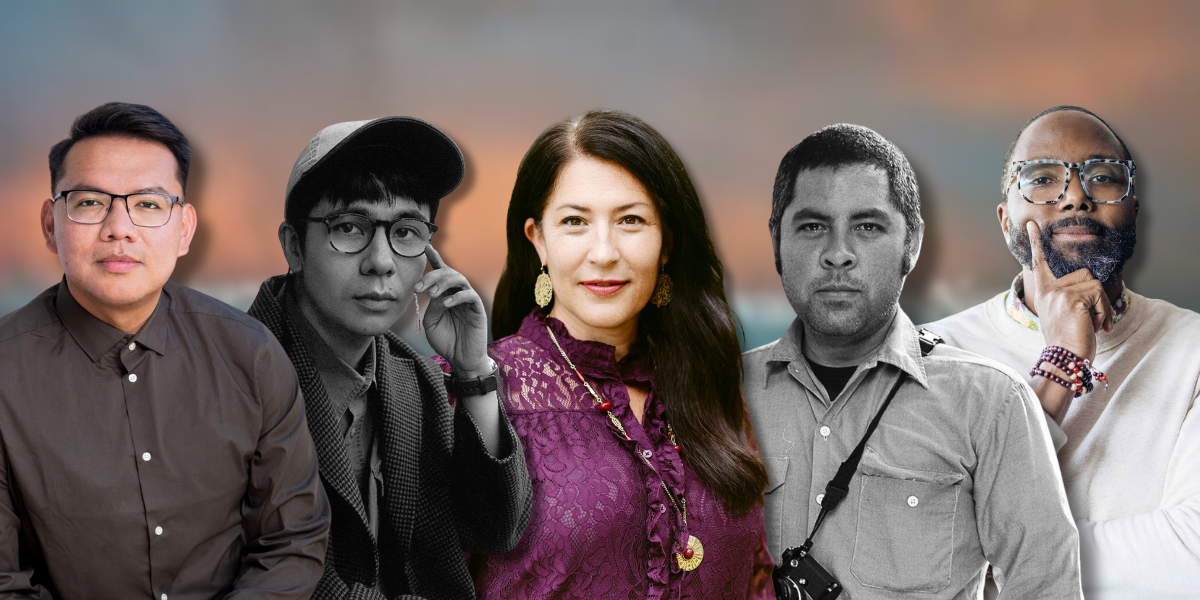
Santa Fe can be a hard place to describe. Yes, we’re a tourist town, and old, rich retirees take up a lot of space. And yes, a browner, poorer class moves on the outskirts. But we’re also a town of arts and artists of all stripes. And a group of people with a strong sense of our history and the cultural mixing conquest and the border bring – complete with genocide and generations of its products. From this beautiful, high desert landscape comes the Santa Fe International Literary Festival, a truly local experience.
Ahead of the 2026 line-up featuring literary stars like Judy Blume and Carl Hiaasen, I had coffee with co-founder Carmella Padilla. “I’m a hometown girl who grew up here, and I know what this community is at its heart,” she told me. According to her, the festival started “very grassroots, very independent” and has benefited from integrating “Santa Fe” into its name. Today, the three-day event offers “an opportunity to experience what some of the coolest, greatest thinkers and writers are doing right now… in a place that’s unlike [any] other.”
I wasn’t sure what to expect, despite hearing great things from many of my local friends. And when I first arrived mid-day on Saturday to hear Jason De León discuss his Soldiers and Kings, I remained leery. It seemed typical Santa Fe – about half the crowd had snow-white hair, and they were ready to cluck enthusiastically along with De León’s political points – our county voted 73% for Kamala Harris.
And while this group was going to return to their fancy houses soon enough, I was pleased to see them turn out for this challenging book. It’s an ethnography of the smugglers, the guías, who take migrants north through Central America. They’re not exactly sympathetic (some are downright scary), and to research this book, De León spent seven years “deeply hanging out” with them – guys he characterized as “roughnecks” during his talk on the mainstage, moderated by poet Hakim Bellamy.
On a pre-festival Zoom, the anthropologist likened his book – and specifically the way he handles race, gender, sexuality, and trauma – to a trick his wife uses in the kitchen. “She sneaks in the vegetables into the pot. She grinds them up into the pasta sauce. And we don’t know that we’re eating vegetables till she tells us.”
Readers may go in thinking “[Soldiers and Kings] was supposed to be about smuggling,” but they’re soon learning the difference between “Black Honduran migrants versus white Honduran migrants versus what it means to be black in Mexico.”
De León highlights the humanity of these “roughnecks” by going deep into their backstory – and his own. He’s a Latino, Gen X man who thanks his therapist and openly talks about being “a survivor of childhood sexual abuse” – even if it took him until his 40s to be able to “even say that stuff out loud.” The crowd loved him, although they asked questions about sexual violence on the trail that seemed self-explanatory to me.
As the first full day of the 2026 Santa Fe International Literary Festival went on, the crowd fluctuated with a young, hipper group coming to soak in the wisdom of U.S. poet laurrette from 2022-2025, Ada Limón. A Mexican-American from Sonoma, CA, Limón took to the stage with Jake Skeets, the current poet laureate of the Navajo Nation.
The two eschewed the traditional subject-moderator format, both reading their works and spending nearly even time discussing their creative process, the merits of entry-level day jobs to creative pursuits, and the beauty of place.
I was surprised that the two didn’t address identity head-on – instead, they let it linger over all of their comments. They shared professional experiences of what it’s like to tell Uber/Lyft drivers, “I’m a poet” (they’re surprisingly conspiratorial) and manage public and private personas. They also shared reminiscences of working administrative jobs at their government office of land management – Limón in King County (Seattle) and Skeets on the res. In these roles, they learned about their local water sheds, plants, and animals. This understanding of their natural world informs their poetry and sense of self.
I’d gone to the festival with De León and Limón on my list as the two Latinos representing this year. In the past, they’ve had Javier Zamora of Solito, Maria Hinojosa, Sandra Cisneros, and Julia Alvarez. As Co-Founder Padilla told me, this pairing of challenging and effervescent work is purposeful, “Our greatest hope is that people will leave hopeful and inspired from the weekend. Even if they’ve had experiences of challenging discussions around challenging topics, they have experienced a sense of connection through being in there in a room with authors who aren’t necessarily always like-minded, but who you somehow come around to having a point of common ground with, and that’s what books can do. That’s a beautiful, beautiful thing.”
It’s true. I came from De León and Padilla, but I stayed for Ocean Vuong in conversation with Rebecca Solnit. Vuong is a queer Vietnamese refugee, National Book Award finalist, poet, and author of On Earth We’re Briefly Gorgeous and The Emperor of Gladness. He blew me away, and I’d never remarked on his career before, let alone read any of his stuff.
Vuong had this incredible way of calling us in, urging us to be better. For example, he mentioned how popular mindfulness has become in the West, but he questioned how we’ve equated it with self-care – listening to your breath, to the birds, to the wind. He said that was “beautiful,” but then he layered in his own practice. How it calls him to consider the people in his community, to ask “are you ok?” and if not, to offer assistance. “Are we ready for that?” he asked our crowd, and the room reverberated in sympathy with his skepticism, even as we recognized ourselves in his critique.
He pulled off this calling-in via his own willingness to show emotion – during his hour on stage, he teared up multiple times and refused to apologize for it. As he explained, crying, emotions, they’re our humanity in action. It was stunning, and I was enthralled with every word.
There were white guys on stage at the 2026 Santa Fe International Literary Festival, but I missed them. That was easy to do. White guys made up less than a quarter of the festival’s line-up, the rare underrepresentation for that group. For the festival largely insisted attendees of all stripes learn from people of color, queer folks, women, and writers who hold multiple of those identities. And that learning was not just an intellectual exercise, but also a spiritual one.
Tickets ran between $25 for a single session, which sold out fast, and $1,300 for primo seats to everything. Padilla and company are working on access, giving away admission to local teachers, librarians, and students. But even where they sat the press – up front, but way to the side – the festival didn’t feel elite. It felt like Santa Fe in all of its contradictions – a multicultural, tourist, hierarchical, arts town striving to be better, to learn more, and show up for each other.
