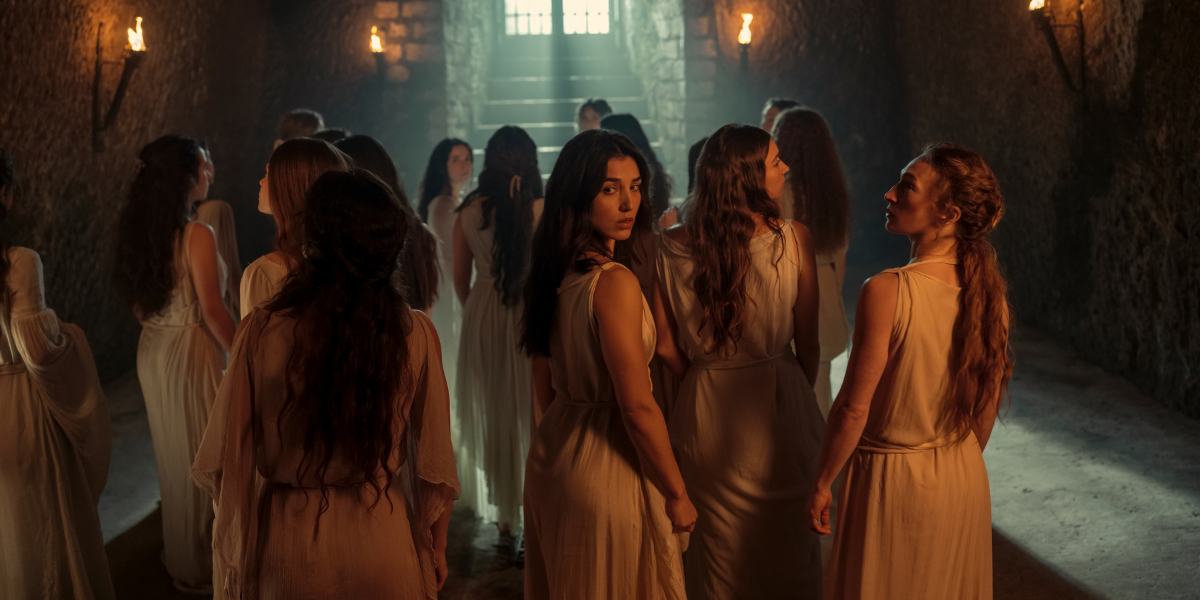
The latest installment of Ryan Murphy and Ian Brennan’s Monster series, The Lizzie Borden Story, brings up a lot of questions. For example, why is early 1990s serial killer Aileen Wournos a character on a show about a murder from the late 1800s? Why are Lizzie and her maid-turned-lesbian lover feeding each other cherries while listening to Jefferson Airplane’s “Today”? And why do Murphy and Brennan depict Borden as a champion for women’s suffrage when there’s no record of any activism of this kind? My best guess is it’s an attempt at creating a pseudo-feminist version of Monster, except this Netflix series falls victim to the same patriarchal nonsense it’s claiming to be against. And while some of those scenes worked, others make you want to turn off your television.
Monster: The Lizzie Borden Story attempts to tell the tale (or at least, some fantastical version) of the wealthy 32-year-old Massachusetts woman suspected of hacking her parents to death. Lizzie Borden herself was acquitted of the murders, but no one was ever found guilty. Over time, she has become a sort of mythological creature, inspiring books, films, even a macabre nursery rhyme. Some of these depictions are over the top. This one is in outer space.
In an interview in Netflix’s Tudum, Ella Beatty (who does a solid job of playing the titular character) shared that the latest Monster is attempting to showcase “female rage and repression.” Within the first couple of episodes, you can certainly see some of that play out. The opening scene is almost comical in its depiction of the murders of Lizzie’s parents, step-mother Abby Borden and father Andrew Borden (Rebecca Hall and Charlie Hunnam, respectively). We also get to see how monstrous the Borden parents can be toward Lizzie. Her rage is visibly simmering underneath the surface with every slight.
Soon, we also see another vessel of female rage: Bridget “Maggie” Sullivan (Vicky Krieps), a live-in maid hired by the Borden’s who is also subject to their incessant cruelty. Sullivan really was the Borden’s live-in maid, though any details about the relationship between her and Lizzie are pure speculation. For the purposes of the show, however, she becomes a driving force for Lizzie to finally stand up for herself.
Sullivan and Lizzie’s dynamic is the most interesting thing in the show, despite being wildly inaccurate. Sullivan gifts Lizzie a book about Elizabeth Báthory (also played by Krieps), potentially inspiring her bloodlust. She brings Lizzie sex toys (that were mostly real). She even takes her to the theater one day and facilitates her meeting with actress Nance O’Neil (Jessica Barden), who becomes a close friend later on. Sullivan is constantly expanding Lizzie’s world, and eventually works with her to plot and prep for the murders. This is where the show is strongest, because it’s still working within Lizzie’s story. Plus, the sapphic chemistry between the pair is top-notch.
But then there’s the rest of it. After Murphy and Brennan’s first three Monster installments (centering around Jeffrey Dahmer, Lyle and Erik Menendez, and Ed Gein), it was refreshing to hear they would be tackling Lizzie’s story next. It’s far enough in the past to not cause the kind of harm to surviving families that the Dahmer installment did. Plus, there’s a woman at the center of it all – rare within the world of serial killers. But it seems that the writer-creators did not believe in the story’s ability to stand on its own.
Halfway through the show, Murphy and Brennan pull us out of the Borden world and into an even less believable version of Aileen Wuornos’ life. In this one, Wournos (played by Sarah Paulson doing what feels like her best Jerri Blank impression) takes out her first victim, then ends up at the Lizzie Borden house with her lover. Because in this world, Wournos can’t just be a killer on her own. She must look up to one of the only other alleged female serial killers on record. And in a way, it’s the same with having Lizzie become fascinated by the Báthory story. Ultimately, the showrunners could have done seasons on each of these three women and done them well. Sadly, stuffing them all into one feels more akin to someone padding their English paper with material researched for a totally different class.
If that weren’t enough to suggest that this show could have done with a few female writers at the helm, there are also multiple, wholly unnecessary rape scenes peppered into the show. Monster shows John raping Wournos, Andrew Borden raping a brothel worker, and some unknown peasant raping Báthory (this one is off-screen at least, but still worse as she is a child here).
While sexual assault is a real-life issue, prolonging the event on screen can cause harm to survivors, while also potentially desensitizing other viewers. Brennan and Murphy do nothing to mitigate those harms, leaving viewers alone to deal with the aftermath of these scenes. Depicting rape in this way does nothing to address female rage. It only adds to it and endangers us further by perpetuating rape culture.
Using music, randomly, from the 1960s now and again and totally changing facts for the sake of entertainment could make Monster: The Lizzie Borden Story unwatchable. The flaws aren’t that bad – there’s a reason Murphy and Brennan get so much attention. But the installment would be phenomenally better without the forced side stories and graphic rape scenes.
If Brennan and Murphy want to depict another female serial killer, here’s hoping they actually allow her to remain the lead of her own series – and hire some women writers so they can do her justice.
