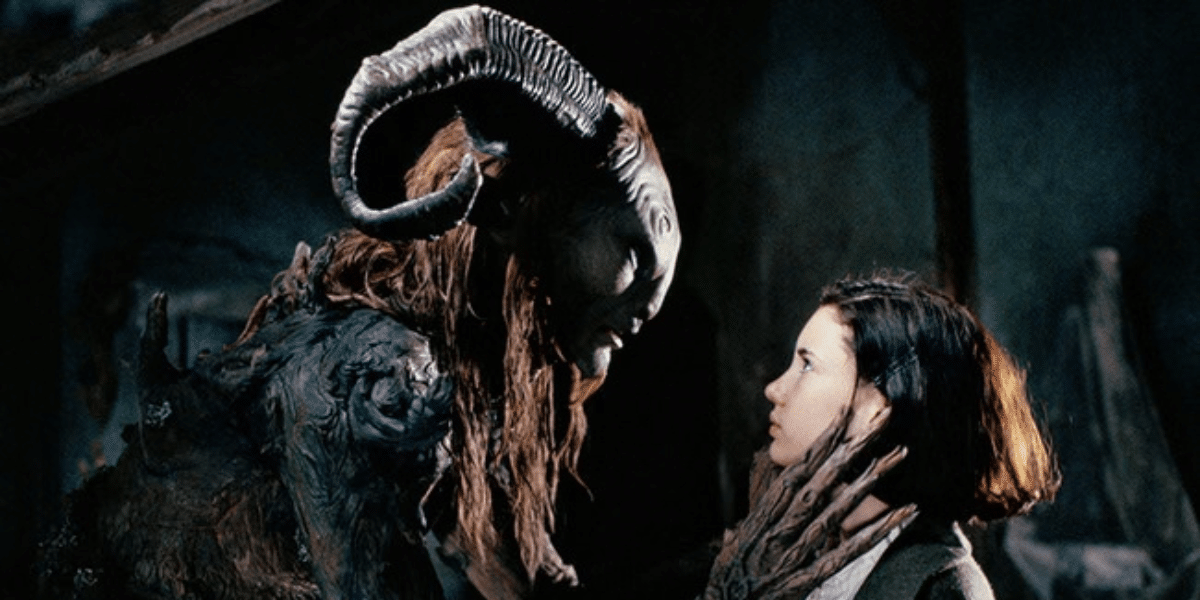
Monsters are real. And they exist outside of childhood fairytales, beyond the pages of a book, and off the screen. That is what Mexican filmmaker Guillermo Del Toro shows us in Pan’s Labyrinth. He’s re-releasing his critically acclaimed 2006 film in 4K and 3D in theaters starting October 9 — just in time for its 20th anniversary. And we’re celebrating the film’s cultural impact, master storytelling, and human-made beauty.
Pan’s Labyrinth takes place in 1944, post-Civil War Spain. Ofelia’s mother has married Captain Vidal, who is in charge of capturing a group of rebels, who have fled into the mountains as part of their fight to escape and destroy Spain’s new fascist regime. Ofelia and her mother follow the Captain to his new post, where the eleven-year-old discovers an old, decrepit labyrinth in the woods. There, she meets a Faun who tells her that she was once a princess in another life and must now complete three tasks to regain immortality and return to her rightful throne. Dark and evocative, the film beautifully weaves Ofelia’s fairytale world with the cruel brutalities of war, resulting in a story about the loss of childhood innocence and the importance of defying authority.
The first time I watched this film I was 6. I can still recall the horror I felt at the tasks Ofelia needed to complete. The nightmares I had with the Pale Man will forever haunt me, its pale, saggy skin dragging across the floor. Even the Faun was eerie — there was no telling what its true intentions were behind those milky white eyes.
Now, rewatching the film as a 26-year-old, I finally understand why the adults in my family were so afraid when Captain Vidal appeared on screen. Here is the true monster: a ruthless, bloodthirsty man, unquestionably loyal to a fascist dictator. For many Central American immigrants (who had fled the savagery of wars and dictatorships), Captain Vidal struck a chord.
And as an American in Trump’s United States, this character feels so menacing to me. The Pale Man at least follows some sort of rule (you must not eat from his elaborate banquet, or he will awaken and eat you). Captain Vidal is merciless, and his inhumane violence is more horrific than any fairytale creature.
Fans of Guillermo Del Toro’s work instantly recognize monsters as an essential part of his artistry. He has famously said, “Monsters exist to be a manifestation of something that we need to understand, not only a problem we need to overcome, but… a more tangible, more mortal side of being human: aging, decay, darkness and so forth.”
Throughout history, humans have utilized horror and fantasy to explain mysterious phenomena. From natural disasters to the human psyche’s dark and sinister impulses, storytellers have relied on monsters and fairytale creatures as allegorical devices to help us better comprehend ourselves and the world around us. If you grew up in a Latinx household, you know that parents tell ghost stories to help children grasp harsh, frightening realities, so much so that this practice has become a part of our culture.
In Pan’s Labyrinth, the creatures that Ofelia encounters directly mirror the monstrous acts of her real world. The greedy toad living under the dying fig tree and the Pale Man with his elaborate feast stand for the power-hungry elite, hoarding wealth and resources at the cost of the nation. The Pale Man’s hunger for children (and fairies!) serves as a direct reflection of Captain Vidal’s willingness to kill, including Ofelia’s mother — whom he sacrifices in exchange for his newborn son — and Ofelia herself.
And the Faun’s indifference to the brutality of man is almost childlike – a kid caught in his make-believe play pays no mind to what is happening around him. He’s Ofelia’s escape from the harsh cruelty of the real world, literally and figuratively. The symbolism and allegories in this film haunt audiences long after the credits have rolled, cementing it as one of Del Toro’s best works.
Of course, Del Toro’s vision could not have happened without the puppeteers, makeup artists, and practical effects teams behind the scenes. Doug Jones played the Faun and the Pale Man, and these characters required extensive makeup, prosthetics ,and mechanical parts to bring to life. And, at Del Toro’s request, the team utilized CGI only to enhance what was already there, resulting in stunning imagery that has truly lasted the test of time.
The artistry of Pan’s Labyrinth makes it timeless and marks the film as a stark contrast to the many A.I. shortcuts studios feel compelling to rely on today. In the months leading up to the film’s 20th anniversary, Guillermo Del Toro has made his hatred of artificial intelligence well known, marking it as “Made by humans. For humans.”
The world has changed in so many ways since Del Toro first introduced Pan’s Labyrinth 20 years ago. Yet, now more than ever, a story about defying authority and deploying your own creativity to both escape and understand the cruelties of the world feels more than necessary – it feels vital.

Catch Pan’s Labyrinth in your local theater as part of its anniversary celebration.
