What is the most “epic” gay movie? Best-Picture winner Moonlight? It’s so quiet and deeply personal. Brokeback Mountain with its sweeping landscapes and major stars? It’s ultimately the story of one tragic couple. The answer may just be Cannes-favorite La Bola Negra, by the Spanish directing duo known as “Los Javis.”
Best known in the Spanish-speaking world for explicitly queer work, the former romantic partners Javier Ambrossi and Javier Calvo co-directed, wrote, and produced the film, which Netflix is releasing in theaters October 16, ahead of an Oscar campaign later this year. Their projects include the reality show Veneno, about a trans actress in Spain, and the lesbian coming-of-age musical La Llamada. But this is their first movie specifically about the “G” in LGBTQ+, and it is memorable.
La Bola Negra, like another well-known gay film, The Hours, is told in three parts across several decades. The first takes place in 1932. A young man from a privileged family, Carlos (Milo Quifes), is shut out of the local country club because of rumors about his sexuality. This part is loosely based on Spanish poet Federico Garcia Lorca’s only explicitly gay play (which gives the film its title). But fascist rebels assassinated Lorca before he could finish it, so Los Javis completed the missing parts.
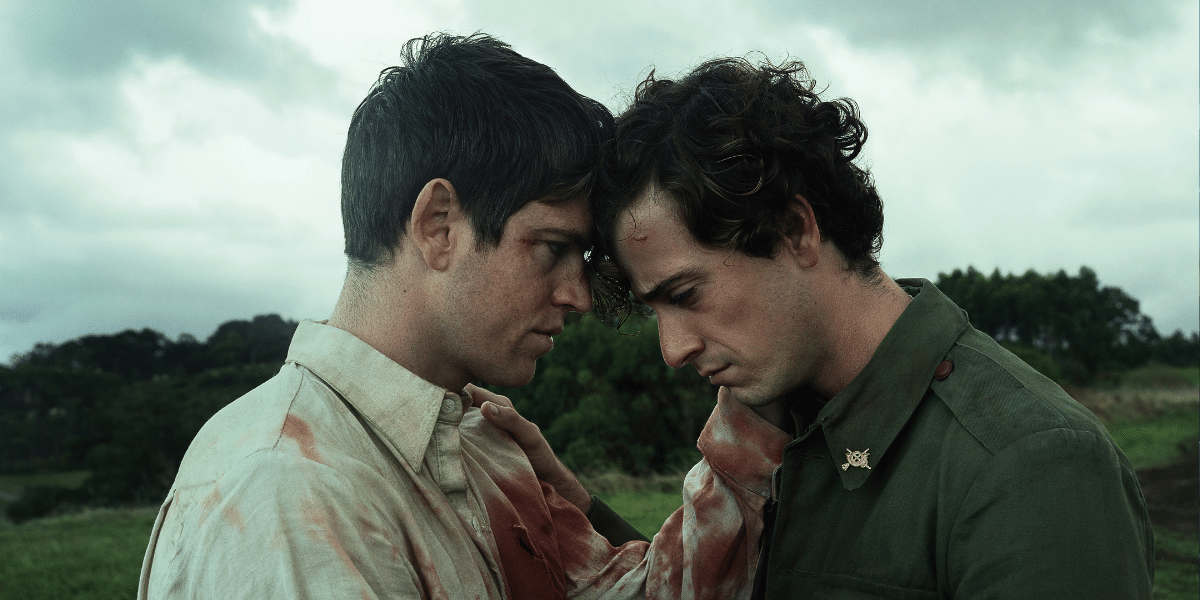
At the film’s center is the tragic Spanish Civil War and the aforementioned playwright, Lorca. In 1937, the would-be military dictators conscribe Sebastian, a young idealistic musician (openly gay Spanish musician Guitarricadelafuente). They assign him to guard an important socialist soldier (the striking Spanish actor Miguel Bernardeau). This part is based on Alberto Conejero’s play La Piedra Oscura. Conejero also wrote at least part of the La Bola Negra script with the directing duo.
Finally, in 2017, we meet Alberto (Carlos Gonzalez), a young historian and failed writer who feels lost. Then he learns about a mysterious inheritance, which forces him to face his troubled relationship with his mother (the formidable Lola Dueñas). Los Javis imagined almost all this section, which ultimately delivers the film’s biggest emotional payoff.
Calling La Bola Negra grand in scale and ambition may be an understatement. It begins with stylized credits made by painting acrylic colors over old photographs. It ends with thunderous, haunting, and frantic scenes. From start to finish, La Bola Negra is bold about its goal: to tell a story for the ages. The familiar themes openly build on the Los Javis’ inspirations – filmmakers such as Almodovar and Fellini. But the project succeeds because this particular story is unfamiliar to many. Lorca and the Spanish Civil War are rarely, if ever, shown in Hollywood, and I do not count Pan’s Labyrinth. And because, Los Javis’ intentions are sincere from beginning to end.
The main messages of La Bola Negra are clear. Be true to yourself. Love can outlast death and time. Art can be the safest refuge in the darkest moments. None of these ideas are especially new. What is original and effective is how the film presents them. It uses soaring music and gripping stories of love and betrayal. Its characters are also instantly familiar and likable. They form the heart of the story: the lonely writer, the closeted young man, the dedicated soldier, people who live under the weight of past violence.
Take, for example, two outstanding supporting performances by Glenn Close and Penelope Cruz (who is vying for her second Academy Award for this part). Close plays Isabelle Durand, an American historian, who speaks accented but effective Spanish. Durand is giving a lecture on Lorca and the Spanish Civil War when young Alberto asks for help solving the mystery of his inheritance. She explains that the country is still in denial and still healing.
Penelope, meanwhile, plays Nene Romero, a cabaret-style performer who tries to raise troop morale. The character is loosely based on a kind of street singer who became famous in Madrid at the time, known as a “cupletista.” Nene meets Sebastian and teaches him an important lesson about sexuality, acceptance, and the beauty of art, as contrasted to the horror of war. Both actresses have crucial roles, and both fully commit to their important parts, elevating La Bola Negra to yet another level.
The third protagonist, Carlos, also meets several determined, powerful women. The most important is his quietly supportive mother. Through these characters, Los Javis honor a key part of how many gay men grow up, learning from determined and quietly powerful women. These relationships add another layer to a beautiful, complex, and richly textured film that is winning over critics and audiences alike.
Yes, La Bola Negra is a tearjerker, but do not minimize the film to a simple drama. The two-and-a-half-hour runtime is more like taking a deep, beautiful breath. The poetic, expressionistic conclusion perfectly concludes a deeply personal love story.
So, is La Bola Negra the most epic openly gay movie ever made? Perhaps. More importantly, it is the kind of grand, unapologetically queer film we have waited far too long to see: sweeping in scope, intimate in feeling, and unafraid to turn love, history, and art into spectacle. Los Javis have not simply made a moving movie. They have made a landmark, one that we sorely, desperately needed.
