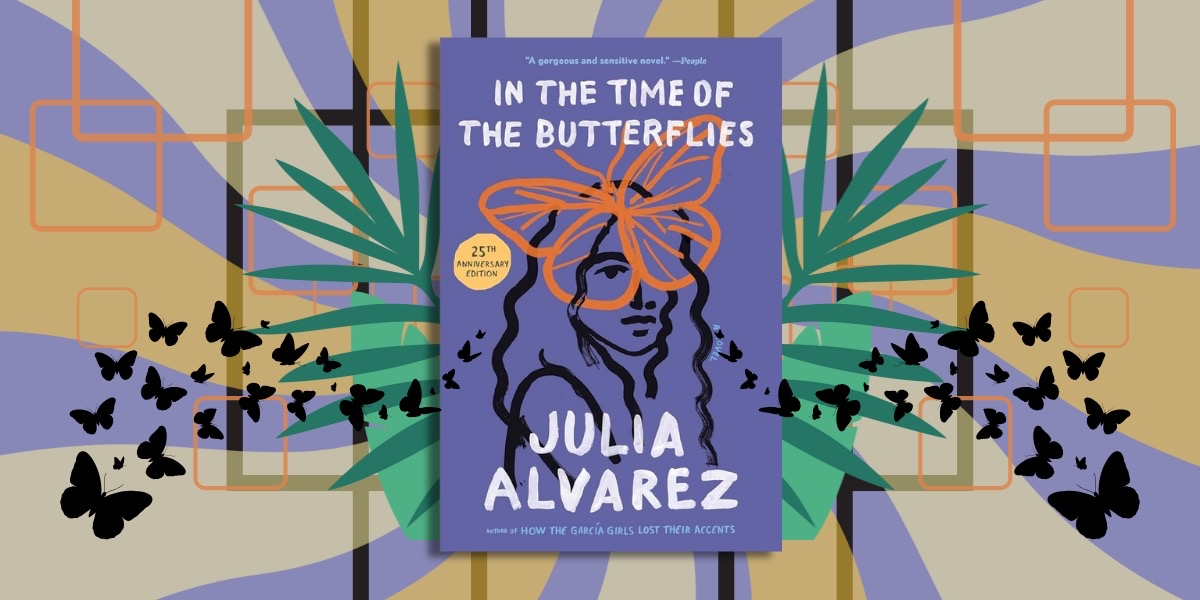
I was in Mr. Justin’s 7th-grade Literature class when I first picked up a copy of In the Time of the Butterflies. We had some independent reading time right at the end of the period, and, as usual, I’d devoured my library book. I was too lazy to walk over to the school library and check out a new one, so my options were limited to whatever was available in my teacher’s classroom library. The black and red cover and the word “butterflies” immediately attracted me – I was an 11-year-old girl, of course, butterflies were going to draw me in! The book, much to my surprise, was not about pretty insects but about strong, courageous women who stood up to a dictator and changed the fate of a country.
Written by Dominican-American author and poet, Julia Álvarez, In the Time of the Butterflies tells a fictionalized version of the real Mirabal sisters’ – the Butterflies – story. María Teresa, Minerva, Dedé, and Patria were born in their parents’ farm in Ojo de Agua in the Dominican Republic. They grew up during the Trujillo regime and witnessed firsthand the devastation he brought to the country.
Minerva, the second-oldest daughter, who was always his biggest critic, was the first to join the resistance efforts while enrolled in law school. The fact that she, a woman, was even in law school was part of a dangerous gamble she had made with El Jefe, Rafael Trujillo himself.
While the novel presents a fictional retelling of the Butterflies’ story, the Mirabal sisters were real revolutionary women whose contributions to the Dominican resistance and eventual assassination by Trujillo’s men marked the beginning of the end of his regime. As well as a larger conversation about gender-based violence. The anniversary of their assassination, November 25, is now known as the International Day for the Elemination of Violence Against Women.
In the novel (and the 2001 film adaptation, which featured Latinx stars like Salma Hayek, Edward James Olmos, Demián Bichir, Mark Anthony, and Lumi Cavazos), we see subtle (as well as some not-so-subtle), blink-and-you’ll-miss-it moments of strength and defiance. They made a bigger impression on 11-year-old me than I realized at the time.
It was Minerva slapping the dictator when he made a pass at her during one of his parties. And later on, facing him directly, not to apologize but to negotiate with him. It was also the Mirabales not having a portrait of El Jefe in their house, as was expected. And Patria stealthily using her religious influence to educate her community about the resistance efforts.
I revisited my obsession with the Butterflies last year, as I watched the film for the first time in over a decade. Now, as the chaotic events of the first few days of 2026 unfold, the story of the Mirabal sisters feels more relevant than ever. For the first time in nearly three decades, we get to see a regime like the one in Álvarez’s book potentially fall after Maduro’s capture. That monumental historic event kept bringing me back to the book I enjoyed so much as a child.
I won’t even attempt to deny that the “how” we got there is questionable and alarming at best. Those in power (all of the power players, on all sides of the issue) likely have ulterior motives that stray far from the “we care about human rights and international law” story. Because let’s be real for a moment, if most people who claim to “care” actually cared about human rights and international law, they would’ve spoken up sometime in the last 27 years, and not just when it became a trendy or convenient issue.
History is rarely, if ever, black and white. It is messy, and sometimes it’s hard to tell wrong from right, especially without the advantage of hindsight. What’s happening right now, as problematic, confusing, unnerving, and enraging as the capture of a dictator, Nicolás Maduro, might be for some, is also a source of hope and rejoicing for every single Venezuelan I know.
Their country, like the Dominican Republic In the Time of the Butterflies, has been destroyed by a brutal, vicious dictator. Under Maduro, like under Trujillo, millions had to escape their country and live in exile, continuing their resistance efforts from afar while yearning for their homeland. Millions more continue to live under a regime that profits from their suffering.
Those of us who have not experienced this have no right to speak over them or berate them for feeling joy when we feel fear, regardless of our political beliefs. My fear, anger, or political opinion do not give me the right to talk over them and deny them that joy and hope. Lived experience trumps academic ideology, every single time.
What transpired on Jan 3 is nothing short of historic (for better or for worse, depending on who you ask, of course). I chose to celebrate the hope it brings for my Venezuelan friends, understanding the fear it created for Americans and people from other countries, too, after the administration’s subsequent comments. There is fear in the unknown of those “maybes,” of course, but there is also hope, and if I take away anything from Minerva Mirabal’s story, it is that hope is the one thing that will keep us going.
