On the Latin American literary and cultural map of the 20th century, Mexican author Jorge Ibargüengoitia (1928–1983) is one of the most provocative and influential. Among his extensive literary and journalistic work – powered by his sharp wit and sarcastic observations on Mexico – Las Muertas (The Dead Girls) stands out. It took him more than ten years to complete and is his only novel translated into English.
Las Muertas is inspired by the high-profile case of sisters María del Jesús and Delfina González Valenzuela, who were involved in prostitution and trafficking women in Guanajuato and Jalisco. Popularly known as “Las Poquianchis,” they ran an extensive crime operation between 1945 and 1964, and are estimated to have murdered dozens of their workers. In his novel, Ibargüengoitia does not offer a faithful reconstruction of the case, but rather a combination of historical facts and fictional elements. “If I had been Truman Capote, I would have gone round and interviewed everybody, got many tapes, but I’m very bad at that, I’m very shy. So I invented the characters, they are composite images of different people I know,” he said in an interview with Herbert Hugh for The Guardian in 1983, quoted in Connotas.
Almost fifty years after its publication in 1977, one of the most significant voices in Mexican audiovisual media, Luis Estrada, brings this black comedy to Netflix. “From a very young age, I was fascinated by Ibargüengoitia’s literature because he handles what is, for me, my favorite genre – satire and black humor – like no one else,” the director and co-writer of the adaptation told El País. The six-episode miniseries is out now and introduces new audiences to the story of Las Poquianchis, the sisters who “turned sin into business, and business into hell.”
What is Las Muertas About?
Set in fictional, Mexico-inspired locations, Las Muertas focuses on the unexpected rise and dramatic fall of Las Poquianchis (named in the fiction as the Baladro sisters), the sex workers under their charge, and their society that pretends not to recognize them. Like Ibargüengoitia’s novel, the Netflix miniseries alternates between the future and the past, incorporating testimonies that reflect different versions of the same story.
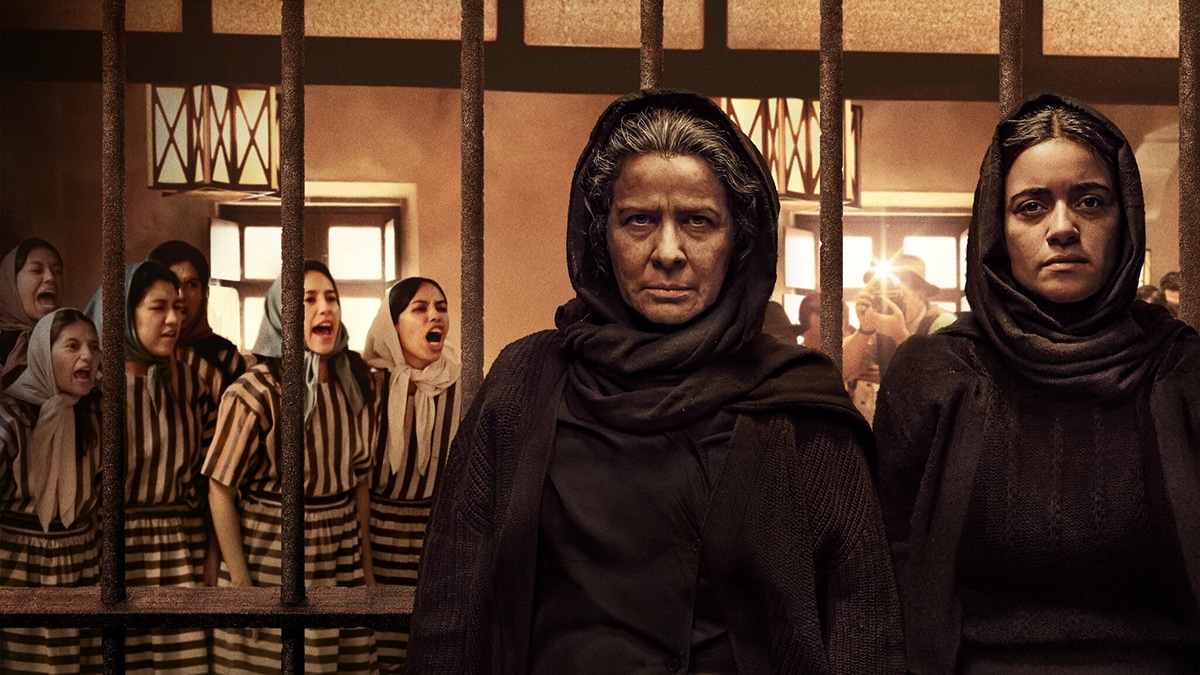
Owners of a brothel, the ambitious Arcángela (Arcelia Ramírez) and Serafina Baladro (Paulina Gaitán) recruit young workers through deception or by buying them from intermediaries. For years, they prosper under the protection of the local government and then expand to nearby cities. Arcángela, with her usual sharp wit, sums up the irreverent spirit of the adaptation: “Look, Serafina, the prostitution business is very simple. The only thing you need to make it work is to be very organized.”
The series begins “in medias res,” when the passionate Serafina and her accomplices arrive in Salto de Tuxpana to settle scores with her former lover, the handsome baker Simón Corona (Alfonso Herrera). Their love has always been intense and complicated, and this confrontation results in a shootout with no victims and a fire that consumes everything in its path.
An aggrieved Simón soon reveals disturbing secrets about the Baladro family sparking official investigations that bring to light the sisters’ most sinister truths, such as their clandestine cemetery. With an ingenious non-linear structure, this satire uncovers the backstory of the Baladro family, their brothels, their crimes, and the network of bribery surrounding them.
Throughout the series, and especially in its final episodes, we see how the press is attracted to the Baladro’s crimes, especially their sensationalist elements. However, the more we learn about the case, the more evident it becomes how political pressure and sensationalist reporting can distort historical truth. “[Ibargüengoitia] was compelled to write this story because of his outrage at the way the media portrayed this horror story which, like many historical events in this country, is very difficult to know how much of it was true,” Estrada explains to Dallas News.
The adaptation captures the spirit of the book with ease. The irony, the absurdity, the grotesqueness, the gloominess – it’s all there. Estrada and his creative team strive to reinterpret the original material appropriately, and in the process, incorporates some clever tricks that enrich the narrative. As you might imagine, the premise of Las Muertas gives rise to some morally twisted and perversely entertaining scenes.
So, Should I Watch It?
Often cynical and humorous, Netflix’s Las Muertas leaves us with incisive commentary on Mexican power relations, systemic violence, and the role of the media in it all.
The Netflix adaptation shows that Ibargüengoitia’s work has aged in the best possible way, and it recovers a shocking past with the hope of bringing new awareness to the present. Unlike the sensationalist press of the 1960s, which described the Poquianchis as “hyenas” solely responsible for all the crimes, this sharp social satire is interested in exploring how institutional and social structures generate and perpetuate abuses of power. It’s easy to recommend.
