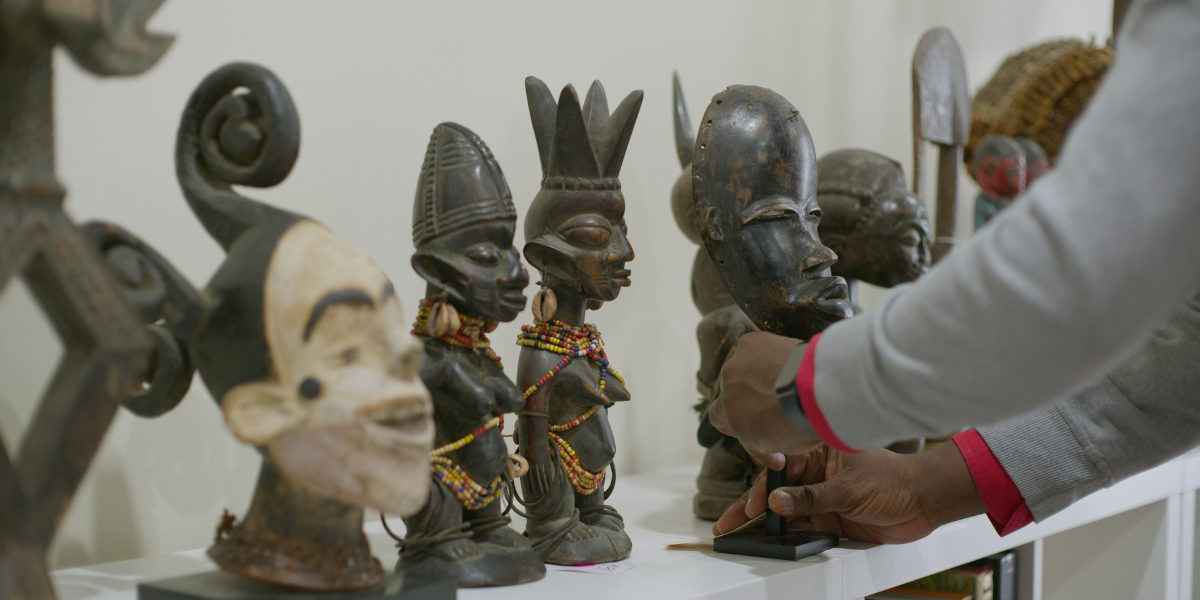
Museums often present themselves as neutral spaces of preservation. Quiet halls. Soft lighting. Clean plaques. Controlled temperature. A promise that history is being protected for future generations. But protected by whom, exactly? And from whom? These are the questions at the heart of Cultural Capital, a powerful documentary now available on YouTube that interrogates one of the art world’s most uncomfortable truths: some of the most celebrated objects in Western museums did not arrive there through admiration or exchange, but through violence, colonial extraction, and theft.
Conversations around decolonization often focus on land, language, governance, and political sovereignty, all of which is necessary. But decolonization also demands that we reckon with culture as property, memory, and power. We don’t talk enough about the art that was stolen, commodified, stripped of context, and transformed into luxury objects for institutions and collectors far removed from the communities that created them. And that silence is not accidental.
Cultural Capital follows the lives of four African objects: a Fang reliquary guardian, a Benin tusk and base, a Kota reliquary, and a Baga D’mba mask. Guided by art historian and appraiser Reilly Clark, the film uncovers how dealers, collectors, and institutions turned this cultural wealth into commodities. These are not merely “artworks” in the Western sense. They originated in shrines, royal courts, and ceremonial spaces. They carried spiritual significance, communal memory, and ancestral connection.
Then colonialism intervened. Military conquest, coercion, looting, and exploitative trade networks removed these objects from their communities and absorbed them into colonial markets. Once displaced, something remarkable and disturbing happened: their meaning changed. Or rather, powerful institutions changed it.
An object once understood as sacred becomes “primitive art.” A ceremonial mask becomes an investment asset. A reliquary becomes a centerpiece for donor galas and blockbuster exhibitions. This transformation is one of the film’s sharpest observations. Colonial theft does not end with physical removal. The theft continues through narrative control.
Ownership, after all, is never just legal. It is epistemological. Who gets to describe an object? Who gets to assign value? Who gets to write “provenance” or chart who owned it, when? That last question matters more than most people realize. In museum culture, provenance carries enormous authority to establish legitimacy. In practice, it often functions as a laundering mechanism, smoothing over violent origins with bureaucratic language.
“Acquired by private collector.”
“Purchased through dealer.”
“Entered collection in 1932.”
Such phrases can conceal entire histories of invasion. The paperwork becomes cleaner than the truth. Cultural Capital carefully dissects how this happens, taking viewers inside institutions like The Metropolitan Museum of Art and Brooklyn Museum, where African objects sit behind glass under the authority of Western curation.
There is a convenient mythology embedded in museum culture: that without Western institutions, these objects would have been lost, damaged, or forgotten. But in reality, the colonizer destroys systems, extracts wealth, then reframes their extraction as preservation.
Sound familiar? It should.
This logic appears far beyond museums. It appears in empire, education, media, and governance. Colonial systems often justify domination by insisting exploitation is actually benevolence. The violence becomes obscured by language.
What makes “Cultural Capital” especially compelling is that it refuses to let Western institutions dominate the conversation. Scholars, curators, and collectors – including Sylvester Okwunodu Ogbechie, Adenrele Sonariwo, and Olusanya Ojikutu – challenge long-standing assumptions about who should control African cultural heritage.
Their presence shifts the conversation from nostalgia to accountability. And accountability demands not merely moving objects from one building to another. It is about restoring agency. It is about rejecting the colonial premise that powerful institutions in the Global North are the rightful gatekeepers of global memory.
Cultural Capital asks us to confront an uncomfortable reality: colonialism did not simply steal resources. It stole narrative authority. It claimed the right to decide what mattered, what counted as “civilization,” and who deserved recognition as creators of beauty and knowledge.
Even today, those hierarchies remain embedded in the art world. Whose aesthetics are treated as universal? Whose work gets categorized as ethnographic? Whose is fine art? These are not neutral distinctions. They are colonial residue.
Cultural Capital ultimately offers not only critique, but possibility. The documentary invites us to imagine a future where museums are forced to reckon with their own origins, where provenance becomes a tool for truth rather than concealment, and where communities dispossessed by empire reclaim both objects and story.
