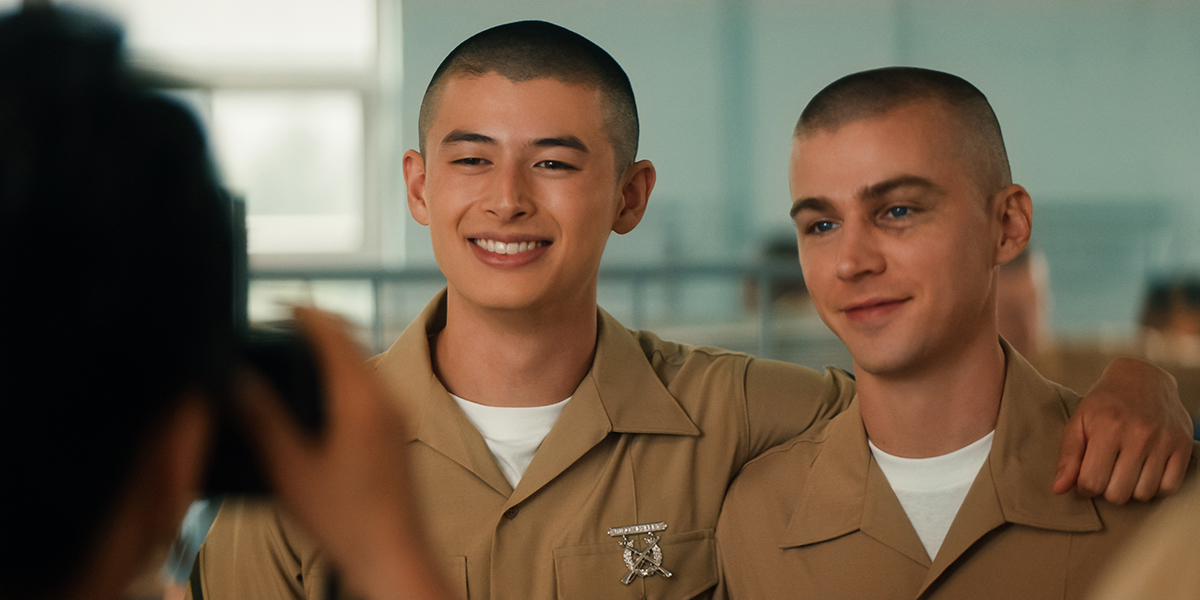
When I watched Boots hit the screen on Netflix, I didn’t just see a streaming series – I saw a reflection of my younger self. The show opens where I began, on the sands of Parris Island, South Carolina, the place where the Marines make men of boys. It’s the same terrain where my father once stood at attention, one of the few and the proud, singing “The Halls of Montezuma” as his lullaby to me.
I, too, chose the service – the Navy. Which makes the jokes Boots cracks at sailors especially delicious: After all, the Marines are technically the Department of the Navy, so jarhead jabs feel like home.
But this article isn’t about good-natured military ribbing. It’s about what happens when those jokes are masking fear, identity, and a truth the armed forces don’t like to talk about.
Boots is adapted from The Pink Marine by Greg Cope White. It follows Cameron Cope (Miles Heizer), a bullied closeted teen who impulsively enlists in the Marines alongside his best friend Ray McAffey (Liam Oh).
On paper: boot camp, transformation, brotherhood. But dig deeper, and you find something bruisingly intimate: what happens to a young queer person when the “boy’s club” is your gym, your dorm, and your battlefield.
The world of Boots dances with the very real rhythms I experienced – bored nights on watch, the cold drip of a rushed shower, the hazy shift between being awake and being told to act awake. It’s there. The rule-breakers who skewered the system and somehow didn’t fall and the fragile ones who did.
But above all: the fear.
Boots doesn’t just portray physical endurance – it dramatizes being visible in an institution built on invisibility. I learned early that my body was a tool, my identity a liability, and my fear my secret uniform. The series shows that the most dangerous thing might not be the confidence-course mud slide or the screaming DI. It might just be the way your own honest desire becomes your badge, your scar, your rumor mill.
When the show delves into gayness in the military – when Cameron wraps himself in a “don’t ask, don’t tell” shroud – it made me wince in recognition. I saw the version of me I’d hoped would die in boot camp, the version that instead burrowed in.
And yet: the show also reminds us of survival, of laughter in late-night solitude, of connection in the least likely places. These aren’t just drill-stories, they’re stories of being seen so much you’d give anything to disappear – and being forced to stay visible anyway.
From high-school JROTC to military university to active duty, the uniform taught me strength: how to stand tall, hold the line, serve something bigger than hunger or heartbreak. But it also taught me fragility: the kind that seeps in quietly, like the hum of fluorescent lights in the barracks. It taught me to flinch at things no one else seems to notice. To brace for the next command. To mistake endurance for worth.
My father’s Marines all wore the same sweat, the same salt air, the same order after chaos. So boot camp to me felt like home, because my home had already been a battlefield. The military was my parent and my bully. The campus of discipline and doubt, of camaraderie and hidden tears. And that’s why Boots hits me hard: it’s not about heroics or propaganda – it’s about truth.
Boots drags into the daylight a world many of us know only in fragments: queer in uniform, Latino in uniform, woman in uniform. We may not all wear camos, but we know what “being seen” can cost you. We, too, have been “othered,” hidden, told to be silent or to shape our silence into performance. This show gives us the language to talk about that. It gives us space to name what the ranks and the training and the orders tried to erase.
Boots doesn’t just entertain – it opens a door. It reminds that sometimes the loudest battles happen in silence. That surviving the system doesn’t mean it didn’t leave marks. It asks what happens when obedience and identity collide – and who do we become when the marching stops?
Here’s what I hope fellow veterans take from it: that the uniform doesn’t explain you. The body you trained doesn’t define you. The secret you held – you’re not alone in it. At the end of the day, Boots isn’t just the story of a gay Marine. It’s the story of refusing to be erased. It’s about the marrow of patriarchy and brotherhood and what happens when a gay kid says, “I’ll do it anyway.” When I watched that kid, I saw myself. And I hope you see yourself, too.
Now, years later, I can see it clearly: the military raised me and broke me, and I, like so many others, learned to salute through the pain. But Boots also gives me permission to honor the parts of myself I once had to hide. To finally say out loud what I couldn’t then – that survival was my first act of resistance.
