Coverage of “Plaster Saints” created in partnership with NFMLA
Carolina Sabrina Caruso’s Plaster Saints takes a sacred space that many women know, the pre-party time when we “get ready” together before a function, and turns it from playful to high stakes in under 13 minutes. The satirical dystopian thriller is set in an America under the oppressive “Liberty Party.” I viewed it at the NewFilmmakers Los Angeles Latin & Hispanic Cinema program this year. I was immediately drawn to its warning about a country moving steadily closer to authoritarianism.
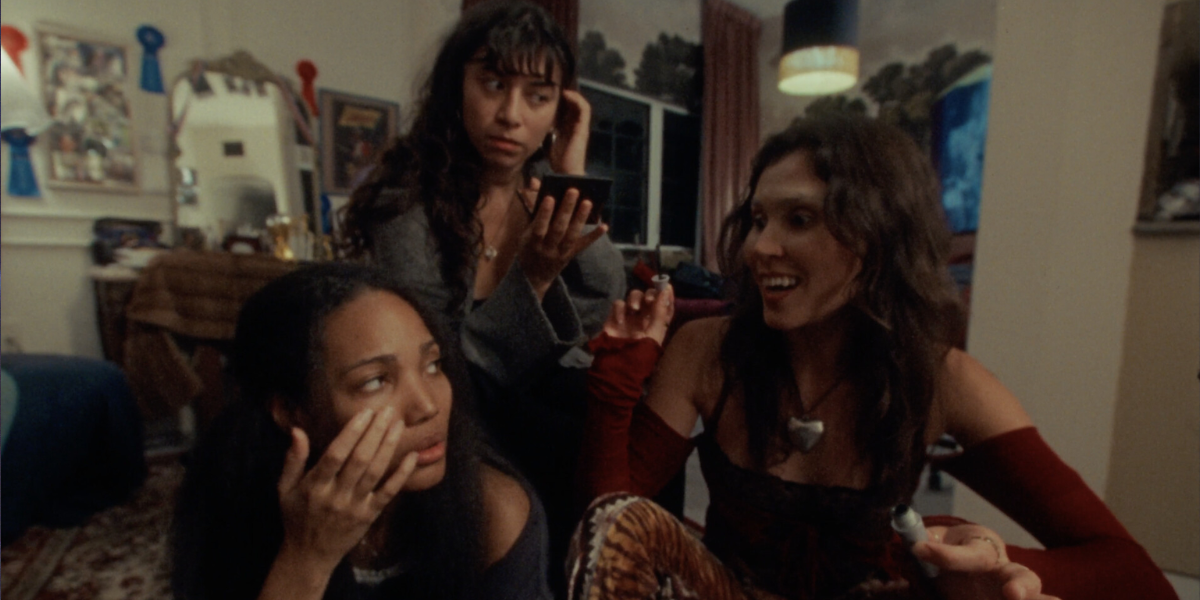
Jessica, Diana, and Claudia, three childhood best friends now in adulthood, gather at Jessica’s apartment ahead of an important gala. Between curlers and shots of vodka, tensions rise as each woman reveals more about who she has become.
Light-skinned Diana is seemingly the most radicalized of the three as she touts attending protests, even though she is the daughter of a Liberty Party senator. Jessica, who is Black, is the first in her family to attend college, and her apartment is littered with pro-Liberty Party imagery. Maybe it was once meant to feign loyalty, but could she be embracing it now? She is celebrating a promotion within the Party where she “flags documentation irregularities for social restructuring.”
Diana and Jessica trade passive-aggressive jabs at each other in the way longtime friends tend do when the ties start to fade. Meanwhile, Claudia curiously moves about the apartment, nervously gathering cell phones and remaining neutral as the other two spar. She is a dark-skinned Latina whose features soon make her particularly prevarious within the group and the Liberty Party’s America.
Everything takes place in Jessica’s apartment, and the imagery, from statuettes to patriotic posters, conveys the sense that the women remain under the watchful eye of the state. To drive this point further, the film occasionally shows us views of the women from hidden cameras in smoke alarms and maybe even in a stuffed doll resembling Thomas Jefferson.
One poster on the wall reads “History Will Absolve America,” a direct reference to Fidel Castro’s “History Will Absolve Me” speech, Caruso said. The Miami-based, Cuban-American filmmaker drew from her own experience and from loved ones who lived under dictators. She described her uncle, who was denied admission to college because a member of the Cuban government reported him for listening to American music. She completed the film before the recent pushback against Flock license-plate-reader cameras, making its warning feel all the more timely.
Caruso was inspired by Jean Paul Sartre’s No Exit, “a play where three strangers wake up in a room together and slowly realize that they’re in hell and their punishment is each other.” The one-room setting made it easier to tell this story without shooting in multiple locations. Caruso leaned on symbolism and the intimate, unguarded dialogue of close friends to create a world that unfortunately, doesn’t feel as distant as it should.
Watching Plaster Saints, we hear sirens outside the window and references to checkpoints, security clearances, and weekly party meetings. There’s a striking cut to a bust of Themis, the goddess of justice, blindfolded and wearing headphones, an image that evokes the willful silencing of truth. Caruso says that the statues are a reference to Mussolini’s “White City,” envisioned as a fascist utopia.
The juxtaposition between Jessica and Diana is most apparent in what they plan to wear to the gala. Jessica reveals a conservative full-length gown in a patriotic blue that reminds Diana of the Statue of Liberty. Diana chooses to reject the boring black gown her new boyfriend, Rich, a.k.a. “Nose Ring,” picked out for her, instead donning a revealing spaghetti-strapped mini dress that shows off her legs.
I enjoyed Caruso’s use of fashion to push this tension forward as no “getting ready” night is complete without an outfit reveal. The scene also depicts how, even under authoritarianism, everyday milestones, like tensions building between BFFs, continue.
Diana can cosplay as a radical who rolls her eyes at her father’s policy priorities, including the privatization of water, because she feels shielded from harm. She shares that her relationship with him is improving as evidenced by her renewed access to his credit card and his approval of Nose Ring. Would a committed radical come around so easily?
Meanwhile, Jessica helps us see what might motivate someone to fall in line. Her new position gives her a salary larger than the salaries of all her family members combined, she says. We also learn that she is gay but chooses to keep it private. Could that be because she has more to lose than Diana, who has her father to protect her?
“I wanted to make viewers uncomfortable and to think about how not everyone has the luxury to be an activist,” Caruso said.
There’s a sudden shift in tone when Claudia finally speaks up. Her brother Luca – a gay, naturalized citizen and artist who the women grew up with – has been detained and is “not showing up in the registry.” State violence is close to home. The ultimate test of friendship comes as Claudia demands that Diana and Jessica use their Liberty Party access to help find her brother. With this set-up, the short film leaves us to wonder: What are these characters willing to lose in the name of friendship? And what are we willing to lose in the name of our beliefs?
Carolina Sabrina Caruso’s directorial debut, the short Plaster Saints (2026), is currently on the festival circuit. Her work explores power, grief, identity, and belonging through genre and a darkly comedic feminist lens.
