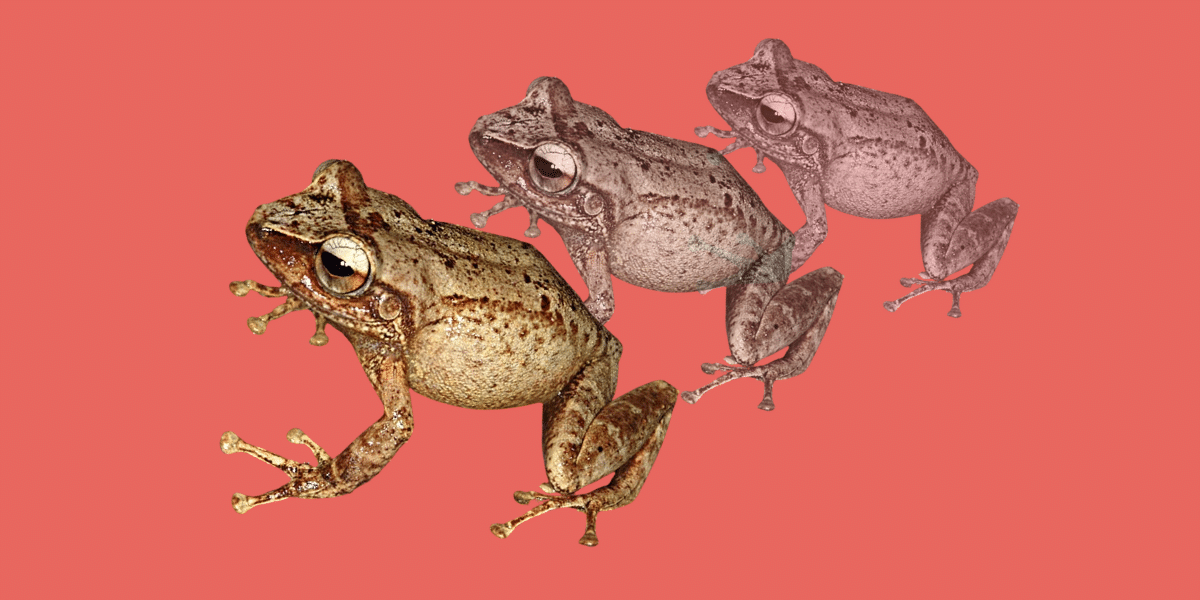
“El coquí is the soul of the Puerto Rican people and of our culture.” Renowned herpetologist Dr. Rafael Joglar’s words resonate, ringing with both tenderness and urgency. They’re calling us to act before climate change, gentrification, and colonialism conspire to silence our beloved amphibian forever.
In the 60-minute documentary, Los Coquíes de Puerto Rico, Mexican director Sonia Fritz takes us on an unforgettable journey with the biologist and his research team through Borikén’s Carite Forest, Isla Mona, and El Yunque Rainforest.
In one scene, Dr. Joglar arrives at Carite Forest shortly before dusk. There, he explains how when a male coquí sings its signature two-part call, the first note (CO) is used to assert and defend territory against other males, while the second note (QUI) signals to females that he is ready to mate. At one point, we hear several different sounds. Smiling, the biologist says, “Sometimes they sing in chorus among themselves.” He describes the beauty of it, making sure we experience the wonder of these tiny frogs and the threats they face.
Climate Change & the Ecosystem
For the past five decades, Dr. Joglar has researched these amphibians. The recently retired University of Puerto Rico (Río Piedras) professor founded Proyecto Coquí, a nonprofit organization dedicated to conserving biodiversity through research, habitat protection, and environmental education.
Of the once 17 distinct coquí species on Puerto Rico, only 14 remain, and of these, five are facing extinction. Coquís rely heavily on specific ambient temperatures and humidity levels to survive. With rising temperatures, their microhabitats face severe stress, which only gets worse with the archipelago’s drought disaster.
Shifts in precipitation threaten coquí egg development. Unlike traditional frogs, coquís use terrestrial environments rather than bodies of water to reproduce, and mini-coquís hatch without going through a tadpole stage. This reproductive cycle makes them hyper-dependent on steady atmospheric moisture – leaving them more vulnerable to drought.
In response, the coquís have become smaller, but that comes with its own risks, reducing the pitch of the males’ distinctive nocturnal mating calls.
Then there’s deforestation, aka decimating la naturaleza to replace it all with cement, more Airbnbs, golf courses, and play areas for the rich! The loss of trees and vegetation reduces the coquís’ food sources (insects) and destroys their ecosystems’ balance.
Our Indigenous Ancestral Connection
Los Coquíes de Puerto Rico also discusses the adored amphibians vis-à-vis our Indigenous heritage. At the Caguana Indigenous Ceremonial Center, in the central mountainous region of Utuado, Fritz interviews archaeologist and University of Puerto Rico professor Dr. Reniel Rodríguez Ramos. Sharing some of the ancestral representations of the coquí, he tells how research reveals that “our native populations had a strong link with amphibians, with rock and concha representations dating back 2,500 years.”
Referencing Atabey, the Taíno deity often called Mother Creator, Dr. Rodríguez Ramos explains how this Indigenous culture links frogs and toads to water and fertility. In examining an image of the Madre Ancestral, we notice her legs splayed wide and knees bent outward, mimicking a frog’s posture. Some say this was the traditional Taíno cross-legged position used during childbirth.
Dr. Rodríguez Ramos further explains, “In our Westernized view, we feel like we’re here to dominate nature – as if we are the center of divine creation.” That belief is in juxtaposition to what the researcher considers our Indigenous Peoples believed, which casts us more as stewards or servants to la naturaleza. And that viewpoint ties with venerating the Mother Creator – or, as Dr. Rodríguez Ramos points out, in Indigenous storytelling, the most powerful figures are feminine.
Entitled Tourists & White Supremacy
In May 2025, some gringo tourist was caught on Reddit intending to harm coquí. The subsequently deleted post by Doodie Man Bunz (the name tells you everything!) went like this: “Spray to keep the loud frogs quiet? I overheard a couple at a restaurant in Condado talking about spraying at their Airbnb to keep the frogs from croaking all night, as they are extremely loud, and they said it worked. I didn’t catch what type of product it was, and they left before I got a chance to ask them, and I haven’t found anything online or in stores. Anyone know what they might be using? I definitely would like to get some. I love nature, but my god, those things are so loud at night and a little annoying.”
Fortunately, my beautiful people went ballistic! Social media blew up with threats to find the douchebag. Others chimed in with solidarity to preserve our beloved coquí.
After my initial enraged reaction, I remember thinking the asshole likely found the toxic chemicals by continuing to ask, albeit quietly. And here’s the part that’s really difficult for me to consider – it might even have been a Puerto Rican who helped him! The vultures here think nothing of selling out to the colonizers.
El Coquí Whispers of Boricua Belonging
This November, I’ll celebrate five years of living here, on my sacred ancestral motherland. I still cherish those childhood memories of visiting family in the countryside of Trujillo Alto and falling asleep to the coquís’ lullabies. Shortly after moving here, I found a coquí on the tile of my shower and took it as one of the best welcome home messages!
But as the years pass in the northeast coastal jewel of the Loíza, I’ve noticed el canto del coquí diminished. Along with the many other luchas on this colonia, I’ve joined the one to save our precious coquí. For without them, surely a part of our people’s soul would die.
