Created in partnership with NFMLA
This year, NFMLA Film Festival, InFocus: Latin & Hispanic Cinema – taking place September 19 in downtown Los Angeles – brings together films that showcase people navigating their everyday lives. Among the titles, Guille, 28 and América stood out to me, demonstrating how much meaning can emerge from seemingly ordinary situations. Although the films could not be more different in setting, tone, or subject matter, both find something universal in their protagonists.
In Guille, 28, two men meet through a dating app and go to one of their homes with the intention of spending the night together. Which is to say, it starts off familiar and uncomplicated: two people talking, flirting, and trying to decide whether they can trust each other. But when Mario realizes that the man he has invited into his home is not Guille, the evening begins to unravel. What follows is not simply a story about a stranger entering someone’s house, but a tense exploration of identity, intimacy, privacy, and the stories we create around people we barely know.
One of the film’s most striking elements is how naturally it presents its two main characters. Their sexuality is neither a dramatic revelation nor a defining characteristic. As the director, Miguel Alcalde de la Fuente, explained to me, he wanted to move away from the idea of homosexual characters existing only through their suffering, and toward a story in which they just “happen to be gay.”
That decision gives the film a particular kind of normality. The apartment, the clothes, the conversations, the atmosphere – all feel recognizable. The dialogue is deliberately mundane, featuring a common conversation about photos on a dating profile. The film’s ordinariness is precisely what makes the shift in tone so unsettling.
In a matter of minutes, a situation that could have led to sex, affection, or a new connection turns into an invasion of privacy. Yet Guille, 28 does not offer an easy division between a good character and a bad one. Mario has every reason to feel threatened: a stranger has entered his home under a false identity. At the same time, the man who is pretending to be Guille is not a purely malicious figure. He has his own vulnerability and is not entirely responsible for Mario’s assumptions about him. The film repeatedly moves the viewer between these perspectives, making it difficult to settle comfortably on one side.
That ambiguity is central to the story. Mario has invited someone into his home without even asking his name, a detail that becomes increasingly important as the situation escalates. So the question is not only how a stranger managed to enter his home, but how easily Mario let someone he barely knew into his life.
The NFMLA selection’s treatment of the internet is similarly complicated. In Guille, 28, the tension between the imagined person online and the real person becomes physical. The boundaries of trust, consent, and privacy become unstable, and the film refuses to resolve them neatly.
The director’s formal choices reinforce that instability. The film is built around only seven shots, with small camera movements carrying a clear narrative purpose. At the beginning, the camera remains relatively static, allowing the conversation to feel casual and contained. As the tension increases, the camera begins to move, creating a growing sense of unease, gradually making the apartment feel less secure, even claustrophobic.
In this sense, the film’s most disturbing idea is that a person who seemed familiar can suddenly be completely unknown. The film suggests that our lives are more fragile than we acknowledge, and that the distance between an ordinary evening and a deeply unsettling experience can be very small.
That same distance between the ordinary and the extraordinary is at the center of América, although the NFMLA short approaches it from a completely different direction.
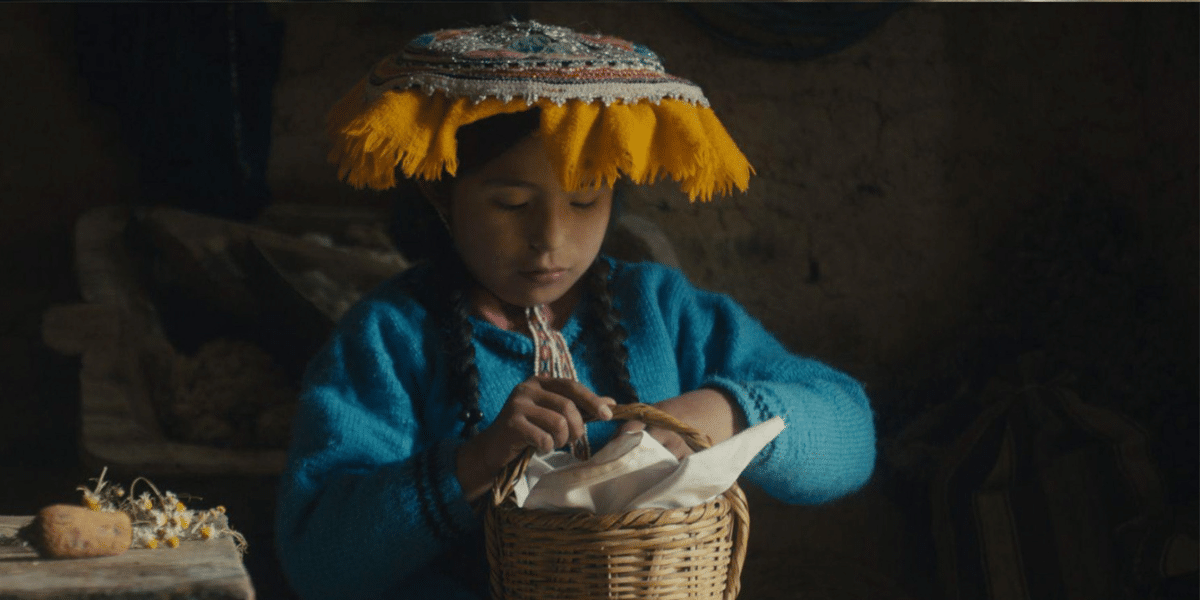
The short follows América, a ten-year-old girl living in a remote village in the Peruvian Andes. Her dream is simple: she wants a bicycle so she can get to school on time. Yet the film spends much of its running time showing us how difficult it is for her to achieve something that should be so basic. América must descend from the mountains, travel a considerable distance, and arrive at school after an exhausting journey. By the time she reaches the classroom, her classmates are already there, dressed and prepared in ways that emphasize the distance between their lives and hers. When one child mocks her, saying she smells like a llama, América’s humiliation becomes another obstacle in a scholastic career already defined by effort.
Director Javier Arias-Stella confessed that the story is based on a real child he met years ago. He was named Américo, lived in the mountains, and dreamed of owning a bicycle. The slightly altered name evokes the continent itself – and the United States as a place associated with opportunity. The NFMLA selection reveals the limits of that promise. America can represent wealth, possibility, and progress, while also containing communities in which access to something as ordinary as education requires an enormous amount of work.
I was especially drawn to this duality. América does not need to make a direct statement about immigration for its meaning to resonate with communities here. After all, América must move from one place to another to access basic services. She is not asking for anything extraordinary. She simply wants to go to school, learn, and have the same chance to build a future as the children around her.
That is what makes the film so moving.
The NFMLA selection also examines the social structures that make América’s journey difficult. Her father initially dismisses school as a waste of time, suggesting that she should focus on more practical concerns. His attitude reflects the gendered expectations, where a girl’s education may be treated as less valuable than her ability to contribute to the household.
By the end, her father recognizes that what she is doing is not a childish obsession – and his evolution is meaningful, proof that América has made her own ambitions visible and viable. She’s demonstrated that education is not separate from her family’s needs, but part of the way forward.
The film communicates América’s unique position through its visual language as well. The landscapes are often green and almost monochromatic, creating a strong sense of place and emphasizing the rural environment in which she lives. Against those surroundings, América’s clothing becomes a point of color. Her blue, yellow, and red knitted garments, as well as the textures of her clothes, make her stand out from the landscape and from the more muted colors worn by her family.
That contrast suggests that América belongs to her environment while also imagining a life beyond it. She is not disconnected from her community, but she is not entirely contained by it either. It’s visual form to the feeling of her ambition.
Although Guille, 28 and América seem to belong to opposite worlds, both films are ultimately concerned with the effort required to move through ordinary life. And they’re both careful to treat their character as people first, symbols second. And they both begin with people trying to do something recognizable – and the complexity emerges from the circumstances surrounding that desire.
And what’s more quotidian and relatable than wanting something?

NFMLA Film Festival, InFocus: Latin & Hispanic Cinema asks us this and so much more. Tickets and the full event line-up are available online.
