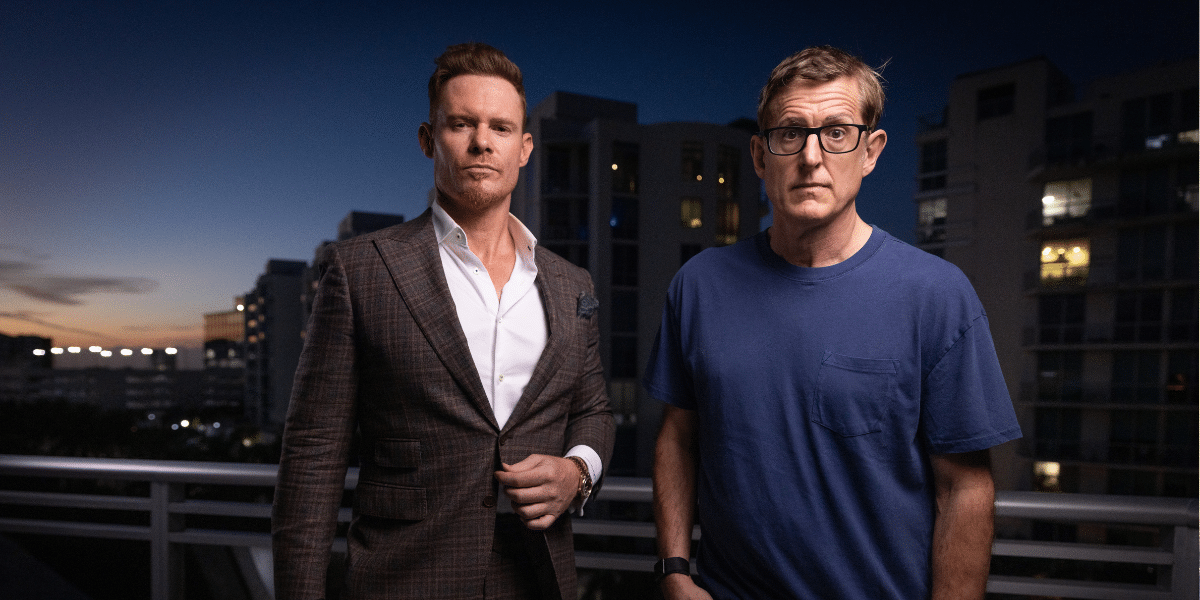
There are moments while watching Louis Theroux: Inside the Manosphere where your body reacts before your brain can catch up. A tightening in the chest. A heat behind the eyes. And yes, at times, the very real urge to gag. Not because what’s being said is new, but because it’s being said so loudly, so confidently, and to an audience that is still learning what it means to be human.
Released on Netflix in March 2026, the documentary follows journalist Louis Theroux as he enters the digital ecosystem of hyper-masculine influencers – men who have turned misogyny into a monetizable brand. Figures like Harrison Sullivan (HSTikkyTokky), Sneako, Myron Gaines, and Justin Waller operate within a feedback loop of outrage, algorithmic amplification, and capitalist reward. Rage is the product, misogyny is the hook, and young men are the market.
To be clear, the manosphere isn’t about men, it’s about misogyny as a system of power, which predates the internet but has found in it a perfect delivery mechanism.
The Algorithm Eats First
The documentary reveals, perhaps unintentionally, that the manosphere is less a movement and more a marketplace. Clickbait rage is these platforms’ currency. The more inflammatory the claim, the more engagement it generates. The more engagement, the more visibility. The more visibility, the more money.
Care, nuance, emotional intelligence, they’re not trending. But domination does. And so does degradation.
We are watching, in real time, the industrialization of misogyny.
The red pill mythology claims to reveal “truth” about women, about relationships, about power. But what it actually reveals is a profound misunderstanding of both women and the self. Men in these spaces speak with authority about women while demonstrating, repeatedly, that they do not know us. And more dangerously, they do not know themselves. Because they’re not selling masculinity. They’re selling a performance.
The Performance of Power
Take the recurring aesthetic: penthouses, luxury cars, bodies sculpted in gyms that prioritize biceps over balance, women posed like accessories in the background. It’s a curated fantasy of control. A visual shorthand for success.
But it’s hollow.
These influencers promote ideas like “one-sided monogamy,” where men are entitled to multiple partners while women are expected to remain loyal. The women who appear alongside them often perform agreement, even enthusiasm. But look closer – really look – and something else flickers behind the eyes. Fatigue. Calculation. Survival.
And that is the question the documentary only begins to ask: What are women willing to endure to secure stability in an economic system that consistently devalues them?
Because misogyny does not operate in isolation. It’s entangled with capitalism, with precarity, with the very real need to survive. When access to resources is uneven, power dynamics distort intimacy. What looks like “choice” is often negotiation under constraint.
The Wound Beneath the Noise
The most revealing moment in the film comes not in a podcast studio or a high-rise apartment, but in a quieter, more intimate space. When we see Harrison Sullivan interacting with his mother, the performance slips.
What emerges is not dominance, but resentment. Not power, but injury.
His earliest experience of authority came from a woman raising him alone. The contradiction is almost too on-the-nose: a worldview shaped by dependence on women, transformed into a need to dominate them.
And here is the uncomfortable truth: many of these men are not powerful. They are wounded. But instead of interrogating that wound, they externalize it. They monetize it. They turn it into doctrine.
A hurt boy with a microphone becomes a man with a movement.
The Pipeline
The real danger, however, is not the influencers but the audience.
Young men, still forming their understanding of relationships, identity, and self-worth, are the real profit-drivers here. And let’s be clear: this is not guidance. It is extraction.
These influencers do not care if they are producing miserable humans. In fact, the more alienated their audience becomes, the more dependent they are on the ideology being sold to them.
It is a closed loop. A pyramid scheme of identity.
So How Did We Get Here?
Inside the Manosphere makes painfully clear that we are at a cultural inflection point. One where the question is no longer whether misogyny exists, but how it is being repackaged, rebranded, and resold to a new generation.
There is a final irony at the heart of all this.
These men claim to offer a path to success – wealth, women, status. But the very ideology they promote isolates them from the things they claim to value. It reduces relationships to transactions. It replaces intimacy with control. It confuses attention for respect.
It does not free them. It traps them. And yet, they keep selling it. Because the illusion is profitable.
Watching this documentary, what lingers is not just anger, but a question: What does it mean to build a culture where young men are taught to fear women, rather than understand them? And perhaps more urgently: What responsibility do we have to interrupt that lesson before it calcifies?
Because this is not just about the manosphere. It is about the conditions that allow it to thrive. The algorithms that reward it. The economic systems that sustain it. And the cultural silences that fail to challenge it.
The documentary pulls back the curtain, but what we do next is on us.
