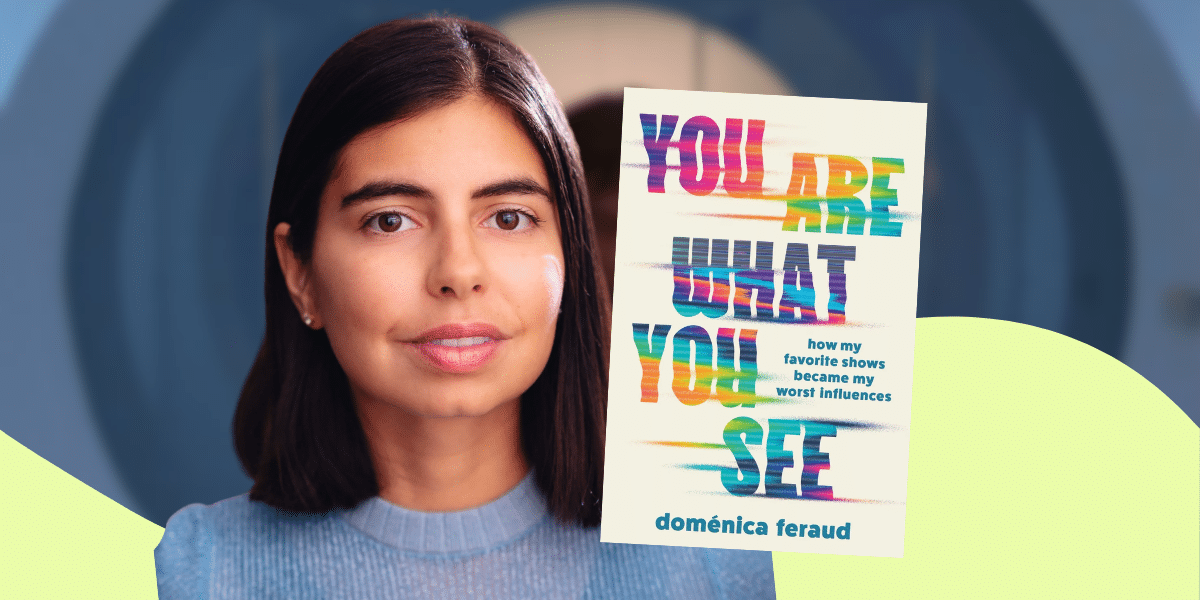
Latina actress, playwright, and producer Doménica Feraud (Rinse, Repeat) is a self-described TV addict. Her obsession began as a toddler watching Barney & Friends and followed her into adulthood, with shows such as Friends, Gossip Girl, and Sex and the City. In her new book, You Are What You See, Feraud, a first-generation Ecuadorian New Yorker, examines how pop culture affects the way she sees herself. Mixing cultural criticism with personal storytelling through a feminist filter, she revisits the TV shows that “sculpted” her – some of them serving as sources of comfort and others leaving a more damaging impression.
In doing so, Feraud writes about how these shows shaped her most intimate experiences – from disordered eating to toxic relationships to power dynamics in the workplace. In the book’s eighth essay, I Like to Be in America, Feraud also shares how her complicated connection to pop culture over the years influenced how she saw herself as a Latina and how she has since pushed back against many of those conventions.
“I loved Ugly Betty, but it was interesting because when I was struggling with my own weight and body image, I would meet people who would tell me I looked like [the character],” Feraud told Latina Media Co during a recent interview. “They didn’t say I looked like America Ferrera. That really affected me.”
For Feraud, writing a collection of essays instead of a traditional memoir allowed her to focus fully on the different aspects of her identity and get to the root of each topic.
“I’m in my early 30s, so I don’t know that I’ve had a life where I could write, ‘And this is how it all began…’” Feraud shared. “There were incidents in my life that I had put away that were suddenly coming to the forefront. The structure allowed me to dive much deeper than I would have anticipated.”
Feraud points to her essay “Thank Heaven for Little Girls,” as a meaningful look into the media’s sexualization and treatment of young girls. She examines books, movies, and TV shows like Vladimir Nabokov’s Lolita, Woody Allen’s Manhattan, and HBO’s Euphoria, while linking their portrayals of girls and young women to her own experience fawning over an older man as a teenager.
“As an adult, I can logically understand why it was so challenging for me to get through the middle portion of Lolita,” Feraud wrote. “I felt uneasy reading about a 37-year-old man having sex with a 12-year-old girl… My brain knew this novel was an artistic masterpiece, but my body wanted nothing to do with it.”
In another essay, “The Legacy of Chuck Bass,” Feraud examines Gossip Girl’s fictional antihero and reflects on the character after rewatching the first episode, in which Chuck attempts to sexually assault two female characters.
“When I was writing the essay and rewatching the show, I realized how terrible a lot of the things I learned from the show were,” Feraud said. “I loved that show growing up. It was really interesting and healing in many ways to revisit it.”
Feraud also goes back to Friends and Sex and the City, though she has “fallen out of love” with the latter. She describes Ross (David Schwimmer) as “possessive and controlling” and points to the Friends episodes where Monica (Courteney Cox) is fat-shamed. While acknowledging Sex and the City was groundbreaking for women at the time, she now sees more harmful elements than positive ones.
“I can see how in the 1990s, having a show like Sex and the City with four women talking about their sex lives and getting to be sexual was really important,” she said. “But in 2026, I see these women as very male-centered.”
Feraud hopes when people read You Are What You See, they realize that “love doesn’t have to be difficult.” It’s one of the lessons she’s had to learn herself after years of internalizing messages about relationships and self-worth from the screen.
“An ideal that was sold to me as a young girl was that love is meant to be tortured, and that easier love is boring,” she said. “When you live through toxic relationships, you see how much they hurt and what they cost. That’s been a big lesson I’ve had to unlearn.”

You Are What You See hits shelves October 13, 2026.
