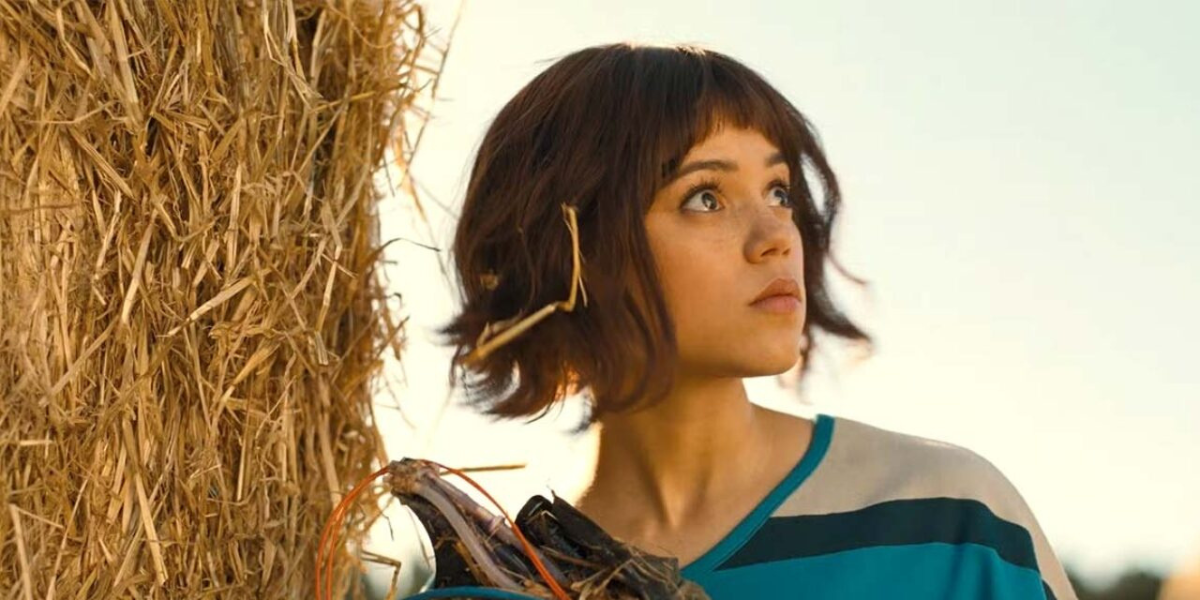
Imagine an Artificial Friend – both childlike and sophisticated – who tries to decipher what human love is and is willing to make all kinds of sacrifices to protect a family. That is the essence of Klara and the Sun, the new dystopian drama directed by New Zealand filmmaker Taika Waititi, who also co-wrote the screenplay with Dahvi Waller. It’s an adaptation of Nobel Prize winner Kazuo Ishiguro’s acclaimed eighth novel, continuing his legacy on the big screen following the successes of The Remains of the Day, Never Let Me Go, and A Pale View of Hills.
Starring a magnetic and endearing Jenna Ortega as Klara, a solar-powered companion robot, the film invites us to question the limits of science, the weight of the decisions we make in the name of love, and what it truly means to be human. Unlike Hollywood’s typical noisy dystopias or robot rebellions, this aesthetically stunning sci-fi comedy-drama has much more to say about humanity than AI. “We just made a film about a robot who happened to be, more human than the family that bought her,” Waititi told Collider. “And, you know, I just wanted to make something that was a really human story about a sort of sweet robot.”
Individual Identity vs. Artificial Intelligence
This adaptation of Klara and the Sun tones down the social and philosophical depth of Ishiguro’s novel, while still exploring on the story’s essential themes.
In the film’s competitive and hostile environment, loneliness, imposed isolation, and the dehumanizing consequences of unchecked scientific progress take center stage. However, the goal here is to examine the irreplaceable nature of human beings. Or, as Ishiguro himself explained to Wired, the entire meaning of the book boils down to one question: “What the hell is a human being, what’s inside their mind, and how irreplaceable is any one human?”
Klara begins her journey assuming that her sole purpose is to keep her young owner company. However, as she spends more time with the Arthurs, the android discovers that this small family has already experienced a loss and that mother Chrissie (Amy Adams) lives in constant fear that daughter Josie (Mia Tharia) will also pass away.
Unable to bear the loss of another loved one, the mother makes a disturbing decision: to program Klara to replace her daughter in the future. From this point on, the plot leads us to wonder whether individual identity is a formula that can be stored and imitated, or whether human beings possess a unique singularity rooted largely in the emotional bonds they form with others.
Throughout its 116 minutes, the feature warns that attempting to replace people with automation constitutes a profound self-deception. Ironically, it is the machine – with its unwavering friendship and loyalty – that ultimately reminds us of our irreplaceable nature.
Artistic Achievements in the Background and Foreground
Ra Vincent, an Oscar-nominated designer for his work on Jojo Rabbit and The Hobbit, created the sets for this post-Third World War world, rife with oddities and devoid of the Internet. With evident dedication, he avoids the coldness of hyper-technology and instead opts for a retrofuturistic aesthetic that combines costumes inspired by the 1950s and 1960s, influences from various eras, and the lush rural landscapes of New Zealand. From the analog counter at the robot boutique to the Arthur family’s magnificent wheat fields to the rustic structure of the McBain barn, every setting in this “dystopian fairy tale” contains meticulous clues that explain why this future came to pass.
On the other hand, it’s fair to say that the heart of the film lies in Ortega’s total commitment. The actress uses impeccable precision to portray how the robot evolves from simple mechanical imitation to a deep understanding of human emotions. By combining physical comedy with profound vulnerability, Ortega builds an endearing character, distinct from her previous roles and reflecting a new maturity. Furthermore, the supporting cast gives it their all, making the on-screen relationships feel real and moving.
Should I Watch Klara and the Sun?
The online chatter about Klara and the Sun is largely about how faithful it is to the original text and its shift toward optimism. I’d be lying if I said this was the reimagining I was hoping for – I miss the book’s devastating subtlety. But I’d also be lying if I denied that Waititi’s film has undeniable charms and stands as a valid reinterpretation in its own right. I’m left with the feeling that its existential themes would have been better developed in a series format, with the time needed to delve deeper into the story.
