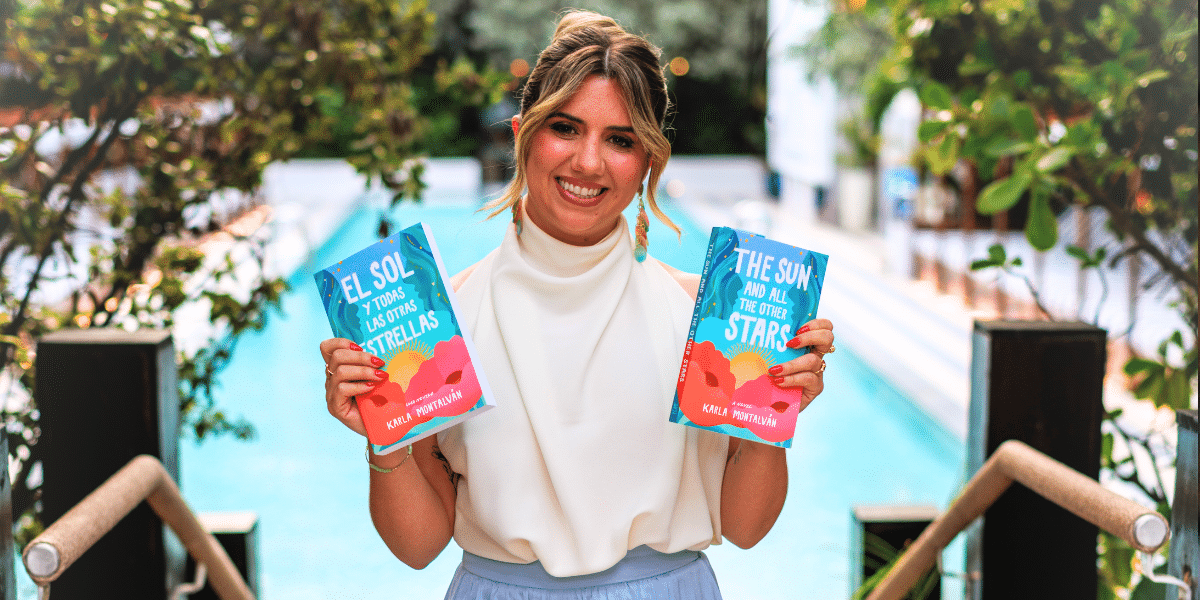
Heartbreak is the love language of Latino folklore. While pop culture pins us as the most passionate lovers on the planet, I fervently believe that our love of heartbreak is almost as big as our love of romance. A few months before starting my novel, The Sun and All the Other Stars, I found myself unable to explain why I was so attached to romantic ideals. My understanding about love came not just from my family and cultural expectations, but my identity – I was a hopelessly romantic Latina, looking for love.
I grew up watching telenovelas, reading Laura Esquivel, cleaning the house to Juan Gabriel on the weekends, and crying over the boleros playing on my grandparents’ sound system while I stirred the frijoles. All my life, I had seen passionate romances everywhere, yet romantic love still felt out of reach.
Modern therapy has data-driven explanations for the perils of dating: the loneliness epidemic, too much time on our phones, various attachment styles. There’s a scientific reasoning for everything, but none of the data could illustrate how I could reject my family and culture’s romantic traditions. Ones that held women responsible for machista matriarchies, where somehow, men were still at the center. It couldn’t explain why, even though I love and respect the women in my family, I never aspired to their romantic relationships.
It also couldn’t explain why, despite all this, I felt heartbroken at the realities of modern dating and meeting partners who were more lost than me. It wasn’t until I stumbled across alternative forms of therapy – past-lives regression therapy specifically – that everything changed.
Trauma’s Cultural Nuances Run Deeper than Talk Therapy
Growing up in a traditional Cuban family, therapy – or even talking about our problems – wasn’t something we did. Only crazy people went to the psychologist. The rest of us dealt with our problems quietly. Intimately. Even better if we didn’t even talk about them. So, when I started going to therapy at eighteen to deal with issues such as anxiety and depression that stemmed from unresolved trauma from my childhood, I didn’t tell anyone.
My first therapist was a counselor at my university in North Carolina. Her office held more certifications than I could count on any particular session, but I often wondered if she could identify Cuba on a map. Many of my struggles didn’t make sense to her. She didn’t understand the nuances of the Cuban diaspora.
I don’t blame her. It wasn’t her job to know. She was there to help me sort through panic attacks that stemmed from being too hard on myself, my long-term (and at the time long-distance) relationship, and the pressure I felt to succeed and make my family proud of my achievements.
How could I make her understand that I was the first woman in my family to live on her own? That most of the women in my family had had their first child by the age of 21, and I had no intention of conceiving. That my family crossed borders and left their life behind so I could live out the “American Dream.” That my family believed I would stay in Miami, meet a nice Cuban boy, and have a few kids – and that would make me happy. But here I was, at the psychologist – and it still wasn’t working.
Generations of Latina Heartbreak
Heartbreak hits differently for Latinos. We understand passion and longing on a level few other cultures do because our heartbreak is generational. That’s something I didn’t understand until I started diving into past life regression therapy, recognizing that many of the issues we face in this life didn’t necessarily start here.
Our great-grandmothers, grandmothers, and even our own mothers didn’t have the same options we do. Yet, we still carry much of their pain and expectation with us. When crafting Mar, the protagonist of The Sun and All the Other Stars, she spoke to me of carrying this pain. Our heartbreak isn’t always tied to a particular guy or relationship, but to the lives and experiences unlived by our generational collective.
While many of us have the option of choosing our partners – or choosing not to have one – many of the women before us didn’t. For our ancestras, their marriages could have been arranged (or the products of rape). Perhaps your family is separated by immigration and diaspora. Also, the machista parts of our culture tell us that strong-willed daughters never “find” love or have families because our independence is actually a curse.
Past-Lives Regression Therapy and Healing Soul Families
You may have heard of past-life regression therapy. Brian Weiss popularized it with his book, Many Lives, Many Masters, decades ago. Even before writing this novel, my experience with regression therapy was life-changing and healing, considering that while our bodies spend a limited time on this planet, our souls carry on.
In my novel, Mar Varela undergoes this therapy to understand a curse that plagues the women in her family around romance. She visits three past lives: a female painter in Renaissance Florence, a sharp-witted sex worker in 1808 Madrid during the final years of the Spanish Inquisition, and a gay man navigating the height of the AIDS epidemic in 1980s SoHo.
Mar starts connecting the dots about the issues that plague her. She also begins understanding how she is connected to others within those past lives. As the author, I chose this form of therapy to showcase the different ways in which the soul experiences grief and heartbreak and how looking into our past can help us understand and shape our future in a better way.
While many people may shy away from these types of therapy or find them too “woo-woo,” they can be an incredible resource to add to your personal healing journeys. Not only is it a gentle form of healing for yourself, but also your soul family.
The Sun and All the Other Stars Offers A New Happy Ending for Latinas
With my novel out now, many people ask me if The Sun and All the Other Stars is a romance, and the short answer is: yes and no. It is a love story, and there are four romance stories within it, but I aspire that beyond the romance, readers can open themselves up to a new take on happy endings and healing.
Heartbreak is not fun, no matter how much we romanticize it. It is a tool that, when used on a path of healing, can lead us to discovering dimensions of love we couldn’t even fathom existed. As a Cuban author, I hope this book can help Latinas define the kind of life and love they want for themselves. I hope it inspires us to look at our lineage and say, “Thank you, I got it from here.”
But most of all, I hope reading this book helps people mend their own broken hearts and transform their pain into something they can stand proud in.

The Sun and All the Other Stars is available now in English and Spanish. Image credit Bokka Media.
