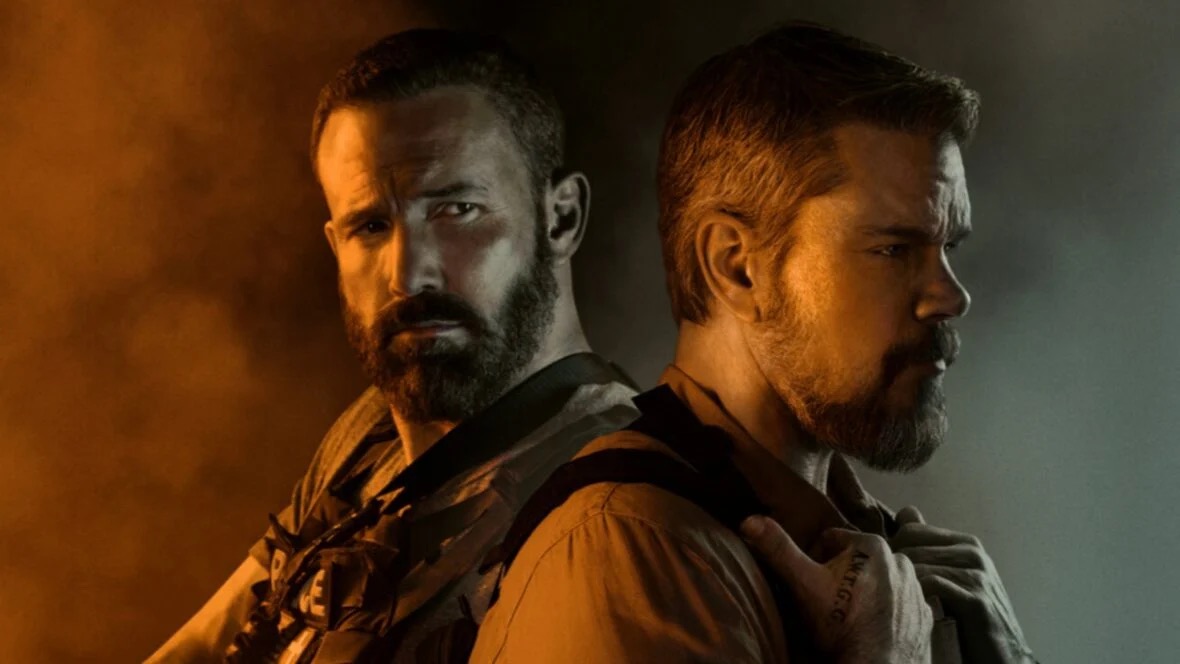
Let me begin by saying that, as a former Jersey and Miami girl (thanks to my parents’ divorce), I might be the perfect critic for The Rip. Maybe I missed my calling as a continuity director or maybe just a professional side-eye artist, but this movie had me engaged, entertained, and furious in equal measure.
I love an Affleck-Damon reunion. I do. There is something baked into my elder millennial nervous system that lights up when these two share a screen. I blame Dogma. I blame Kevin Smith. I blame my own inability to quit emotionally investing in Boston boys with tortured charisma. So when The Rip dropped on Netflix with its Miami TNT unit, its cartel cash, and its promises of sweaty betrayal, I was ready.
And look. The movie is entertaining. The action works. The betrayals land. Steven Yeun and Teyana Taylor bring gravity. Sasha Calle gives Desi a pulse that the film desperately needs. The plot twists are slick AF! You will probably have a great time. Hell, I had a great time!
But this film betrayed me.
On paper, The Rip should have worked. Dirty cops. Stolen money. A Cuban-American city where corruption is so baked in, it comes with cafecito. That is not an invention. That is Miami. The problem is that The Rip is not actually in Miami. The film claims Hialeah as its heart, but it was shot mostly in Kearny, Bayonne, Elizabeth, Wayne, Los Angeles, and Long Beach with a tiny sprinkle of Boca Raton thrown in like parsley on a plate of lies.
If you have spent your life bouncing between cities the way I have, you know when a place is being impersonated. Cities have accents. Streets have posture. Light hits buildings differently. You cannot fake it.
Let’s start with the basics. It is pronounced Hy-uh-lee-uh. Not High-lay-ah. Not whatever vowel sancocho half this cast was serving. Matt Damon was the only one who got it right, which only made it more painful. It’s like ordering a pastelito with ketchup and asking why everyone looks horrified.
Then there is that cheap sign when they enter the city. Boys. There is a giant fountain on Okeechobee Road. A glorious, ridiculous fountain. It announces Hialeah like a crown. You erased it. You replaced it with something that looks like it came from a suburban strip mall. And the attic. The place where it all goes down. Never in my life have I seen a Hialeah house with a full standing attic like that. That is fat-free Cali architecture pretending to be a South Florida Cuban crawl space, and it is not convincing. In real Hialeah, that space would already be an efficiency with a microwave and a dream, going for $2,000 a month, utilities not included.
I do not know why I expect more from Affleck and Damon. I just do. Maybe it’s nostalgia. Maybe it’s the illusion of conscience that comes with their public branding. I am not saying they burned that trust to the ground. I’m saying, I expected better than being told it’s raining while someone is very clearly pissing on my Hialeah heart.
Here is why that matters.
Locations are not wallpaper. They are economic engines. When you shoot in a city, you hire its people. You feed its restaurants. You pay its drivers. You give its residents a piece of the story being told about them. Affleck and Damon’s company Artists Equity loves to talk about sharing profits with workers, and I applaud that. But equity is not just about backend bonuses. It is about who gets paid upfront to be present.
Miami did not get that.
Hialeah did not get that.
Instead, they took its corruption, trauma, and beauty and filmed it somewhere safer and cheaper. That is not just a production choice. That is a political one. The movie throws in some Spanish. It sprinkles in Cuban slang that is often mangled beyond recognition. It gives us a diverse cast, which I appreciate. But representation without investment is just tourism.
This film is about dirty cops and dirty money. I understand why filming in Miami might feel risky. I really do. That city does not play when it comes to exposing its own rot. They could have set it Los Angeles, and it would have worked just fine. Instead, they chose Miami and then refused to show up for it.
So what we get is another story where a Latin city becomes a backdrop for white male moral collapse. Cocaine cowboy energy. Corruption porn. Hialeah’s potholes are currently pursing their lips and giving you the Cuban abuela side-eye. That money could have gone to fixing them, but instead it went to pretending Bayonne was la ciudad de progresa y factoría. Ultimately, as per usual, there was no accountability for the community that actually lives inside those narratives and is now dealing with the very real fallout of ICE raids, political targeting, and economic extraction.
And with all that going on, The Rip takes our city and flattens it into an aesthetic. Call me a buzzkill, but that ruins the whole damn thing.
