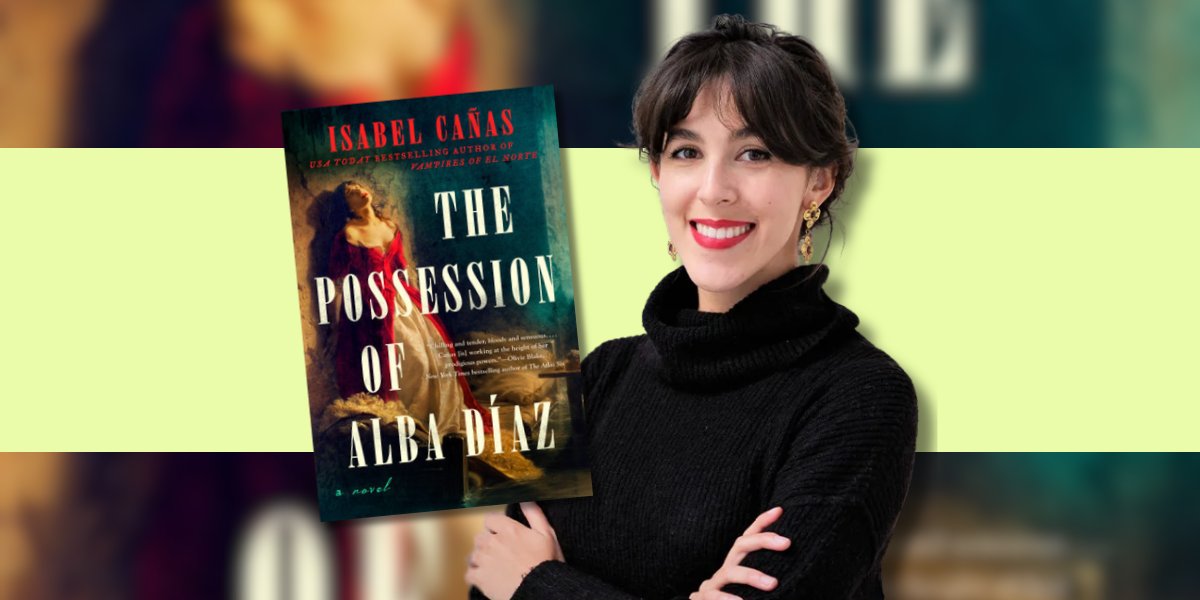
I’ve said this before, and I’ll say it again: no one does horror like Latinx folks. We’re raised by stories of ghosts, hauntings, demonic possessions, and vile creatures and we love every second of it. We also know how to do romance and forbidden love like no other (see telenovelas). With a background like that, it is no surprise that Mexican-American author Isabel Cañas was drawn to “horromance.” After the success of her previous novels, Vampires of El Norte and The Hacienda, Cañas gives us The Possession of Alba Díaz, the journey of a woman seeking bodily autonomy in a time when her sex meant she was someone else’s (read: a man’s) property.
It’s 1765 in Zacatecas, Nueva España – what would later become México – and Alba may be raised as a devout Catholic but she isn’t interested in marriage. To escape the machinations of the men in her life, she becomes the beard to a childhood friend whose family is indebted to hers. Soon, they’re off to Mina San Gabriel, a hacienda that should provide the new couple some privacy (and respite from the Plague). But it’s more than they signed up for when Alba starts hearing voices warning her to leave. She also spends more time with Elías, a mysterious alchemist and her husband’s distant cousin. The two turn out to have a shared history, based in the mines of both Almadén and Mina San Gabriel, where the rule is that when you descend into the dark, you never go alone. And so, Alba and Elías slowly descend into darkness together, both of them seeking answers and freedom.
With this setup, the novel provides a perfect mix of mysticism and sorcery, combining the science and supernatural powers of alchemy with the patriarchal grip the Catholic Church has held for centuries on small towns (and, to be quite honest, some larger cities, too). The Possession of Alba Díaz focuses on the ugly side of Mexican history – on the bits of history that could very well be considered horror. It reminds us of all the earthly and unearthly ways in which a woman’s body can be owned, back in 1765 and in 2025.
I’ll admit I put off reading it for a bit, as I can have a hard time with horror (thankfully, this novel is spooky enough but perfectly manageable, even for someone like me!). But, I was absolutely enamored by Cañas’ writing – to say I was hooked from page one is an understatement. Her words are immersive and lyrical, and she does a fantastic job of transporting the reader back in time. Her characters are multifaceted, complex people – she crafts them in such a way so it’s impossible to like most of them, even as I kept wanting to know more about them.
As I read her words, I could feel the angst, the guilt, the shame, the passion, the fear… and the anger, both Alba’s and my own, brewing with every page. Alba’s rage is a product of her powerlessness; mine stems from the frustration I felt for Alba, yes, but also from knowing that 270 years later, not much has changed. There’s a lot of anger in Cañas’ writing, but also defiance and, oddly enough, hope.
The Possession of Alba Díaz is an unsettling read, but trust the process, I promise you, the ending is worth it. It’s also beautiful – scary and haunting, but oddly optimistic. It’s one of those books that I would love to see turned into a movie. We’re severely lacking possession and exorcism stories in film lately, and Cañas’ words would translate magnificently from paper to film – and, I’m not gonna lie, it would also be a very welcome break from the many nostalgia-driven remakes that have saturated the box office lately.
Women being pawns and pieces owned by a larger system is nothing new. Not too long ago, I heard someone say, “The best position for a woman to be in is to be a wealthy widow.” In a society that is hell-bent on determining our value by how willing and able we are to fulfill our “duty” to be wives and mothers, then sure, being a rich widow means you’re done with both of those things. But we are more than that. Women are more than the people we take care of, and we are owed the chance to decide when – or if – we take on those roles. We are owed control over our bodies and our identities.
While the story is set nearly three centuries in the past, it takes place in a period in time when women’s bodily autonomy is in question at best. The Possession of Alba Díaz feels especially relevant, as women today face the reality of not being entirely in control of our bodies, echoing the book’s fictional main character. We are contending with a system that treats us as less than human while it forces us to accept guilt and atone for others’ wrongdoings. Yet, much like Alba did in the late 1700s, many of us still chose love, adventure, and defiance, knowing it might just cost us our lives – in the words of Alba herself: “I will not be cured.. but neither will I be caged.”
