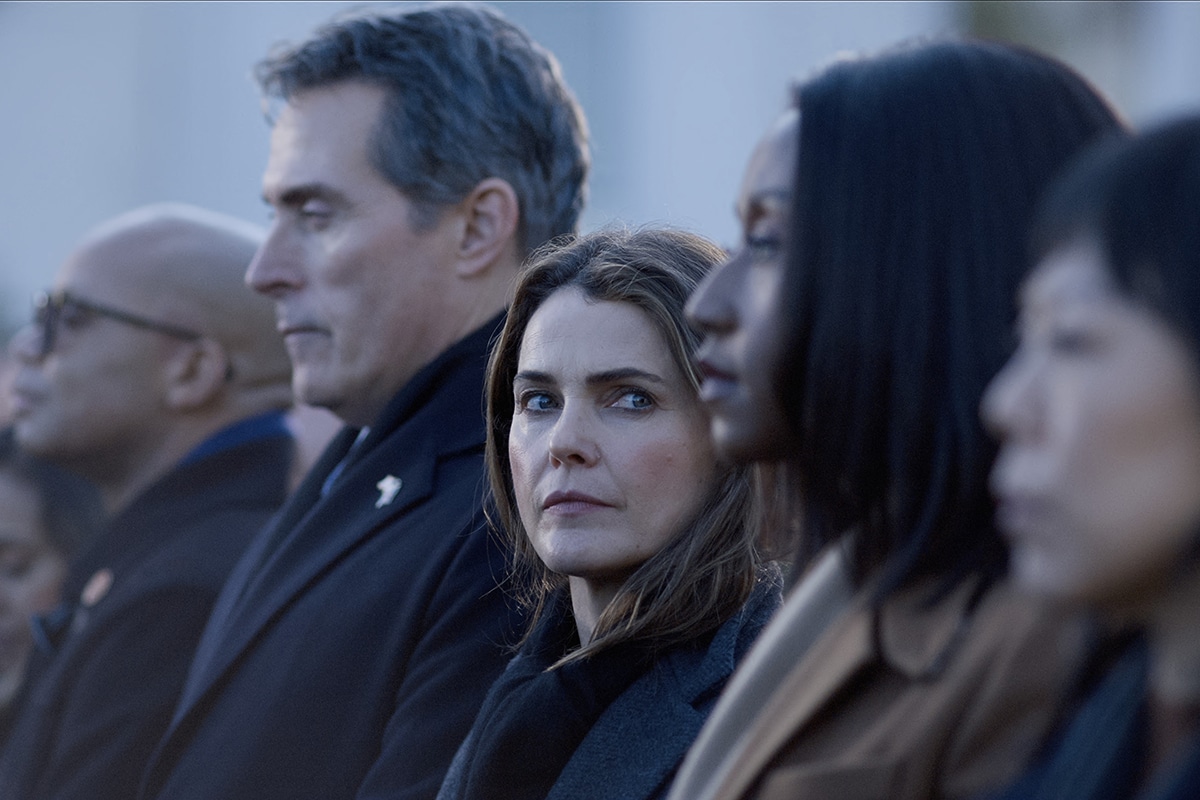
What happens when the man you fell in love with is constantly mirroring your own demise? What happens when that man is the second most powerful person in the whole wide world? Netflix’s The Diplomat returns with eight episodes of strategy, uncomfortable intimacy, and a Freudian banquet. After what felt like the best cliffhanger in modern TV (forgive me, David Chase), Kate Wyler (Keri Russell) and her rotten better half, Hal (Rufus Sewell), drag us through the transition of power after U.S. President William Rayburn dies and Grace Penn (Allison Janney) becomes president.
If you have not seen this series, close this tab and go figure out where House of Cards got it completely wrong. If you have seen the previous two seasons and are ready to know what happened on the lawn of the American ambassador’s UK residence, you are in for a treat. Maybe.
In a moment when the United States is jumping headfirst into autocracy, The Diplomat shines a light on a fictional, yet very plausible, world of international diplomacy. Think all the times our governments have been on the brink of global nuclear catastrophe while me and you are unknowingly binge-watching a show on Netflix.
Now, in its third season, the series created by Debora Cahn makes our gender politics explicit, writing them across our actual politics at the highest levels of the U.S. Government. Vice President Grace Penn becomes president, betrays Kate, and hands the vice presidency to Hal, the famed war diplomat who insists on making his wife cannon fodder every time there’s an amoral decision to be made.
Why Kate thought Penn would choose someone with a backbone to be her accomplice remains a mystery to all of us.
The truth is, Kate Wyler is subdued by her own pride and supposed moral superiority. Hal knows precisely how to use both whenever there is an ace hiding under the table. And if you think this is an overly produced Mr. and Mrs. Smith, think again. The Diplomat is a subtle narrative of leadership as we once knew it, which now seems to belong only in the realm of fiction. In the best style of Greek tragedies, The Diplomat stages what happens when the leader of the free world is a woman who wears her insecurities on her sleeve. Will she prove the prejudices about female leadership wrong?
Yes – but not how you think.
For seven and a half episodes, we swallow Kate’s pettiness. We watch her bang her head, and yes, her greasy hair, against a wall for being used and misused by her now Vice President husband. The Kate Wyler never-ending whining aria tries to elicit sympathy, while the real story unfolds behind the curtains, where power is traded by people who never have to ask for it.
Here is the bitter core that Season 3 refuses to spit out: Competence, when performed by a woman, becomes a service. It is not a path to authority. It is a tool for smoothing male ascendance. Hal is promoted on the back of Kate’s credibility, and Penn stabilizes herself on the back of Kate’s labor. The system survives because Kate will do the right thing and live with it, while everyone else benefits.
Season 3 keeps insisting Kate can be both ambassador and Second Lady. Genius tactician and human shield. It is a neat slogan until you notice the bill. Every time she nears real power, the narrative redirects the reward, a win becomes proof she is indispensable rather than an invaluable leader, and a confession becomes a liability she must carry. The show wants us to respect her stamina, while we end up exhausted.
And still, we watch. After all, the pacing works, the performances land, and the writing knows how to savage without shouting. This is why the disappointment bites: The Diplomat knows exactly how misogyny survives inside institutions. It knows power disciplines anyone who moves differently, and then it chooses the familiar hierarchy anyway. The smartest woman in the story keeps the world from burning and is sent back to tidy the ash.
Kate Wyler can negotiate peace in the morning, soothe egos by lunch, and fly home to the reality that the system prefers her exhausted rather than in charge. That’s the lesson of The Diplomat and that’s why we can’t look away.
