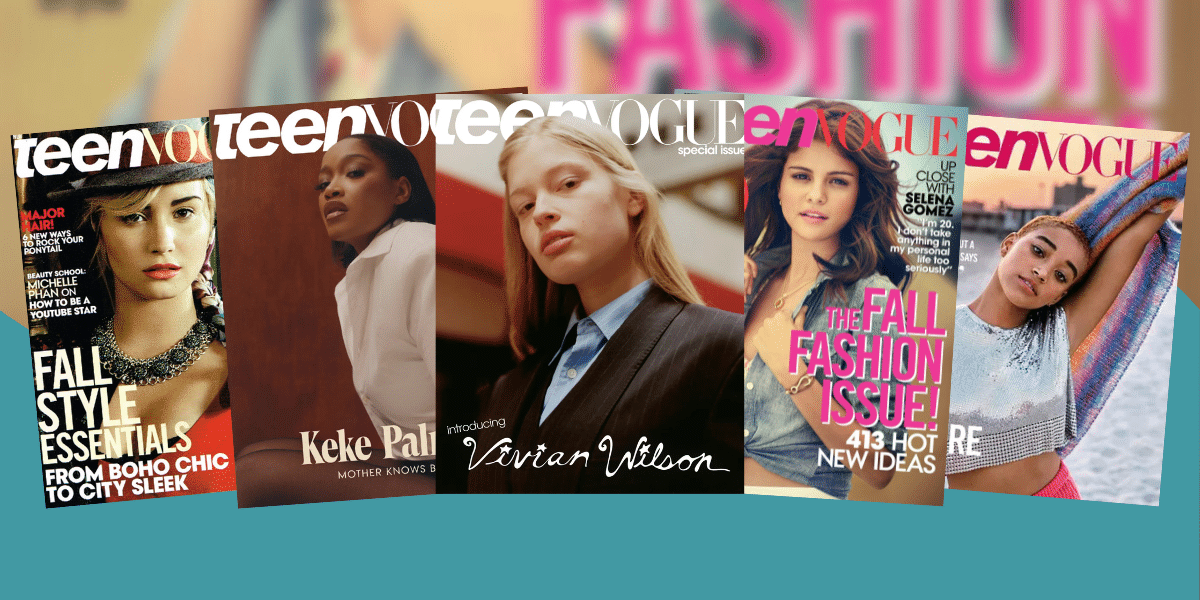
I’ve been a Teen Vogue girl for as long as I’ve been a reader. I mean that literally. I have every issue from 2010 all the way until their last print edition in 2017 stacked in boxes like they are archival material. In a way, they are. I grew up on those pages. Before I ever called myself a journalist, I was a teenager circling sentences in Teen Vogue with a pen because I liked how honest they felt. It was my dream job. It was the first media space that made me feel like a young woman of color had a place in national conversations. So watching it get gutted this fall felt personal in a way I have not been able to shake.
In September, the Roosevelt Institute honored Teen Vogue with its Freedom of Speech and Expression Award. They praised the publication for giving young people a political platform outside what mainstream media deemed newsworthy, and for doing so with depth, clarity, and courage. Less than two months later, Condé Nast folded Teen Vogue into Vogue.com and laid off most of its staff, including many of the BIPOC and trans editors who shaped its most important work.
A lot of people missed why this was so devastating. If you have not read Teen Vogue since the era of mascara quizzes, it might be easy to shrug off its closing as just another media layoff. But Teen Vogue became something else entirely in the last decade. It was a place where young people could read about reproductive rights, labor organizing, Indigenous sovereignty, LGBTQ legislation, climate anxiety, campus protests, and real political analysis written in language that treated them like they mattered. They broke national stories. They published award-winning investigations. They platformed trans youth at a time when major newsrooms were backing away.
And the work was not abstract. It was vulnerable, community-centered journalism.
I think about the piece “39 Abortion Stories Show Just How Important Abortion Access Is,” which gathered deeply personal narratives from people across the country. I remember reading it and feeling the weight of how powerful it is when a publication trusts young readers to sit with complexity and truth.
I think about the JLo essay about growing up Latina American and seeing yourself in a superstar. I devoured that one as a teenager because it was the first time pop culture coverage made me feel seen without flattening my identity.
And I think about the mental health story written for Latine girls, about how cultural pressure shapes the way we carry our pain. Teen Vogue published that for readers like me, readers who never saw our inner lives explored with that kind of care.
Those are the stories that built my voice. And they are the stories Condé Nast just discarded.
And on a personal level, one of the hardest parts of all of this was seeing Kaitlyn McNab, Teen Vogue’s culture editor, lose her job too. Kaitlyn was one of the first Belizean journalists I had ever met. I am a Belizean American, and meeting her made me feel like there was finally someone in the national media who shared a piece of my world. Her essay about experiencing her first carnival in Grenada stayed with me for weeks. It captured joy, heritage, movement, belonging, and what it means to hold multiple identities at once. Seeing her stories in Teen Vogue made me feel seen, not just as a young woman of color, but specifically as a Central American Caribbean Latina. Losing her voice at Teen Vogue feels like losing part of my own.
Condé Nast insists Teen Vogue will remain a distinct editorial property. They say it will keep its mission and its point of view, even as it now lives inside Vogue.com. But the reality does not match their press releases. Teen Vogue’s editor in chief is gone. Its politics editor is gone. The editor who coordinated the Vivian Wilson cover story is gone. Seventy percent of the team is gone. The remaining staff is almost entirely white. Teen Vogue now has zero dedicated politics reporters.
It is hard to call something distinct when you have removed the voices that made it distinct in the first place.
What hurts the most is that this was not a failing publication. Teen Vogue was doing some of the best youth-focused political journalism in the country. They helped young readers name injustices they were already feeling. They were clear and loud and unapologetic during some of the most politically chaotic years of our lives.
And Condé Nast knew that. They resourced the Vivian Wilson cover shoot in Tokyo. They promoted Teen Vogue’s political reporting when it earned traffic. They accepted the Roosevelt Institute award. Then, they pulled the plug.
As a Latina journalist, I cannot ignore what this says about who gets to tell political stories and who does not. Teen Vogue’s shift from fashion to political analysis was built by young writers of color. It was Latina, Black, Asian, queer, and trans editors who refused to separate culture from politics because our lives have never allowed that separation. Teen Vogue understood that. They treated our identities as political realities, not trends.
Which is why their shutdown feels like something larger than a company restructuring. There is a pattern in mainstream media, especially now, where outlets that center marginalized voices become expendable once they grow too bold. We are in a moment where political coverage is becoming softer and more cautious. Billionaire owners are setting limits on what journalists can say out loud. There is a real fear around honesty right now.
Teen Vogue did not play it safe. And Condé Nast decided that was no longer convenient.
So the question is now: where do young women like us go? Where do teenage Latinas read about reproductive rights in states where they might soon need abortion care? Where do college students read about their own campus organizing without being framed as dramatic children? Where do young queer people see reporters covering anti trans legislation with compassion and accuracy? Where do young journalists get their first political byline when entry-level jobs barely exist?
There will be answers. Young journalists always build new spaces when old ones collapse. We are seeing that already in independent media, newsletters, youth-led publications, and community projects. But the loss of Teen Vogue still matters. It matters because it was one of the only times a massive media company gave young women of color a stage and let us speak loudly.
For me, the grief is simple. A publication that helped shape my voice no longer exists in the form that made me love it. A dream I held since childhood is now a door that has been quietly closed. And a generation of girls who deserved a political home in mainstream media just watched one disappear.
Teen Vogue taught us to pay attention to power. So we are paying attention now. The people at the top will be fine. The readers and writers who needed this space will not. But the work Teen Vogue did will not vanish, because the girls it raised are still here. And we are not done speaking.
