From Con Sólo Mirarte and Nueve Vidas to the recent Las Locuras, Rodrigo García Barcha, the son of Gabriel García Márquez, has established his career by portraying unconventional female characters. With Santita, his first miniseries for Netflix, he not only continues this trend but expands upon it in an ingenious way. Set between Tijuana and Mexico City, the story revolves around María José Cano, aka “Santita” (Paulina Dávila), a disabled anti-heroine who answers to no one and whose life is marked by an unresolved past and a longing for a fulfilling sexual life.
The opening minutes of the miniseries find her out on the street, delivering a baby under extreme conditions. It immediately becomes clear that she is a tenacious and courageous woman who refuses to be intimidated by adverse circumstances. A firm believer that “chaos is the breath of life,” she’s a compulsive drinker, a poker expert, and a fan of cockfighting, all in a doctor’s coat. Yes, she describes herself as a “first-class sinner.”
For María José, the greatest challenges lie not in the social or professional spheres, but in the sensory realm: she’s been unable to orgasm since her accident. But she’s determined to change that with a fearlessness that sometimes pushes her to dangerous limits.
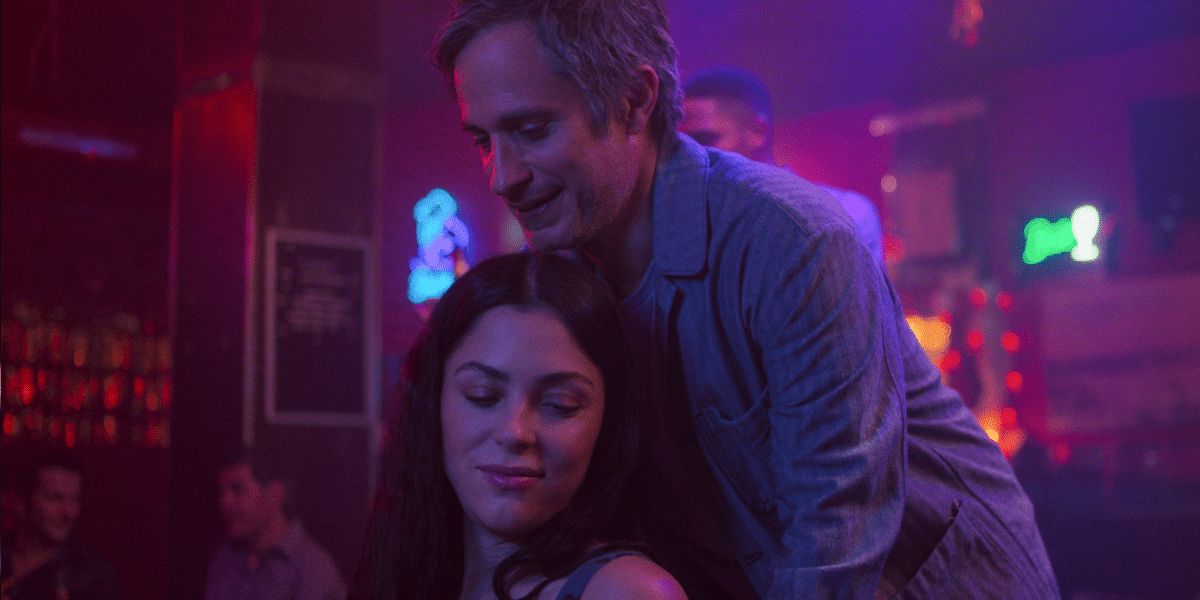
Her carefree and somewhat erratic daily life is disrupted when the past comes knocking at her door. The appearance of her former fiancé (Gael García Bernal), now vulnerable and ill, drags her into an emotional crossroads that forces her to reexamine her choices and the unresolved issues between them. What follows is a battle of wills in which the former lovers reflect on the life that slipped through their fingers.
Dávila delivers one of the most complex performances of her career, rich with emotional and physical nuances. In her skin, Santita is a troublemaker like few others – biting and playful one moment, deeply sensitive the next. Alongside her, García Bernal brings a moving humanity to his role. Weakened and pensive, his character seeks to finally confront the mystery of his abandonment. The two achieve a beautiful chemistry that allows us to feel the weight of their shared history.
Santita is Provactive Social Commentary
Although Santita may seem like an uncomfortable story at first, it manages to be inventive, revealing, and surprisingly funny. By focusing on María José’s independence, specific traits, and erotic odyssey, the series dismantles all kinds of stigmas associated with disability: from tragic heroism to condescending idealization, including infantilization – you know, that social tendency to treat people with limited mobility as eternal children or asexual beings. The result is a story as provocative as it is necessary, one that demonstrates that life and passion do not stop at a physical limitation.
One of the most outstanding qualities of this miniseries is that it never falls into moralizing sermons. On the contrary, it offers a rarely explored perspective that invites the audience to confront their prejudices. Along the way, the series is not afraid to point out systemic discrimination, the lack of accessible infrastructure, and, especially, the violence faced by this group.
According to data from UN Women and UNFPA, women with disabilities are two to three times more likely to experience violence than the rest of the population, a risk that can be up to ten times higher in the context of sexual violence. In Mexico, data from CONAPRED confirm that eight out of ten women with limited mobility have experienced some form of abuse or aggression. In this context, Santita takes on a necessary political dimension. By highlighting rights violations and structural barriers, it serves as an urgent mirror for countries still striving to become truly inclusive.
The show’s technical craft deserves a special mention. Backed by intimate and evocative cinematography, this Netflix dramedy unapologetically embraces its arthouse instincts. Among its most beautiful and symbolic sequences are Santita’s dreamlike world, in which she skates peacefully through her deserted city, as well as the cathartic moment when our protagonist sings “La Tirana” at the top of her lungs. Meanwhile, the sound design, by Tomás Barreiro, underscores the story’s everyday rhythm and serves as a mirror of María José’s inner complexity. The soundtrack is not merely accompaniment – it is an eloquent emotional map.
Watch It – And Prepare to Be Challenged
If you’re looking for a love story with a “damsel in distress” as the protagonist, keep on moving. But if you want to immerse yourself in a curious, emotionally transformative, and unapologetically sensual story, this is the series for you.
With a keen eye for the female psyche, García Barcha delivers a most human and provocative Mexican dramedy that certainly deserves a second season. In a vast but repetitive streaming catalog, Santita offers rare honesty and biting humor. Definitely tune in.
