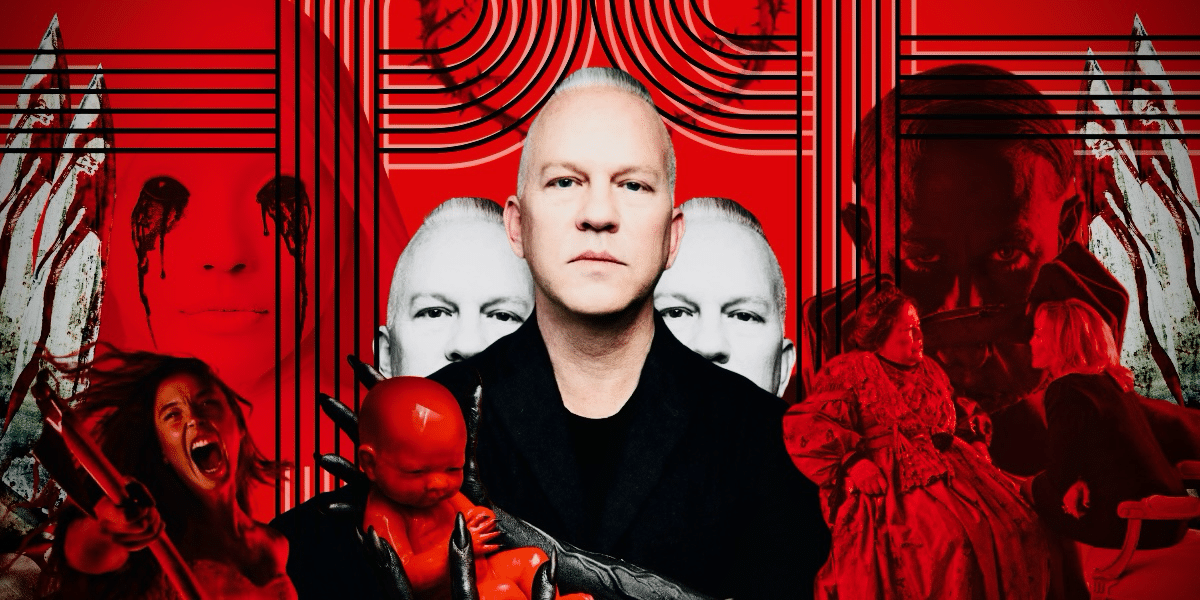
There is a lot of Ryan Murphy chatter in the world right now.
Between Monster: The Lizzie Borden Story and the return of American Horror Story for its 13th season, Ryan Murphy is once again occupying that peculiar place in pop culture where everyone seems to be watching his work while simultaneously announcing that they are exhausted by it. And with Lizzie Borden, one criticism has become particularly loud: That didn’t happen.
Well, yeah.
That’s kinda the point.
There are plenty of legitimate criticisms to make about Ryan Murphy’s work. You don’t have to like every season of American Horror Story. God knows I don’t. You don’t have to enjoy every creative decision in Monster. We can and should have conversations about the ethics of fictionalizing real people, particularly victims of violence whose surviving families have to live with those portrayals.
But somewhere along the way, audiences started demanding documentary standards from a man who has spent more than a decade making theatrical fever dreams out of history, rumor, folklore, sex, violence, camp, and whatever strange cultural artifact happened to catch his attention.
Have we been watching the same Ryan Murphy?
American Horror Story has always operated this way. Reality is the seed, not the finished product. Murphy and his collaborators take real crimes, historical figures, conspiracy theories, urban legends, and cultural anxieties, toss them into a blender, and hit purée.
The result isn’t history. It’s mythology. And Monster isn’t nearly as far removed from that formula as people seem to think.
With Monsters: The Lyle and Erik Menendez Story, Murphy explicitly described the series as taking a “Rashomon approach,” presenting competing perspectives instead of declaring one version of events to be definitive. The term comes from Akira Kurosawa’s classic 1950 film Rashomon, which presents events from multiple, often conflicting, and deeply subjective perspectives. The point isn’t to determine which person is lying. It’s to consider how memory, experience, bias, and perception can produce radically different versions of the same supposed truth.
That’s an important distinction when watching Monster. Murphy isn’t necessarily asking us to accept everything we’re shown as fact. He’s asking us to sit inside different interpretations of events and wrestle with the uncomfortable space between them.
That philosophy becomes especially obvious in “The Hurt Man,” the extraordinary fifth episode in which Erik Menendez recounts the abuse he says he endured. The episode runs for more than 30 minutes in a single uninterrupted shot. No frantic editing. No visual escape hatch. Just Cooper Koch’s face slowly filling the frame as Erik tells his story.
Murphy wasn’t recreating a court transcript. He was using filmmaking to force us to sit with someone’s perspective.
Then came Ed Gein.
There, Monster became even more interested in the mythology surrounding its subject. Gein isn’t culturally significant because America kept reinventing him. Norman Bates. Leatherface. Buffalo Bill. The historical man was swallowed by the monsters we created from him.
Which brings us to Lizzie Borden.
Lizzie may actually be the perfect subject for Murphy’s approach because American culture already turned her into fiction long before Netflix got involved.
She was acquitted.
We do not know who killed Andrew and Abby Borden.
Yet generations of Americans can recite some version of “Lizzie Borden took an axe” as though a children’s rhyme constitutes a verdict. The historical Lizzie Borden and the cultural Lizzie Borden are already two different women.
So when Monster gives us invented relationships, imagined motivations, and Sarah Paulson’s Aileen Wuornos wandering into the narrative decades later, the most interesting question is not, “Did this happen?”
The better question is: Why is Murphy showing it to us?
That’s where I think Lizzie Borden could have made its intentions clearer. I would have introduced Aileen earlier. Let her and her partner read about Lizzie in the first episode, and suddenly we’re forced to wonder whether what we’re watching is actually Lizzie’s story at all. What if this is Lizzie refracted through Aileen’s imagination, with Aileen’s own trauma bleeding into the spaces history left empty?
I would have done something similar with the stories Lizzie and Bridget read. Give us another woman accused of something terrible whose actual guilt has become impossible to separate from folklore. Make the lineage unmistakable: story becomes rumor, rumor becomes legend, legend becomes “fact,” and eventually nobody remembers where one ended and another began.
Would that have worked better? I think so.
Was I in the writers’ room? No.
And even if I were, I doubt Ryan Murphy would have listened to me anyway.
But that brings me to what I find much more interesting about Monster than its historical inaccuracies. Every season asks us who the other monster is. Dahmer, the Menendez brothers, Gein, Borden, Us.
The press. The tabloids. The police. The courts. Hollywood. The spectators gathered outside the courthouse. The people buying newspapers for another gruesome detail. The filmmakers recreating it. The streaming services distributing it. And yes, the millions of us watching from the couch.
We are living through an era of true crime saturation so complete that we’ve forgotten how strange our relationship with real violence is. We devour documentaries, podcasts, reenactments, YouTube investigations, and prestige dramas about murdered people, then argue over which adaptation most faithfully recreated the blood spatter.
We’ve become so accustomed to consuming real horror that fictionalization somehow feels like a greater offense. Maybe that’s why Murphy’s approach makes people so uncomfortable.
Monster takes the machinery of true crime and makes it theatrical enough that we can see the machinery working. Rumor becomes scene. Speculation becomes dialogue. A newspaper story becomes mythology. A murderer becomes an archetype.
And eventually, we have to confront an uncomfortable possibility: Maybe the monster Ryan Murphy is portraying isn’t only the person whose name is in the title. Maybe it’s also the culture that can’t stop looking. Maybe it’s us. And what we do with that truth is still unwritten – which means we should do better.
