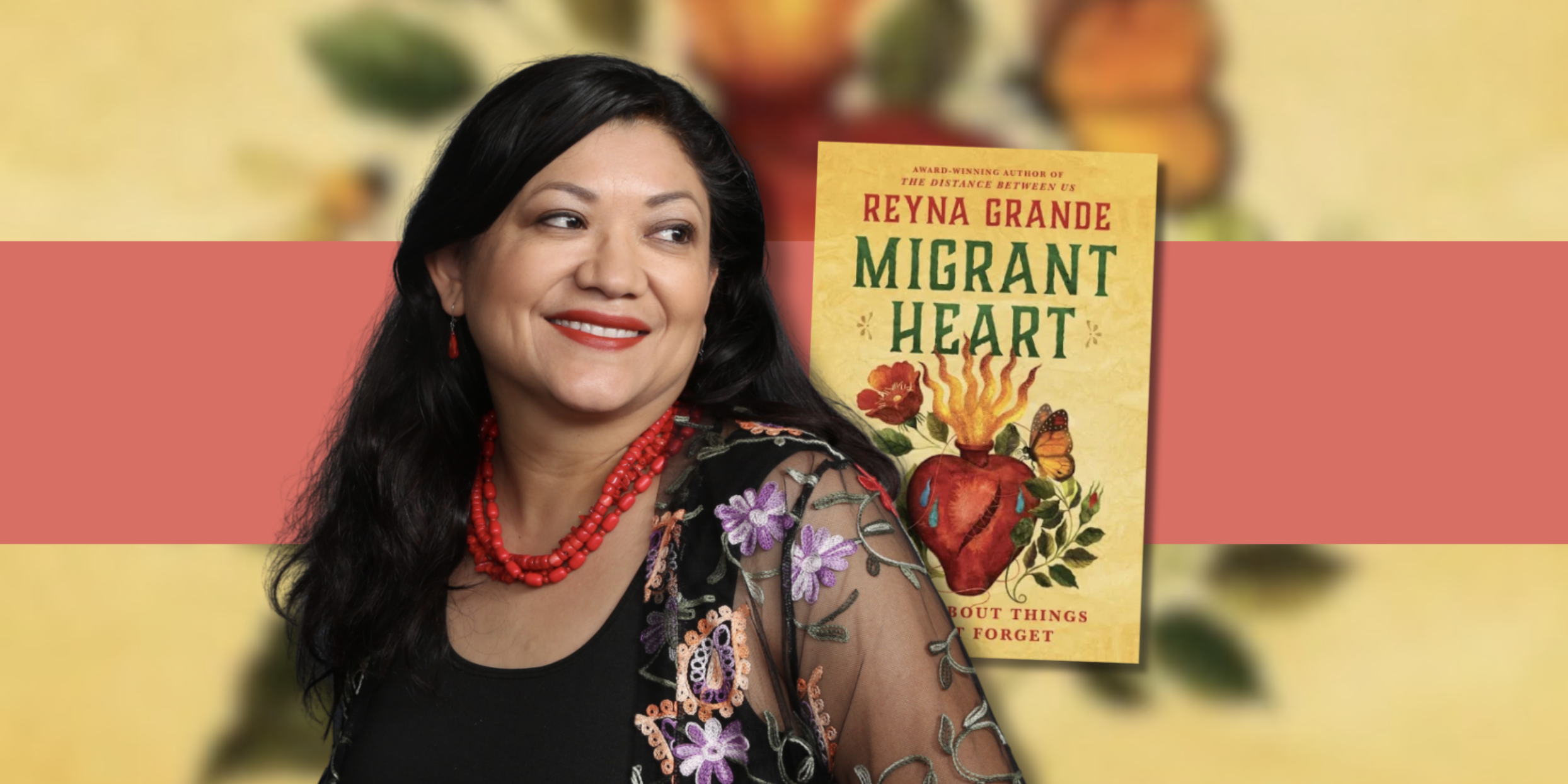
Currently, Mexican American author Reyna Grande is best known for her groundbreaking memoir The Distance Between Us and works of historical fiction, including Across a Hundred Mountains. And she’s just released a debut collection of essays that are sure to grow her reputation. Migrant Heart: Essays About Things I Can’t Forget is a personal, moving, and oft-experimental work of nonfiction.
In it, Reyna Grande explores her childhood, family, migration, foray into motherhood, and writing career throughout the years. Told with almost unbelievable vulnerability and honesty, this new book is undoubtedly a career highlight and demonstration of how far she pushes the boundaries of genre and expectation.
“After I finished my previous book, which was a historical novel, I was thinking about my next project,” Grande told Latina Media Co. “I wanted to come back to writing nonfiction, but didn’t want to write another memoir like my previous two. I wanted to try something different and have been wanting to do essays more because they are not something I’m very comfortable with.”
“There is this constant attempt to erase us from the collective memory [and] I wanted to write about us as a way to push back against that erasure,” she continued. “That has been something that drives me in my work – how can I document our community?”
Thankfully, Grande already had ten or so personal essays that she’d written over the past decade. Often, she’d be asked to contribute a piece to a curated anthology, as was the case with her essay “The Parent Who Stays,” which appeared in The Displaced: Refugee Writers on Refugee Ñives, edited by Viet Thanh Nguyen. Though it ultimately didn’t reappear in Migrant Heart, she was able to revise, update, and polish others, to fill in narrative gaps.
One notable difference eagle-eyed readers might notice between Migrant Heart and other, more traditional collections of essays is Grande’s willingness to experiment, play, and push the boundaries of the form. One essay, “Brown,” stands out for its use of classic playwriting structure and formatting. In it, Grande uses the same typewriter font, centered text, capitalized character names, and dialogue of plays. Her explanation? A need to ignore the rules and honor her narrative instincts.
“That essay happened because I was taking a playwriting class in the school where I teach, and for years, I have been fantasizing about adapting my novel, A Ballad of Love and Glory, into a play. But I was struggling to condense it. At the same time, I wanted to write an essay about colorism, my daughter, and being married to a white guy, and I thought, ‘I’m just gonna write it as a play because that’s where my head is right now,’” she explained. “One advantage for me is that because I’m new to writing essays, I wasn’t too familiar with what the rules are, but that’s a strength because what that means is I’m gonna try anything. Forget the rules, I don’t know them anyway. I’m just gonna have fun.”
She continues experimenting with essays, including “Dictionary of a Father’s Death,” where she mimics dictionary entries by alphabetizing and offering personal definitions to medical terms she found while searching through hundreds of pages of his medical records. Complete with many traditional aspects of a dictionary, even down to the pronunciation sections, the essay is not only stunningly accurate but also an honest depiction of a woman watching her father pass away – told in a way that makes sense to Grande’s language-focused mind.
In “The Storyteller’s Daughter,” Grande explores the impact her writing career – with its constant travel and other commitments – had on her children and family, particularly her daughter. In a stunning and significant move, Grande includes an essay from her daughter that she wrote for school about her mother, reflecting on how much she admires and loves her, despite the challenges her mother’s absence creates for her.
“That sense of being away from home and wondering what I’m missing out on with my children is something that I have to carry wherever I go,” Reyna Grande said. “Two weeks ago, my daughter had her prom, and I was in New York. I helped her with her dress right before I left, and we had a really nice day of doing that project. But there was still that guilt, right? I do carry that around with me.”
Ultimately, Migrant Heart is a collection that asks us to reflect upon our own pasts and learn how to heal. In Grande’s most vulnerable essay, “Spare the Chancla and the Child,” she explores the physical abuse that is still common in many Latine households. She was initially scared to write it, let alone include it in the collection, but has gotten lots of positive responses – proving the importance of doing the things you’re afraid of.
Grande hopes Migrant Heart can be a source of pride and belonging, as well as assurance that no one is alone in their journey toward healing or facing past traumas. As a storyteller, she has made it her responsibility to give us a light in the present and constant darkness.
“I’m keeping a record of our community,” Reyna Grande said. “In times like these, I feel that we need these stories, but in a way that uplifts us, inspires us, and gives us hope. At times, we are in survival mode. But despite that, we can find ways, where we can continue to thrive.”
