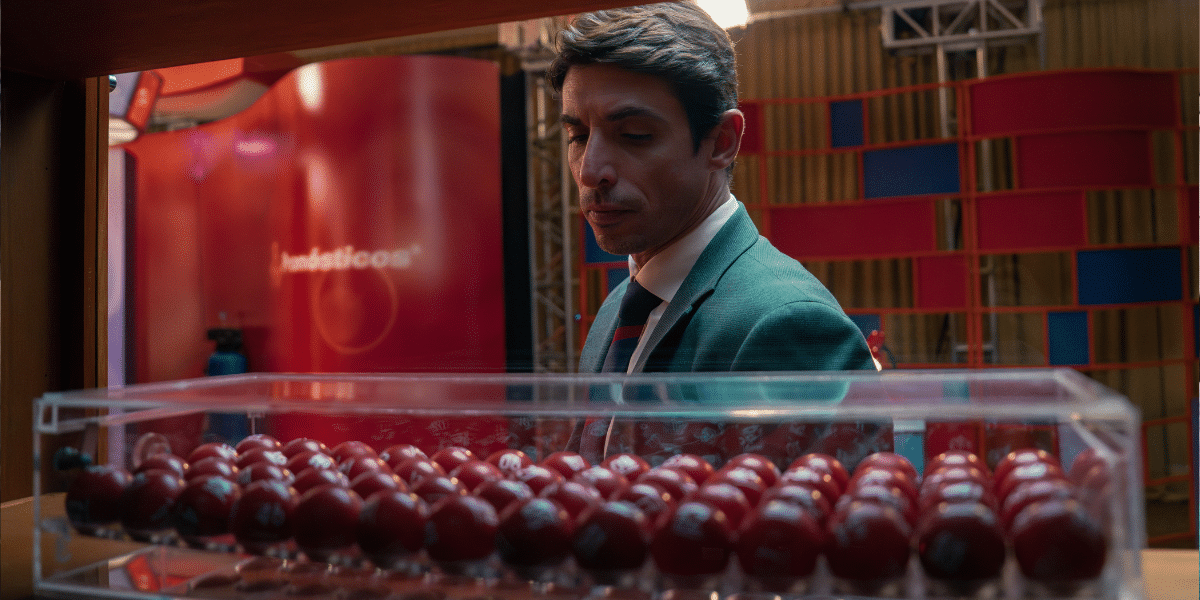
On the night of January 22, 2012, Mexico witnessed the most unusual scam in the history of its national lottery. A group of MeLate lottery operators, with privileged access to the lottery’s facilities and procedures, rigged the 2518th draw, broadcast on national television. With their scheme, now the subject of Netflix’s Me Late Que Sí miniseries, they misappropriated a prize of 160 million pesos (approximately $8 million) before millions of viewers’ eyes.
How did they do it? The fraudsters created and played a montage to simulate the draw, deceiving the authorities and the public. Although ingenious, their plan wasn’t successful for long. Thanks to the authorities’ prompt intervention, the masterminds never got to enjoy the fruits of their labor.
Co-produced by Sony Pictures Television Latin America and Dynamo (Narcos, One Hundred Years of Solitude), and under the skilled direction of Rodrigo Santos (Chespirito: Sin Querer Queriendo) y el uruguayo Federico Veiroj (Así Habló el Cambista), the series explores the mechanics of the fraud and its consequences on the National Lottery and the lives of those involved. In 2022, this peculiar story received its first Hollywood treatment with Corazonada: La Leyenda del Mexican Dream. Now with this second production, it’s confirmed – the MeLate scandal is a made-for-the-screen story.
“Me Late Que Sí connects with the audience because, at some point, we’ve all imagined what we would do if we won the lottery and how that dream could change everything,” executive producer Andrés Calderón told Produ.
What Is Me Late Que Sí About?
Set in late 2011 and early 2012, Netflix’s new Mexican series straddles reality and fiction. It tells the story of José Luis Conejera (played intelligently and entertainingly by Alberto Guerra), a disillusioned civil servant at the MeLate Lottery. He may have once dreamed of a career in motor racing, but now he’s in increasingly desperate financial circumstances.
Tired of his boss’s abuses of power and wanting to secure his teenage daughter’s future, José Luis decides to risk everything on one last card: stealing “La Gallina de los Huevos de Oro,” aka the lottery’s jackpot.
Early in the season, José Luis meets with a clever magician, who brilliantly sums up what we’re doing here: “For a trick to work, all you need to do is make people see what you want them to see, and only what you want them to see.” Inspired by the illusion of magic and the magic of television, our protagonist begins to devise his fraud.
Furiously obsessed with his goal, José Luis assembles a peculiar team. There’s the young lottery television presenter Lina (Majo Vargas), who’s fighting hard to get her son back. Charly (Luis Alberti), a former alcoholic turned religious, who’s in charge of safeguarding the lottery balls. And, last but not least, brothers Gilberto (Aldo Escalante) and Mario Velasco (Jero Medina), responsible for the audiovisual production of the segment.
Although none of these characters have much depth in the miniseries, Me Late Que Sí emphasizes their ordinariness. As Santos explained to Produ, “Unlike heist movies with extraordinary specialists, here they are ordinary, even mediocre people. Their ‘talent’ is that they were there.”
Beyond the tragicomedy, Me Late Que Sí is a classic heist story and, as such, focuses on the fraud’s complex engineering and the chaotic adventures along the way, including researching the target, coordinating the team, rigging the lottery, and suffering the inevitable consequences. In a successful gamble, directors Santos and Veiroj opt for a slow pace, keeping the plot at a simmer.
As in many crime stories, Me Late Que Sí makes a broader point, exploring the nature of luck, the dark side of sudden wealth, and the consequences of greed. It also has a lot to say about systemic failures, corporate corruption, and the dominant classes’ abuses of power.
So, Should I Watch It?
Me Late Que Sí doesn’t get everything right, but it is undoubtedly a bittersweet, carefully crafted work worth watching. Yes, everything happens as you would expect and in a precise manner. However, there’s enough irony, intrigue, cruelty, and laughter to keep you hooked.
By reflecting on the biggest theft in Mexican lottery history, Me Late Que Sí fosters collective memory and critiques Mexico’s economic inequality.
