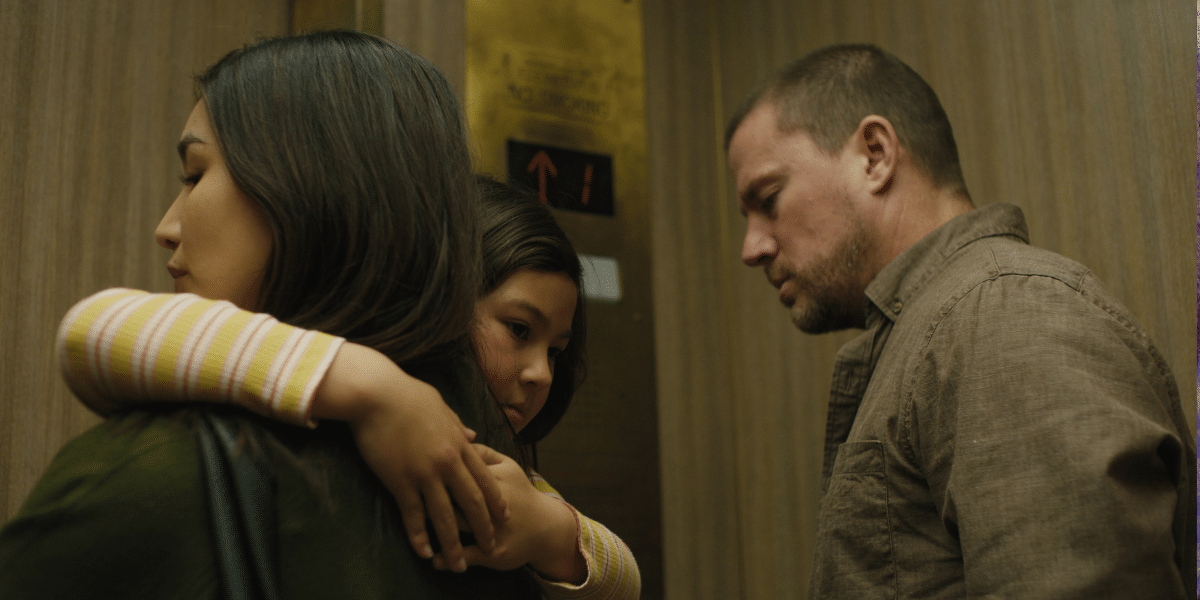
I may be too close to Josephine. The Grand Jury Prize Winner for U.S. Dramatic Competition at the 2026 Sundance Film Festival follows the titular eight-year-old heroine after she witnesses a sexual assault in Golden Gate Park. She’s portrayed by Mason Reeves, who gives an emotionally raw and stunning performance. Her parents, played by Channing Tatum and Gemma Chan, do what they can to help her process the trauma, including encouraging her to testify in the hopes the rapist will go to jail after the victim declines to participate.
That’s a lot. And maybe it’s more for me, as a mom of a similarly aged daughter who’s spent a lot of my career working to end gender-based violence. The characters’ mixed-race family also reflects dynamics I see in mine, although writer/director Beth de Araújo is drawing on her specific cultural upbringing as the daughter of a Chinese-American mom and Brazilian dad.
Nonetheless, the film was so close to me that I didn’t just cry once or twice while watching it. There were points when I was sobbing so hard I was shaking. It might have been embarrassing, but the whole Park City theater was similarly moved, the film having earned every tear. And I obviously don’t know their relationships to the film’s subject, so maybe my closeness wasn’t the issue.
I generally avoid films and shows about gender-based violence. I find they tend to get it so wrong as to be useless, if not counterproductive. The revenge fantasy (whether it’s victim JLo training to kill her abuser in Enough or a throw-away plot point like in Netflix’s The Abandons) is both overdone and so far from the actual experience of sexual assault as to put it on another planet. And that’s just one issue among many. Too often shows dip into sensationalism, making a spectacle (which is particularly egregious when it’s of the sexy variety) of something that is nothing of the sort. Too often, the emphasis is on the crime and not the fallout.
All of which makes it harder for real victims to be understood. And then, when those victims are women of color – who are more likely to be sexualized and less likely to find help in the justice system – well, the problem of our myth-making around abuse, it’s just that much worse.
Josephine, on the other hand, exposes the devastating dynamics of this particular act of violence. That’s clearly in part because writer/director de Araújo is building upon her experience. As she detailed for The Moth before creating this film, she was just eight when something very similar happened to her.
And the heartbreaking truth at the center of this film is what makes it reverberate off the screen, following me long after leaving the theater. I saw a lot of films at Sundance. Four alone on the day I saw Josephine. I don’t think I can remember a distinct line from any of them, but I can recall several from this film.
There was the early scene when Tatum’s character Damien is trying to assure his daughter that nothing like what she saw will ever happen to her or her mother. Chan’s Claire responds with “You can’t say that to her.” The pain bounces between them, even as Damien loudly insists that he can.
The film ends with Josephine out jogging with her dad again, the activity they were doing when she saw the crime. This time, they’re on the beach instead of the park. Josephine gets ahead again, but slows this time when her dad asks. And while he originally insisted that his daughter and wife will always be safe, now he admits, “I’m scared.” I’m ready to cry again just thinking about it.
Because the thing about rape is that it’s frighteningly common. According to national data, one in five women will experience an attempted or completed sexual assault in their lifetime. And the problem is both personal and systemic. The case of bad men doing bad things and consistently getting away with it.
De Araújo doesn’t show the verdict in the criminal trial, but she does make clear that even if found guilty, this man will face less than a decade in jail. In the Q&A after my screening, the director explained why she made this choice – the man she helped convict was released when she was in high school. Her whole childhood, she lived with the limits of our justice system – and that’s a best-case scenario. Experts estimate only 2% of rapists are convicted.
Instead, the resolution is really when the victim meets Josephine in the courthouse and thanks her. It’s so raw and poignant and true. This little girl had to do what an adult woman couldn’t. The weight of an impossible, cruel world upon her little body.
Because in the film, Josephine has to learn so much to understand the terrible thing she saw. Her parents have to explain sex to her – consensual and non-consensual sex. They have to help her understand that, while yes, there are bad men out there, not all men are evil like that. They have to help her process her risk and her identity and the whole culture that props up gender-based violence.
It’s too much. Too much for a little girl. But honestly, too much for all of us. Our systems don’t care about violence against women. In the case of interpersonal violence – and to be clear, rapist who don’t know their targets like the one in this film are less than a third of these crimes and the easiest to prosecute – all we really have is each other, our immediate circles.
You have to hope your support system will be up to the task. But none of us really are. Plenty of the films I saw at Sundance were about imperfect parents trying to do their best for their kids. But the hard truth is that parents’ best can’t keep their kids safe. Not in this unjust world we’ve built.
It’s a devastating fact to face as a mother. But with Josephine, de Araújo makes us look. She artfully portrays the way violence ripples across our communities. She gives us the pain and the heartbreak of it.
I wouldn’t say Josephine ends on a note of hope. This film is too smart for that. But de Araújo does show us something real – that people survive. That surviving violence doesn’t have to be “all that you’re about,” as Claire tells her daughter. And that message, with all its intense, painful beauty, is what Hollywood nearly always misses, even as actual survivors say it again and again. It’s enough to make you weep.
