Look, I love a good space epic. Give me imperial clones, galaxy-sized existential dread, and a centuries-spanning prophecy, and I’ll happily clear my schedule. So when Foundation Season 3 finally dropped on Apple TV+, I fired up the rewatch machine and dove back into the vast, cerebral, and gorgeously rendered world built by David S. Goyer, Josh Friedman, and the ghost of Isaac Asimov.
But here’s the thing: while the show is undeniably stunning, smart, and a genuine feat of science fiction worldbuilding, it’s also… exhausting. Foundation demands your attention, your patience, and – honestly – your willingness to take notes like you’re prepping for a dissertation defense.
Previously on Psychohistory…
Let’s rewind. In case you’ve forgotten (and honestly, who could blame you with these massive gaps between seasons), Foundation chronicles the fall of a 12,000-year-old Galactic Empire ruled by a trio of clones – Brother Day, Brother Dusk, and Brother Dawn – all copied from Cleon I like Apple updates with varying levels of glitches.
The math genius at the heart of it all is Hari Seldon (played with weary gravitas by Jared Harris), whose science of “psychohistory” predicts the collapse of society. He proposes a plan to preserve human knowledge through the Foundation. His protégé Gaal Dornick (Lou Llobell), a former heretic from the planet Synnax, ends up at the center of this mess, when she’s not busy in cryo-sleep, of course.
Add in mysterious humanoid robot Lady Demerzel, political betrayal, time jumps, clones in existential crisis, and now The Mule, a Mentalic warlord with terrifying power, and you’ve got a sci-fi stew that’s both rich and heavy.
Season 3: The (Very Slow) End Is Nigh
Season 3 opens with real momentum – finally. After the galaxy-sized slow burn of Season 2, I was ready to be flung headfirst into the End Times. And to be fair, we kind of are: Gaal sees the future (again), and surprise! The universe is going to implode in four months.
Except… four episodes in, only a couple of days have passed.
Now, I get it. This is prestige sci-fi. Big themes, long arcs, multiple timelines. But the show’s pacing still manages to frustrate, especially since so much of Season 3 hinges on a clock that’s supposedly ticking. We’re watching multiple storylines unfold – from splintering the Cleonic dynasty to desperate maneuvering of the Foundation’s new leaders – and it’s all good, but also glacial.
Clones, Chaos, and Consequences
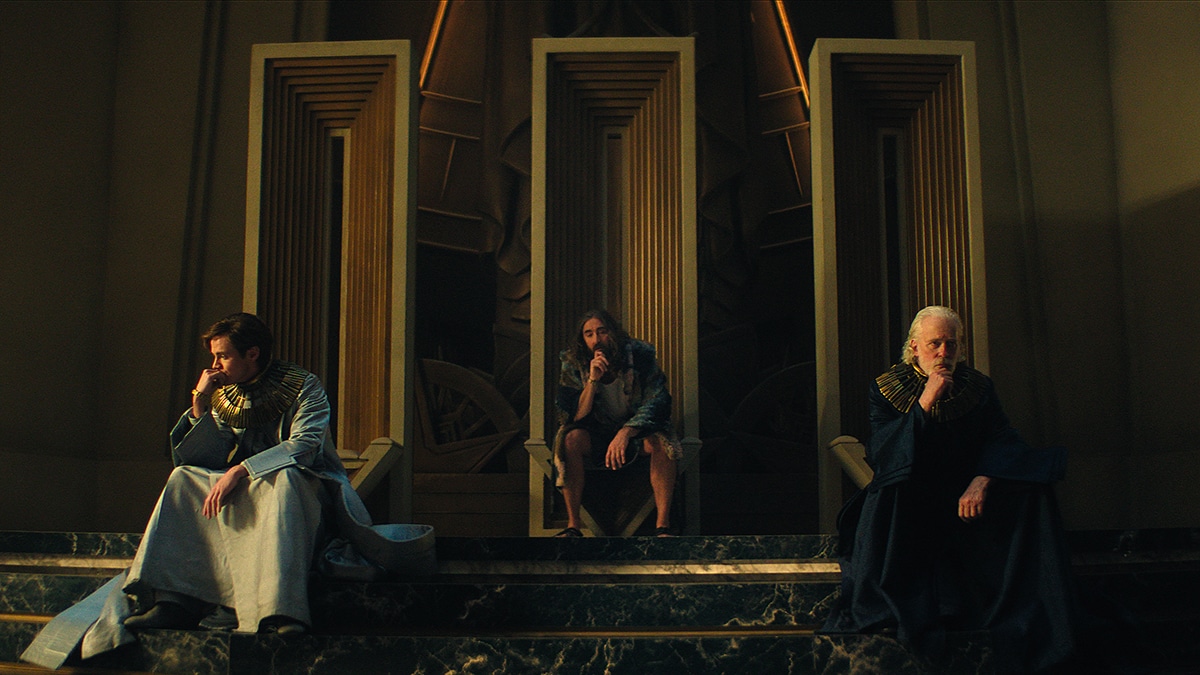
One of the most fascinating arcs this season is the unraveling of the Empire’s genetic dynasty. Brother Day (Lee Pace, in peak space-daddy mode), Brother Dusk (Terrence Mann), and Brother Dawn (Cassian Bilton) are done with tradition. Like, “maybe we shouldn’t clone ourselves anymore” levels of done. Each one is spiraling in their own way, grasping at meaning, love, or just survival in the face of the collapse they were engineered to outlast.
Watching Lee Pace trade confidence for desperation is a gift. His Brother Day is terrifying and magnetic, even as you can see the cracks forming. And shoutout to Demerzel (Laura Birn), the AI puppet master whose loyalty to the Cleons feels increasingly tenuous. There’s something brewing under that metallic surface, and it’s going to blow.
New Faces, New Fates
Season 3 also introduces some intriguing new players. Cherry Jones joins as Foundation Ambassador Quent, bringing the kind of steel-spined gravitas that instantly ups the stakes. Brandon P. Bell’s Han Pritcher is doing covert work with sharp efficiency, while Alexander Siddig’s return as Dr. Ebling Mis adds some deliciously layered fanboy energy to the psychohistory plotline.
But let’s not bury the lede: Pilou Asbæk’s The Mule is here, and he’s not messing around. As a Mentalic bent on domination, he’s a force of nature. It’s early days yet, but if the show sticks the landing, he could become one of the most iconic sci-fi villains of the decade.
The Beauty and the Burnout
Visually, Foundation remains unmatched. Every frame looks like a luxury perfume ad set on a Dyson Sphere. The VFX budget is clearly working overtime. And yet, there’s a hollowness at times, like the show is so preoccupied with looking brilliant, it forgets to move.
It’s not just the pacing – it’s also the weight of everything. Watching Foundation sometimes feels like homework, but the kind of homework you choose to do because you want to feel smart at brunch.
Final Thoughts: Worth the Wait? Kinda.
Is Foundation Season 3 worth watching? Absolutely, especially if you’ve already invested in the first two seasons. It’s ambitious, gorgeously made, and increasingly layered. But it also risks alienating even its most loyal viewers by dragging out a four-month galactic countdown over what will likely be another eight-episode season.
I’m not saying I want it all to end. I just want it to move along. Because with all the cryo-sleep, time dilation, and philosophical debates, it’s easy to forget that this show is, at its core, about urgency. The universe is ending. Let’s act like it.
