There are certain movies I’m immediately drawn to, almost against my will. Every time a film promises a new way to think about love, death, or the afterlife, I lean in. Eternity does that in the trailer, but yet, like many films that hit a little too close to home, it sat on my watchlist longer than I expected. Maybe because I knew it wouldn’t be light. Or maybe because I knew it would be.
Directed by David Freyne and co-written with Pat Cunnane, Eternity is a fantasy romantic comedy that disguises an emotional gut punch as a whimsical thought experiment. Premiering at the Toronto International Film Festival and released theatrically by A24, the film received positive reviews, and rightly so. But what makes Eternity special isn’t just its originality. It’s the way it sneaks serious, uncomfortable questions into a story that looks, at first glance, like a charming afterlife rom-com.
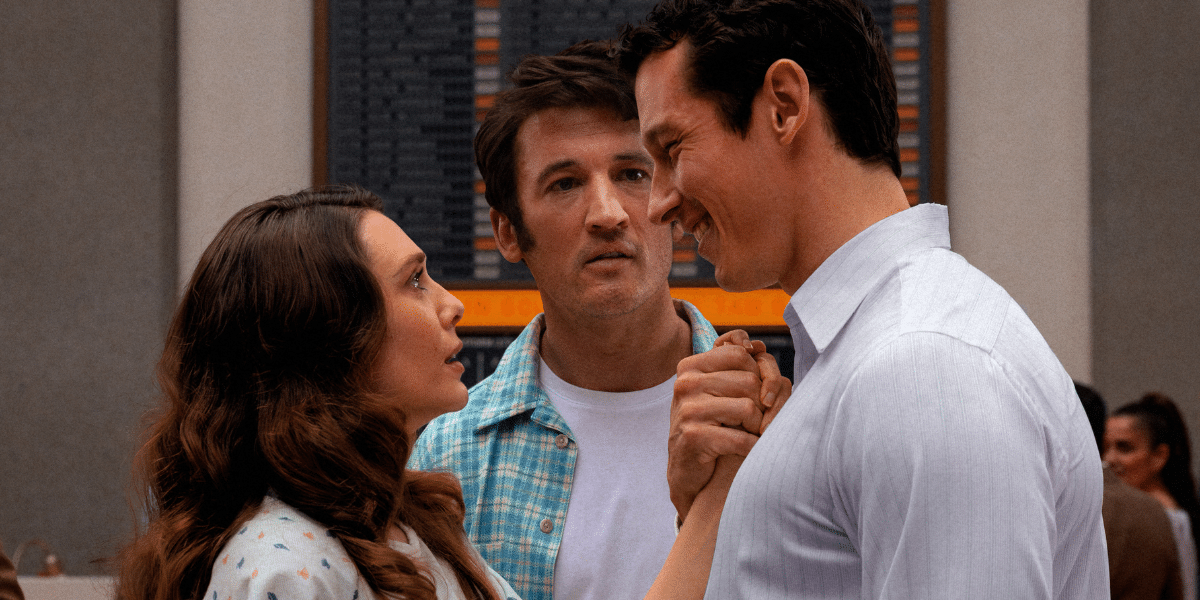
The premise is simple and impossible at the same time. Joan, played by Elizabeth Olsen, dies and arrives in the afterlife, where she’s told she must choose which man she will spend eternity with. One is Larry, her second husband, portrayed by Miles Teller, the man she built a long, complicated, ordinary life with. The other is Luke, her first husband, played by Callum Turner, who died young in the Korean War and has been waiting for her for 67 years.
It’s enough to send anyone into an existential spiral.
The Afterlife, Reimagined as Administration
In Eternity, the afterlife is not a reward. It is not a soft cloud or a harp or a reunion staged for comfort. It is infrastructure. Trains arrive and depart. There are junctions and coordinators and rules printed neatly enough to suggest order where none truly exists. Eternity, here, is bureaucratic. It demands decisions. And once you make them, you cannot undo them.
Choose wrong and you are not punished with fire. You are punished with absence – “The Void” waits quietly, infinite and dark, less a threat than a consequence. It is what happens when choice collapses under its own weight.
Joan is granted a mercy that feels almost cruel in its generosity: she is allowed to try two eternities before committing to one. One with Luke, whose love is preserved in amber – young, untested, interrupted before disappointment could set in. The other with Larry, whose commitment survived the slow erosion of time – the illnesses, arguments, boredom, tenderness, resentment, and laughter, the grinding intimacy of a life fully shared.
The film is careful not to treat these relationships as interchangeable. It refuses the lie that all love is the same, just wearing different clothes. These are not two men competing for Joan. They are two histories asking her to decide which version of herself should last forever.
Chemistry Is Not the Answer (And That’s the Point)
One of Eternity’s quiet achievements is its understanding that chemistry alone is not a moral argument. It is difficult for an actor to convincingly love one person on screen. Asking them to love two, in completely different emotional registers, borders on impossible. And yet Elizabeth Olsen does it with a restraint that feels almost reverent.
Her Joan is not dramatic. She is overwhelmed in the way people are when there are no good options left. Her voice is soft. Her confusion lives behind her eyes. There is a mid-century elegance to her performance – measured, contained, never pleading for sympathy. She’s a woman who has already lived several lives and is now being asked to decide which one will be her forever.
One is a dream that never had to grow up. The other is a life that did. Eternity understands something rare: love does not weaken because it changes. It changes because survival demands it.
Memory, Choice, and the Violence of Nostalgia
The Archives are the film’s most devastating invention. Within each Eternity exists a place where souls can replay their memories. Luke returns, consuming the past as if repetition might turn it into permanence. Larry refuses to enter at all.
That refusal is not indifference. It is wisdom.
The film draws a careful distinction between remembering and living. Nostalgia, it suggests, is seductive precisely because it edits reality. It removes the fights. The disappointments. The compromises. It keeps only the sweetness and calls that truth.
Joan’s struggle is not about choosing the “better” man. It is about choosing which life reflects who she actually became, rather than who she once was or who she hoped she might have been if loss had not intervened.
Watching This as a Widow Is Not Neutral
I cannot pretend I watched this film from a distance.
I lost my husband when he was 25. Our marriage lasted only two years, but it was intense in ways that compress time. It was passionate. It was destructive. By the end, it was violent. And yet I cannot lie – when he died, my world shattered. I was not broken in ways I am still learning how to name.
For years afterward, I lived inside imagined futures. Fantasies of the life we might have had if death had not intervened. If love had not curdled under the weight of pain. Memory is not honest, but it is powerful.
I am now engaged, older, living a life shaped not by fantasy but by reality. The love I share today is not cinematic. It does not sweep me off my feet. It is practical. It is negotiated. It is full of arguments about vacations, misplaced socks, and why the forks keep disappearing. And I know how unromantic that sounds.
But this is the question Eternity dares to ask without flinching: Which love is greater? The love that exists only as sweetness, preserved because it never had to survive? Or the love that chooses you every day, even after the illusions fall away?
What Eternity Ultimately Understands
Eternity does not offer comfort. It offers clarity.
It suggests that forever is not about grand gestures or moral accounting. It is not about who loved you most purely or longest or hardest. It is about who knows you as you are now, not as you were when the world was smaller and hope was easier.
By the time Joan makes her final choice, the film has quietly dismantled the idea that love is proven through sacrifice alone. Sometimes love is proven through staying. Through letting go. Through choosing reality over fantasy, even when fantasy is beautiful.
This is a film that understands grief as an ongoing negotiation rather than a wound that closes. It knows that love and loss do not cancel each other out. They coexist. They shape one another.
If you have wondered who you might have been in a life that never came to pass, Eternity will not let you look away. It will sit with you. And it will ask you to choose.
