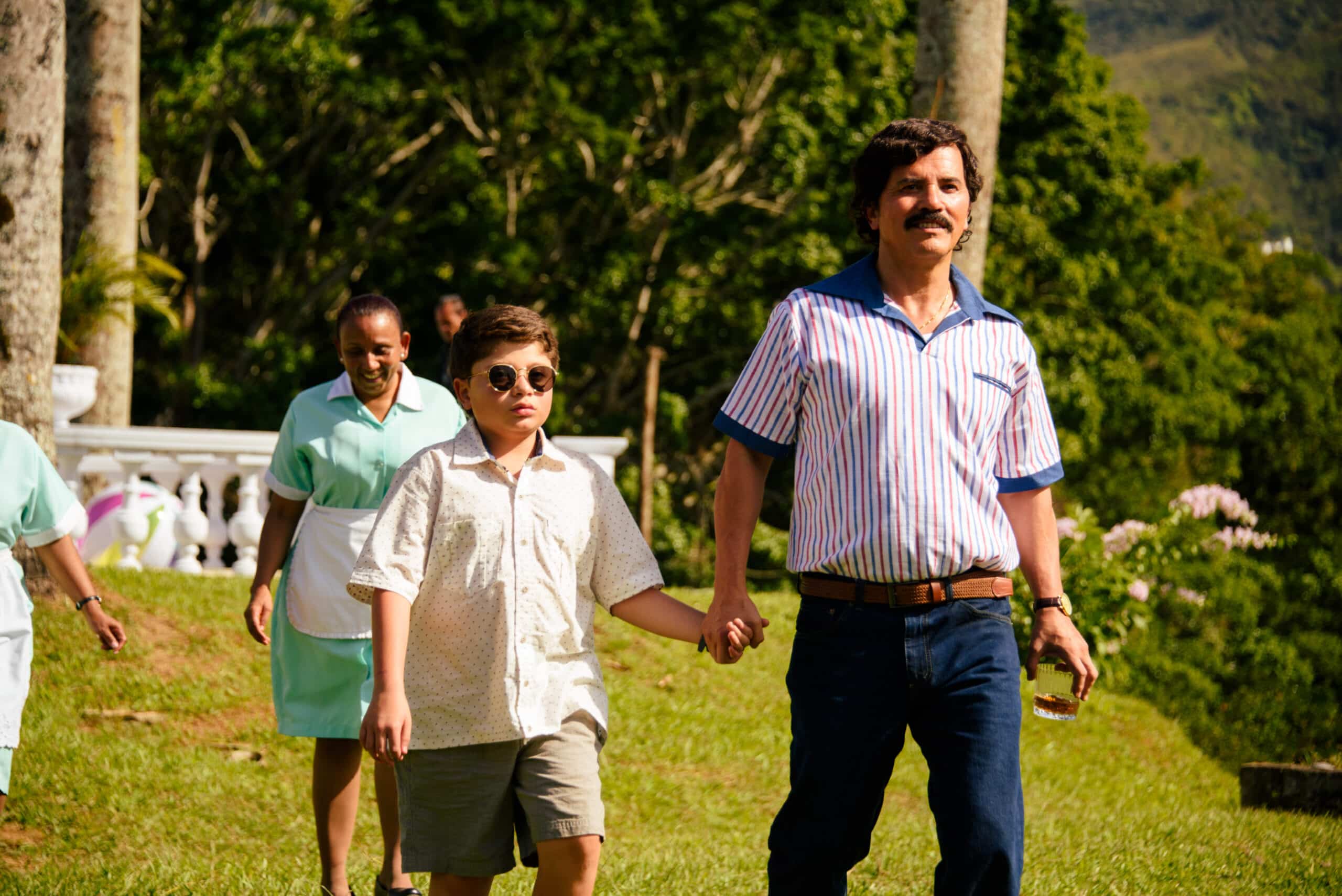
I’m going to say something mildly controversial, but hear me out: some shows should not be made. Some shows, even if they do get made, should never see the light of day. The perfect example? Shows (and movies, and making-of documentaries) about narcos. I know, I know they’re popular, and that’s why we have so many of them — we crave the drama, as long as it’s on our screens and not in our real lives. That’s why Hulu’s Dear Killer Nannies exists in a bit of a gray area for many, but I still stand by my opening statement.
Dear Killer Nannies follows Juan Pablo “Juanpi” Escobar, yes, the son of that famous drug lord, played here by John Leguizamo. We see his childhood and young adulthood living in his father’s hacienda, his relationship with his father, his “nannies,” and his eventual awakening to the realities of his father’s work and what it means for the rest of the family.
The show also follows the group of sicarios closest to Escobar Jr., the ones who serve as his caretakers: Kiss, Rodri, Angie, Lagaña, Dorado, and Tina, whom he considered his “friends and life teachers.” We witness these characters’ internal struggle, their pain, their glory. Dear Killer Nannies presents sicarios as human and flawed…
But I’m sorry (I’m not, actually), I refuse to feel bad for them. I refuse to see them as anything other than monsters. I can’t. And while we’re on the topic of things I’m not sorry about, I don’t want to hear the story of the child of one of Latin America’s biggest drug dealers and how he felt his father was a loving, doting, albeit scary at times, father. Juanpi might’ve been an innocent, but unlike others, he was afforded the luxury of protection and hiding when things inevitably got heated. Most other victims and their kids (many of whom I knew personally) were not afforded those luxuries. I can agree that as a kid, he was a victim, but at some point, he made his choice.
And let’s be honest, Dear Killer Nannies got made and reached the Top 10 in many Latin American countries because it follows Pablo Escobar’s son.
Look, I may not be Colombian, and I was just a baby when Pablo Escobar was killed, but I still live with the consequences of people like Escobar and his hitmen using my country as a playground and battleground. Mexico is filled with innocents, victims of the likes of Pablo Escobar and his sicarios, whose stories go untold, whose legacies were terminated early and unfairly, and whose names have been forgotten. While Dear Killer Nannies (very briefly) mentions the victims of cartel violence in Colombia, a message at the end of an episode isn’t enough.
My issue with narco shows is they inevitably glorify these men. Much to my chagrin, I found myself rooting for Rodri and Angie to find happiness and I felt sad when one of them was killed. The shows are written this way – so you empathize with people who don’t deserve it. Because real sicarios kill for a living, profiting off of keeping people sick and addicted, and causing one of Latin America’s most violent reigns of narcoterror ever.
We don’t need another show that allows the general public to romanticize drug violence while rooting for the budding romance of two drug hitmen, all while trying to find morally gray areas as some sort of entertainment. I’m over it. For many of us, violence like this isn’t the stuff of movies and shows. It’s daily life. Our childhoods, young adulthoods, and even our current day-to-day lives are still affected by people like Juanpi’s “nannies.”
If the media we allow into our homes directly impacts the way we behave, how we think, and what we believe, why are we allowing these stores to exist on our screens (and our bookshelves!)? Why are we tuning in to see ourselves portrayed as the worst of us? Narratives that reinforce the idea that Latinxs are dangerous, just like the current administration says?
We deserve better.
Some stories are better left untold. People like Pablo Escobar (and Griselda Blanco, Armando Carrillo, Teresa Mendoza, and the many others who get flashy biopics and bioseries inspired by their lives) should not be action heroes or even cautionary tales. They should be forgotten. Removed from pop culture and relegated to being historic characters of a dark time in our past, one we should be ashamed of.
