Bad Bunny proved Latino culture didn’t have to translate itself to succeed. Benny Blanco coming out with Hermoso and radio’s first bilingual Latino AI reveal what happens when the industry copies the signifiers but misses the source of their power.
For much of Hollywood history, Latinos faced a brutal bargain: Visibility comes with conditions.
You could enter the room if your name sounded less Spanish. You could become a star if your accent disappeared, your skin remained within the industry’s acceptable range, and your ethnicity could be presented as an intriguing detail rather than a political fact.
Now the incentives are shifting.
Latino audiences represent approximately one-fifth of the United States. According to the Latino Donor Collaborative, we drive between 28 and 35 percent of the domestic box office, spend 55.8 percent of our television time streaming, and collectively represent $2.8 trillion in consumer spending.
Suddenly, everybody wants a slice of the pie.
The problem is that the industry is trying to eat it all without learning who baked it.
Bad Bunny Didn’t Cross Over. The Audience Crossed to Him.
Bad Bunny became one of the world’s most powerful entertainers without sanding down his Puerto Ricanness for Anglo consumption. He kept his Spanish, Puerto Rican slang, and confrontations with colonialism, displacement, and the sale of Puerto Rico to wealthy outsiders.
With Debí Tirar Más Fotos, he moved even deeper into Puerto Rican musical history. The album draws from plena, salsa, and música jíbara while addressing gentrification and cultural erasure. As Bad Bunny told Time, he’d found “the sound that represents me.”
His historic 2026 Grammy win – the first Album of the Year awarded to a Spanish-language album – confirmed that the old crossover bargain was no longer the only route to stardom in the U.S.
But executives seem to have taken the wrong lesson.
The lesson isn’t simply that Spanish sells or that a reggaetón beat can unlock a demographic. Bad Bunny’s power comes from refusing to treat Anglo America as “the man” whose permission must be won.
Enter Mr. Selena Gomez
Benny Blanco is one of the industry’s most successful producers and songwriters. He’s also, for at least one paragraph of this article, Mr. Selena Gomez.
Hermoso – Spanish for “handsome” – is his first entirely Spanish-language album. The project includes Netón Vega, Selena Gomez, Becky G, BB Trickz, The Marías, Mora, Ovy on the Drums, and Myke Towers.
Collaboration across languages and cultures isn’t automatically appropriation. Blanco says he grew up around Latino people and music. He also connected the album to his Mexican American wife’s love of Latin music and condemned the government’s treatment of immigrants in an interview with El País.
Those facts complicate the easy accusation, but they don’t make the questions disappear. Why this album? Why this aesthetic? Why now?
Blanco’s got proximity Latinidad – access to the aesthetics and economic value of our identity through neighbors, collaborators, or a spouse, without inheriting its social consequences.
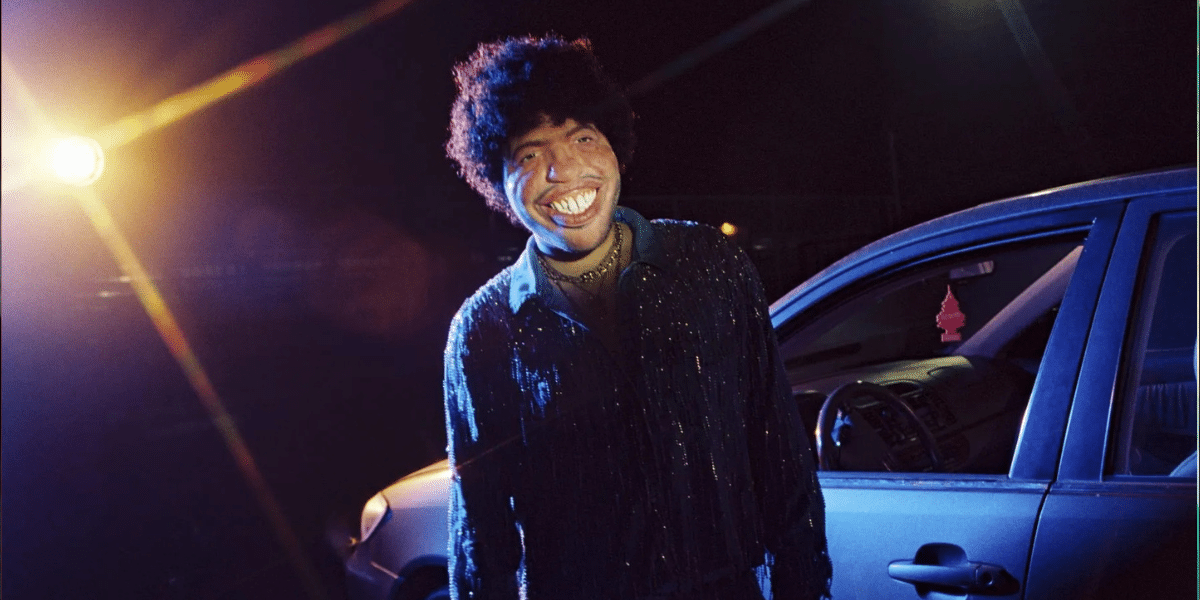
The Hermoso promotional image makes that tension difficult to ignore. Blanco appears with an oversized dark hairstyle and radically exaggerated teeth and facial features. The joke is that this distorted version of Benny Blanco is hermoso.
But images don’t arrive without history. In an entertainment culture shaped by blackface, minstrelsy, and racial caricature, that visual comes uncomfortably close to transforming Black and brown features into spectacle.
Now We Have a Latino Who Doesn’t Exist
The same market logic is clear with Coyotec, the industry’s first Spanish-language and bilingual AI radio personality.
Created by Entravision in collaboration with Mutante, their show GeeGee & Coyotec pairs the AI with veteran broadcaster Geraldine “GeeGee” Guzman. After launching in Los Angeles, the act is expanding across five new markets on Entravision’s Fuego Network.
The rollout confirms that Coyotec isn’t just an experiment. He’s a scalable media product — a Latino identity detached from a Latino person.
Coyotec has no childhood, migration story, racialization, or memories of being told when Spanish was acceptable. His creators can optimize his Latinidad, tailoring it to advertisers without a Latino host demanding a raise, retaining ownership, or challenging management.
The fact that he’s bilingual makes the experiment even more revealing. Bilingualism is often treated as a problem when it belongs to a Latino worker – an accent to soften, a language to hide, or extra labor to provide without extra compensation. In Coyotec, it’s a marketable feature.
The Consequences of Marrying Whiteness and Latinidad
For a long time, proximity to whiteness could provide Latinos access to institutional power. The unspoken question was: How close can you get?
But commodified Latinidad goes in the opposite direction: How close can whiteness – whether owned by a person, corporation, or algorithm — get to Latinidad without inheriting its consequences?
That’s the tension connecting Benny Blanco, Coyotec, and the industry’s response to Bad Bunny.
Media scholar Laura Michelle Fernández shows how malleability makes Latinx identity easily consumable for a presumed white audience, particularly when white-presenting characters can move safely back into whiteness. Actual Latinos don’t always have that flexibility.
A performer can activate Spanish for an album cycle. A brand can deploy cultura in an advertising pitch. Marketers can assign an AI personality a Latino identity without experiencing what that identity costs when it isn’t fashionable. Meanwhile, Latinos with accents, darker skin, working-class backgrounds, or complicated immigration histories have to navigate systemic oppression.
So yeah, “appropriation” alone is too small a frame. Appropriation asks who’s allowed to use a culture. Commodified Latinidad asks who gets to profit and what happens when impostors take up all the space.
Nielsen’s 2025 Diverse Intelligence report emphasizes that Latinos are curators and trendsetters, not a monolithic audience passively receiving whatever has been translated for us. Yet Nielsen also found that less than 1 percent of digital advertising spending by U.S. online retailers went to Spanish-language websites during the first quarter of 2025, even as Latino audiences over-indexed in streaming consumption.
The money follows Latino attention more readily than it follows Latino ownership, employment, or decision-making power. That’s the plot.
If Hollywood wants the loyalty behind our spending figures, it should stop treating Latino culture as a downloadable feature. It should invest in the people who make the culture, hire us behind the camera and the microphone, give us ownership, and allow us to remain the complicated, regional, political, and specific individuals we are.
Because the final question isn’t who can sing in Spanish, wear the clothes, or generate the voice.
It’s, who remains Latino when Latinidad stops being profitable? And how do we build from there?
