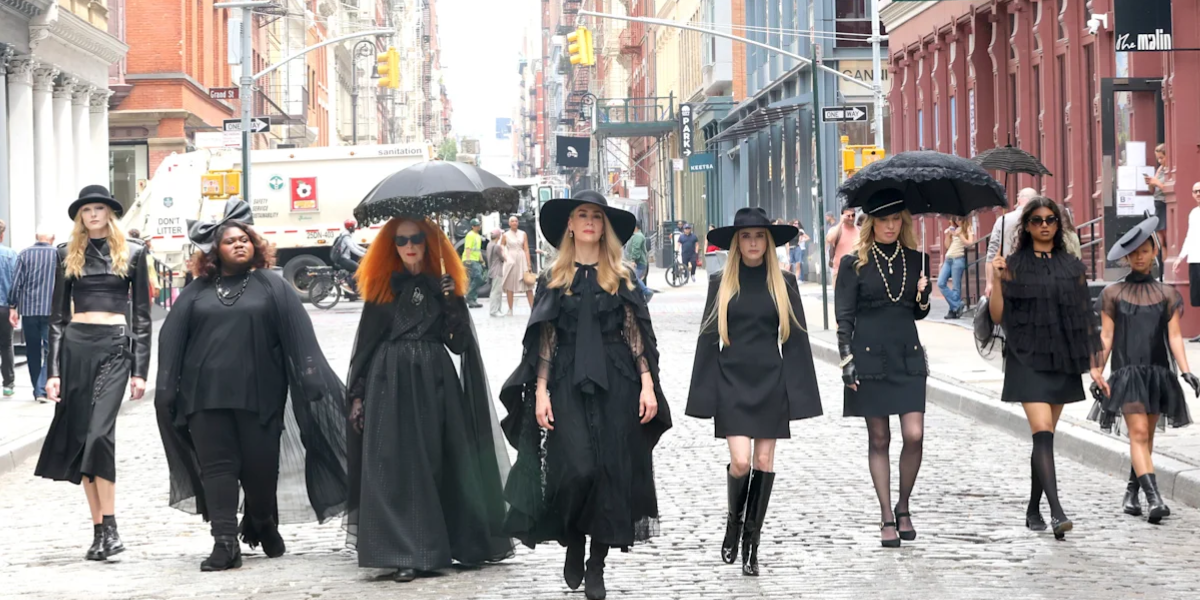
Once upon a time, back when surfing through TV channels was still a thing, I would switch between shows like Lizzie McGuire, Floricienta, That’s So Raven, and Aventuras en el Tiempo, wishing I could wear what the girls on my screen were wearing. Even from a young age, I knew that clothes and what I wore mattered to me – and that my body was very different from the actresses’ on my favorite shows. Fast forward to the present and things have not really changed that much. Yeah, sure, we do not have fat characters on TV, but their clothes try to hide them, make them smaller, visually and emotionally. As an adult who loves (and can afford!) fashion, and who literally went to school to understand and learn more about it, I feel the same way I did as a child watching TV: I don’t feel seen. This feeling is only exacerbated by what I wat today. And yes, I’m talking American Horror Story, the most recent season, and the fan-favorite third season, Coven.
In AHS: Coven, fashion is a silent main character along with Cordelia, Fiona, Delphine, Marie, and Madison. The iconic witchy look quickly became synonymous with 2013 fashion: flowy dresses, transparent fabric, wide-brim hats, oversized glasses, Peter Pan collars, skater skirts… The looks are almost, if not more important, than the characters themselves, even earning the show a feature on Vogue. However, not all characters are treated (read: dressed) equally. The show notoriously dresses Queenie (the show’s only fat character, played by Gabourey Sidibe) in more conservative, boring, and less trendy ways than her co-stars.
However iconic the styling generally, American Horror Story failed with Queenie. Her plain looks aren’t sacked by the writing or Sidibe’s personal style. Despite constant ridicule for her body and weight, she always carries herself with confidence, never showing signs of defeat or shame. Yet she wears shapeless, oversized T-shirts, leggings, and cold-shoulder tops – all clothes that no confident, proud, and powerful fat woman (or witch!) would wear. It’s heartbreaking to see that 13 years later, nothing has changed. In season 13, Queenie wears a cape, skinny jeans, and the same type of oversized tee we saw her in dozens of times. Over a decade later, the disrespect of fat characters on TV continues.
And no, it’s not just Queenie in American Horror Story. It’s most fat characters. Fat Barbie in the Barbie movie? Covered up, unlike all the slim Barbies around her. Younique and Mercedes in Glee? Wearing more “modest” versions of the stage costumes Santana, Quinn, or Rachel are wearing, despite being notorious, attention-loving divas. Kate Pearson in This Is Us? Dana Sue in Sweet Magnolias? Melissa McCarthy’s Ursula in The Little Mermaid? Covered up. Hiding their bodies. Making them visually smaller. Hell, even Shrill, a show who’s main purpose is to shed light on cultural fatphobia, opts for a styling that hides Annie’s curves over one that would accentuate her body.
The excuse seems to always be the same tired “the styling choices make sense for the character”, but that is precisely the problem (although, also no. Nobody can tell me Ursula the sea witch would ever be caught dead in a “modest” dress). Writing fat characters into contemporary movies and shows is not enough, not if the writers continue to write them as anything other than well-rounded people who enjoy dressing up as much as their slim counterparts. And not if costume designers don’t learn to dress fat bodies in ways that don’t immediately imply shame and try to visually minimize the character.
It’s funny – not funny “haha”, but funny “weird” – how it’s always the bigger women who are written and styled to look like slobs, who don’t care about their appearance or are ashamed in their body. More often than not, fat characters are dressed in a way that does not accurately represent the way modern fat women dress and express themselves in real life, opting instead for depicting them (us!) in this puritanical way where larger bodies need not be seen too much.
These styling choices and stereotypes still plague Hollywood – in writing rooms, costume departments, directors’ chairs. We allow these limited portrayals into our homes and thus solidify the incorrect belief that fat people – usually fat women – need to hide their bodies behind hideous prints, dress in boring all-black (no hate to all-black dressers, I’m criticizing the boring version here), or be completely unaware of trends.
We can’t pretend that there isn’t a historic connection between Hollywood and the way people dress. Before social media, before magazines, before fashion week, it was Hollywood that dictated the latest styles. The industries have had a symbiotic relationship for decades, if not longer. Even now, we look to actresses and the best-known Hollywood costume designers to tell us how to dress. We can’t pretend that what we see in movies doesn’t shape the way we think, act, or speak… So why are we not alarmed when, in the year 2026, larger women are still relegated to the roles that force them to shrink and hide?
In order to adequately represent the fat women that exist in real life, Hollywood needs to address its fatphobic bias. Currently, most fat characters are still a fill-in or token, or, even worse, comedic relief – basically, not as well-rounded (pun fully intended) humans that, yes, enjoy dressing up and taking up space, among other things.
Clothes are a representation of ourselves, our personality, and our spirit, communicating first to the world who we are. So why do we still allow Hollywood to depict us as anything other than well-adjusted, proud members of society? Hollywood styling (and writing!) is fatphobic and needs to stop.
