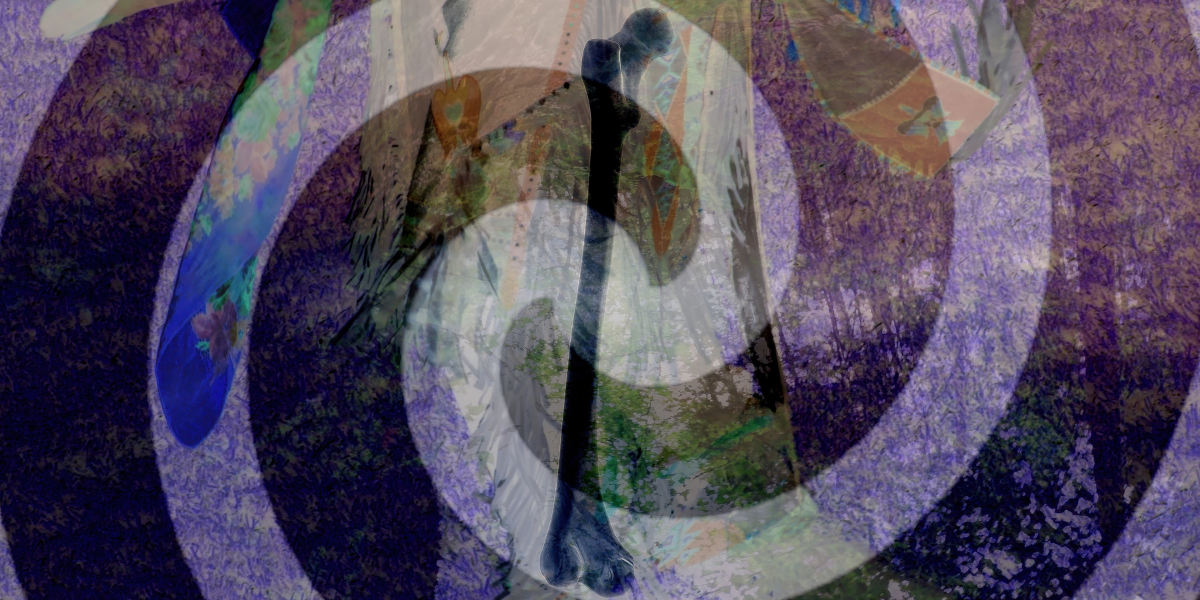
There’s a shot in Aanikoobijigan [ancestor/great-grandparent/great-grandchild] of a bumper sticker that reads, “Archeology is not a crime.” I’ve seen those stickers in New Mexico and never understood what they were about, until now. They’re trying to defend grave robbing.
Watching the genre-bending and prize-winning Sundance documentary Aanikoobijigan, I kept returning to one disturbing question – what, the fuck, is wrong with these people who want to keep pilfhuman remains squirreled away in boxes in archives? It’s repulsive, right? Or “perverse,” as film director Adam Khalil told me in a pre-premiere interview at Sundance.
I sat down with him and his fellow director, Zack Khalil, to talk about this urgently needed and innovative film. Because Aanikoobijigan is not your typical documentary.
The brothers are “trying to reappropriate contemporary cinematic and doc formulas to make them our own,” as Adam said. For example, the film portrays the members of Michigan Anishinaabek Cultural Preservation and Repatriation Alliance (MACPRA) as actual heroes, shot from below so they look larger than life.
Zack notes that the brothers are purposeful in creating “portraiture,” so their perspective as filmmakers is clearly visible. “We’re hyper aware of the ways in which settler colonial cinematic conventions have been used as a weapon to dispossess Indigenous people of our lands and cultures and bodies. And so we try to think really critically about how to approach filmmaking from an Anishinaabe perspective. Part of that is this level of transparency,” he explains. They’re “showing the seams… [so the audience is] really feeling the construction of the image.”
As one of the film subjects says, “there’s no such thing as objective.”
Zack and Adam know and show how science’s supposed objectivity has oppressed Indigenous people. In the film, they trace how the justifications for keeping Native human remains have shifted through time – from “proving” eugenics / a biological racial hierarchy to working to disprove tribes’ claim as the original people on the land – but one way or another, that “science” is about supporting a racist viewpoint and not advancing the common good.
Because when you think about it, it’s a “human rights issue” to disrespect the dead. Aanikoobijigan also takes pains to explain that while that’s while simple human decency demands not stealing or hoarding human remains, the crime is worse when it’s committed against the Anishinaabe people.
“Why burial is so important to Anishinaabe people is that throughout our lives, it’s this final act of reciprocity. Throughout our lives, we take from Mother Earth in so many different ways. In our final act of passing away and moving on into this other state, we return ourselves to the earth, and we return everything that we took back to the earth,” explains Zack. So burying the dead is this culmination of their “ethos of sustainability reciprocity, which is very empirical and material.”
When people say Indigenous communities are the real stewards of the land, that their ways reject capitalistic extraction and instead honor harmony, this is what they mean.
Too many institutions that should know better are standing in the way, keeping the Ancestors hostage and so negating Indigenous people’s humanity and disrespecting their worldview. They do all of these mental gymnastics to justify their heinous choice, and that’s the case despite the 1990 Native American Graves Protection and Repatriation law requiring museums, universities, and other groups to return human remains to the descendants who want them.
But the Harvards of the world are requiring tribes to prove their specific ties to each ancestor, which is almost impossible to do. Or it was, until the Tribes joined together in MACPRA so they could petition together and jump the institution’s supposedly “objective” and “scientific” hurdle.
In setting up this juxtaposition, Aanikoobijigan exposes as fraudulent the historical scientific documents of the West. The Khalil brothers give us montages of diagrams of racialized faces meant to “prove” inferiority, clearly showing the flaws in all this science.
In contrast, they also give us artistic typefaces and treatments of Native words and concepts, allowing the viewer to escape science altogether and revel in their particular subjectivity.
The brothers don’t stop there – they subvert the very communication methods of science documentaries to make their point. So when they talk about their community’s “spiralic sense of time,” they show this “engineering style diagram… like you read in a science textbook.” It cloaks the Anishinaabe perspective in the legitimizing language of academia. This tactic provides “an opening for people to really understand in a deeper way, our perspective,” as Zack says. “And that will help, we hope, more ancestors come home expediently and never be disturbed again in the future.”
Because, as he says, their mission is to “educate the next generation of archeologists and museum professionals and anthropologists to understand, not just intellectually, but emotionally and on all these other levels, the importance of repatriation, the importance of respect for the ancestors.”
It’s a noble cause, artistically rendered. But what’s perhaps more impressive is Zack’s favorite line in the film, spoken by one of the MACPRA members, “It doesn’t have to be me versus you. You can be us.” He’s describing the changing dynamics that lead to successful repatriation. “What we’re really surprised to find throughout making the film is that when these institutions finally started to turn the corner, it was often and almost always the work of a handful of individuals within the institutions who decided to really change how the institution responded to these requests,” Zack explained. “It’s so hard to imagine these sides, who seem diametrically opposed, actually being able to find common ground and work together. But [that] really is the story of repatriation. The ancestors are bringing us together in some ways.”
“You can be us.” It doesn’t erase the differences between groups. But it does invite us to work together to a shared understanding of the common good. One that respects our common humanity. And would get us far from the perverse act of stealing human bones and pretending it’s for science.
Consider it a mantra to live by.
