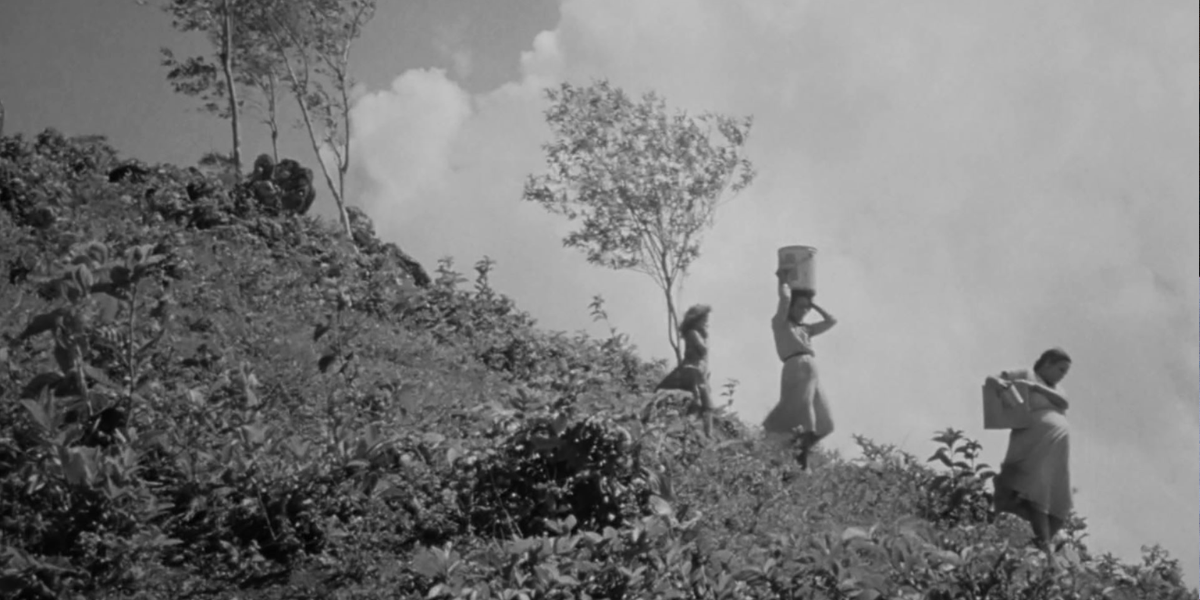
Watching Todo Parecía Posible (Everything Was Possible) is like taking a stroll down memory lane with my abuela. As black and white images flash across the screen, I recall the strong, fiercely proud jibara, the matriarch of our family, toiling in her small farm during my childhood visits to Borinquen Bella. And that’s where Puerto Rican filmmaker Ramón Rivera Moret’s documentary hits hardest – capturing the struggles, dreams, and contradictions of a people caught in a colonial trap – via exploring examples of early Puerto Rican cinema.
Conceived as a mediation across memory, the project weaves archival footage from a body of films produced by Puerto Rico’s Division of Community Education (DIVEDCO) in rural communities from the late 1940s to the early 1960s. This mountain region was plagued by poverty and illiteracy, so DIVEDCO used cinema and graphic arts to empower vulnerable families to become active participants in improving their lives. Despite the difficulties of those years, it was also a time of sweeping economic, industrial, and ideological transformation led by Puerto Rico’s first democratically elected governor, Luis Muñoz Marín. Rather than a straight-up political critique, Todo Parecía Posible invites viewers to reflect on the era’s utopian vision for Puerto Rico’s future.
A few things stand out for me as I process the distressing and defiant scenes before me. The first is a ubiquitous shot – a man standing on a hilltop blowing into a large caracola marina (conch shell). Back in those days, there was no Instagram or Facebook feed, which meant words traveled differently. The conch was a call to a community gathering. Every time I see this sequence in one of the scenes, I feel an ancestral whisper, knowing that our Indigenous Taino used the conch as a form of long-distance communication to call to ceremonies and alert to danger.
Todo Parecía Posible also reminds just how resourceful Boricuas are. It’s something I’ve seen in my mother, tías, and other family members. Nearly five years of living en la colonia, I’ve also learned this about myself, like when I had to walk half a mile under the sweltering Caribbean sun with two empty, gallon-sized bottles to get water in the recent severe agua shortage. I did that for four days straight. It’s the “solo el pueblo salva al pueblo” (only the people save the people) mindset. No waiting on the government. Here, in Borinquen, we make shit happen. Period. The end.
This mindset is evident in the short educational docudrama, El Puente (The Bridge, 1951), featured in Todo Parecía Posible. When the skies open and a nearby river swells, fear in the young teacher’s face is palpable. Imagining many might try to cross the river to get home, she desperately tries to keep her students in the classroom.
Based on a true story of a little boy who almost drowned in the central mountainous region of Orocovis, the film shows frantic mothers and other adults yelling at the children on the other side to stay on the land. Refusing to heed, at least three children jump in and soon find themselves struggling against the swelling river. After that big scare, the community gathers to discuss a solution. Eventually, they construct a bridge, safeguarding their children’s trip to and from school. An impactful scene shows women, men, and older children carrying plows and other instruments as they begin the huge task ahead.
Another snippet tackles the colonial patriarchal and feminist resistance. In the short, Modesta (1955), a mother and housewife (the movie’s namesake) defies her machista husband by founding the League of Liberated Women and organizing a community strike with other women in the barrio to demand equal rights. As a staunch feminista, I particularly enjoyed the Modesta part of the documentary.
With a collaborative soundtrack created by iLe (of former Calle 13 fame) and Ismael Cancel, Todo Parecía Posible is a journey through memory and identity, nostalgic for a Puerto Rico where collective effort reigned over individuality. Over half a century has passed since those films were made. Still, many of us continue to fiercely work toward Rivera Moret’s “desire to transform the country.” Even if we never turn the archipelago into a utopia, I’m here to help us get a bit closer.

Todo Parecía Possible is screening in Miami’s Third Horizon Film Festival, Saturday August 1. Watch for more screenings on the film’s website.
