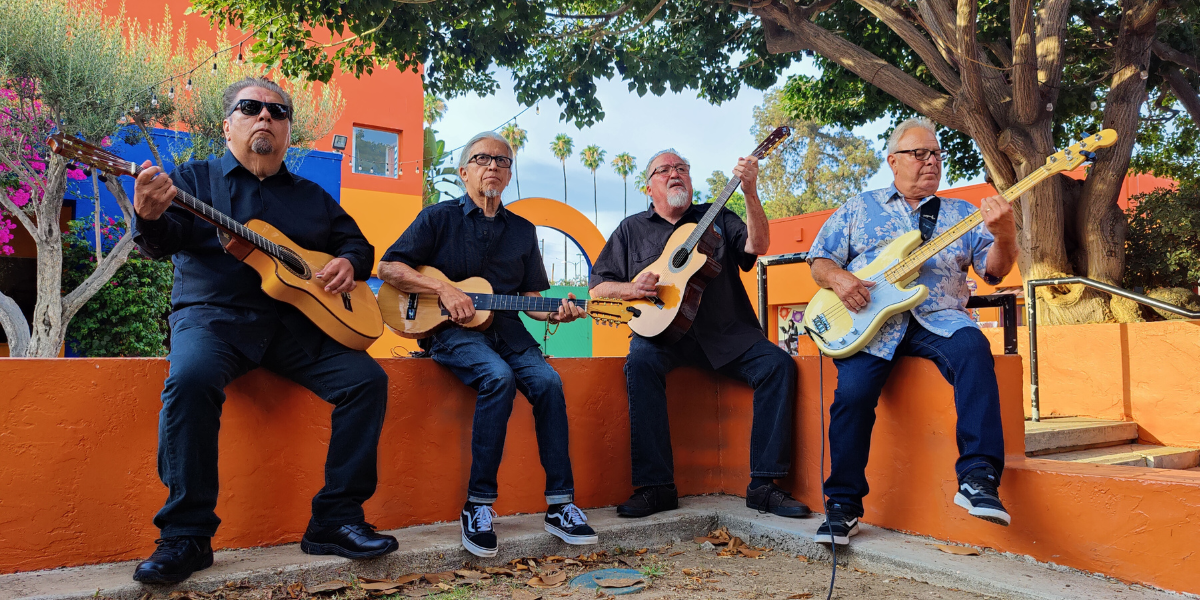
Having premiered at SXSW, Los Lobos: Native Sons brings the band’s enduring history to the screen. The band from East LA is perhaps best known for contributing to the La Bamba soundtrack, but there’s so much more to their story than that. The documentary shows us what they had to navigate to become one of the most prolific bands in the country.
As the band’s official photographer, Piero F. Giunti asked the guys what it would take to share their story, and they told him to put a team together. So Giunti reached out to Robert Corsini, one of the film’s producers, who put him in contact with Doug Blush.
When Giunti vetted Blush to determine if he was a legit fan, Blush shared a story from his college radio days. He was working a late-night shift when a bright and beautiful vinyl caught his eye. It was Los Lobos’ debut, How Will the Wolf Survive?, and Blush played “Lil’ King of Everything” and the title track and became a lifelong fan.
“When he told me that, I was like, ‘You’re the guy. You’re perfect,’” Giunti said at the film premiere. For his part, Blush was excited to bring this band’s story to the screen as a co-director and producer. “This story has inspired both of us through our whole lives,” said Blush.
Los Lobos’ story is one of hard work and perseverance, starting with their humble beginnings of playing weddings, quinceañeras, and backyard BBQs. From there, they began producing songs for movie soundtracks for acclaimed Latino films, such as La Bamba and El Mariachi, which led them to winning Grammys and touring the world. They most recently won The Grulke Prize for Legacy Artist at this year’s SXSW festival.
The underlying thread throughout their music is their Chicano roots. In the documentary, they share that they felt an obligation to spread their culture and use their music to take a political stance. They sing about immigration and the border. They supported the Chicano movement and were the backing band for the 1977 album, Sí Se Puede!, which was released to support the United Farm Workers.
Co-directors Blush and Giunti mostly tell their story through archival footage and talking head interviews featuring some renowned friends they’ve made along the way, including Dolores Huerta, John Doe, and Linda Ronstadt. A lot of the photos they use are from the band’s personal collection, which was amazing for Giunti to go through. Guitarist and percussionist Louie Pérez handed him 15 boxes of photos, while guitarist and vocalist Cesar Rosas gave him 250 contact sheets of photos he’d shot through the years.
When I asked Perez what the secret is to keeping a band together for over 50 years, his response was simply friendship (besides the mortgage payment, he joked). He met three of his bandmates in high school, and they were friends before forming the trailblazing Latino band in 1973.
“There’s a thing about being brothers that kind of keeps you together,” Perez said. “If you took away the music, which you never would, if you took away the band, which you never would either, you’ll still have these four guys that grew up together.”
Certainly, what makes this film so endearing to watch is the band members’ brotherhood. Their friendship is so evident as they crack jokes and poke fun at each other while sharing their experiences.
Another highlight of Los Lobos: Native Sons is learning how they came to produce the pioneering La Bamba soundtrack. The title track’s music video was the first time many of us heard a song sung in Spanish on mainstream TV.
The most surprising thing to learn is that instead of riding La Bamba’s success, Los Lobos went back to their roots instead. They didn’t want to become a cover band (although they usually play “La Bamba” at their shows). So they followed the soundtrack with La Pistola y el Corazón, which features original and traditional Mexican songs. Even though the move was considered “commercial suicide,” the album won a Grammy Award for Best Mexican American Album.
U.S. Congressman Joaquin Castro was 13 years old when La Bamba came out and remembers seeing the music video play on heavy rotation on MTV and VH1. In recent years, Castro has led an initiative to include more Latino films in the Library of Congress’s National Film Registry. Thanks in part to his leadership, La Bamba was added to the registry in 2017.
“It’s a reminder that across generations, Mexican Americans, Latinos have had an incredible impact, incredible talent, (and) incredible potential to serve this country,” Castro said at the SXSW premiere. “And so thank you, Los Lobos. Thank you all so much for inspiring so many generations of listeners. Thank you for your activism and being part of the movement for justice in this country, and thank you for continuing to inspire so many across the world.”

Los Lobos: Native Sons screens on July 26 and July 29 at The Woods Hole Film Festival in Woods Hole, Massachusetts, August 1 at the Oak Cliff Film Festival in Dallas, Texas, and on September 27 at the Port Townsend Film Festival in Port Townsend, Washington. Los Lobos is currently on The Brotherhood Tour with Los Lonely Boys.
