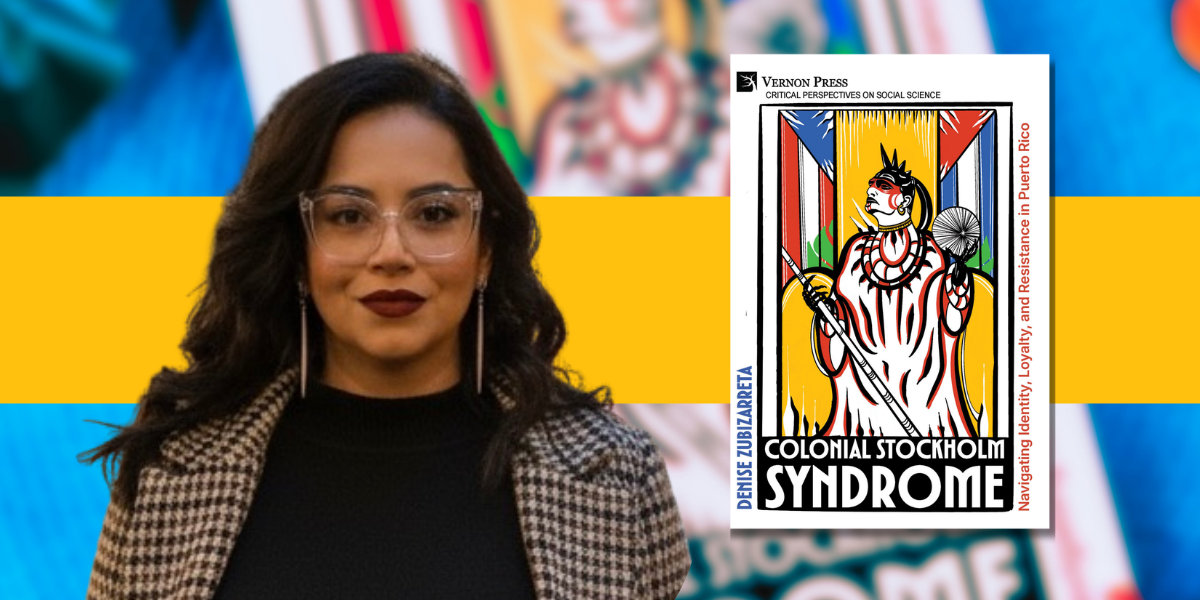
Some ideas arrive all at once. Others stalk you for years. My new book, Colonial Stockholm Syndrome: Navigating Identity, Loyalty, and Resistance in Puerto Rico, began as a question that refused to leave me alone: Why do colonized people sometimes defend the very systems that harm them?
As a Puerto Rican and Cuban scholar, artist, veteran, and communicator, I have encountered that question over and over again. I have seen it in political debates, in conversations about statehood, independence, and status, in media narratives, and, if I am being honest, in myself and in people I love.
Puerto Rico occupies a unique and often misunderstood place in the modern world. It remains one of the oldest colonies on Earth, shaped by more than four centuries of Spanish rule before becoming the United States’ possession in 1898. For generations, Puerto Ricans have had to navigate relationships with distant powers that shaped our economy, politics, language, education, and sense of self.
That is not only a political condition. It is a psychological one.
That realization became the foundation for what I call Colonial Stockholm Syndrome or CSS.
The concept draws from the well-known idea of Stockholm Syndrome, but it is not a neat copy-and-paste framework. CSS describes the survival-based attachment that can emerge between colonized populations and colonial systems. It examines how generations living under colonial rule may develop complicated loyalties, emotional dependencies, and identity negotiations that make resistance difficult even when injustice is obvious.
For some readers, the title may feel provocative. Good. It’s meant to.
But the book is not an accusation directed at Puerto Ricans. I’m not claiming that people are weak, irrational, or incapable of independent thought. Quite the opposite. CSS came from my attempt to understand how human beings adapt to unequal power structures when those structures become normalized across generations.
When I began researching this project, I quickly realized the conversation extended far beyond Puerto Rico. Across the Caribbean, Africa, Asia, the Pacific, and Indigenous communities, people continue to wrestle with the afterlives and ongoing realities of colonial power. Flags may change. Administrations may change. The psychology of domination often lingers.
This book combines history, critical theory, political analysis, and personal reflection because understanding Puerto Rico requires all of them. Statistics alone cannot explain colonialism. Neither can emotion. The challenge is learning how to hold the data and the ache at the same time.
Writing this book was deeply personal. I have spent much of my life thinking about displacement, identity, and power. As an artist, I am drawn to symbols and memory. As a scholar, I am drawn to systems and structures. This project became the place where those parts of myself finally sat at the same table.
I am especially proud that the cover features my own artwork. The image reflects many of the themes explored throughout the book: resilience, resistance, memory, and the complicated relationship between colonial histories and national identity. Seeing my research and visual art come together is a full-circle moment, with a little glitter in the wound.
Colonialism is not sustained by force alone. It also relies on stories. It relies on institutions. It relies on repetition. It tells people who they are, what they should want, what they should fear, and who they should thank for survival. Over time, those narratives can become so deeply embedded that questioning them feels dangerous.
That danger is part of the design.
Puerto Rico makes this painfully clear because the island’s political status remains unresolved. Puerto Ricans are U.S. citizens, yet those living on the island cannot vote for president. Federal laws shape daily life despite those in the archipelago not having full political representation. Debates over statehood, independence, and free association remain emotional because they are not just legal questions. They are identity questions.
Discussions of statehood are difficult for me. If someone told you their spouse beat them regularly, controlled their finances, dictated the terms of their existence, experimented on them without consent, and repeatedly demonstrated that their well-being was secondary to someone else’s interests, most people would recognize that as an unhealthy relationship. Yet when Puerto Rico raises questions about colonialism, exploitation, or political inequality, one of the most common responses is, “Well then, maybe you should become a state.”
To me, that logic has always felt strange. It is the equivalent of hearing someone describe domestic abuse and responding, “Have you considered marrying your abuser?”
Before anyone rushes to the comments, I am not suggesting the relationship between Puerto Rico and the United States is literally identical to interpersonal domestic violence. I am saying that both involve power. Both involve dependency. Both involve narratives that teach people to normalize conditions they might otherwise reject. And yet, here we are.
As Colonial Stockholm Syndrome enters the world, Puerto Rico is once again confronting the vulnerabilities that have defined life on the island for generations. More than 40,000 people are without water. Many also remain without reliable power. Families are again being forced to manage daily life with infrastructure failures while questions about accountability hover over the island like a storm cloud that never quite leaves.
Colonialism matters now. It’s not safely in the past, tucked away in history books between sepia maps and dead empires. Puerto Rico refutes that myth.
The relationship between Puerto Rico and the United States has grown increasingly contentious in recent years. Disaster recovery, privatization, infrastructure collapse, economic dependency, political status, and self-determination are not abstract policy topics. They are lived realities. They show up in empty faucets, dark homes, closed schools, medical instability, and families forced to decide whether staying is still possible.
That tension is central to Colonial Stockholm Syndrome.
I am deeply grateful to Vernon Press for believing in this project and helping bring it into the world. Academic publishing can sometimes feel sealed behind velvet ropes, but from the beginning, I wanted this book to be useful beyond the walls of higher education. I wrote it for scholars and students, yes, but also for community organizers, journalists, artists, and everyday readers trying to understand Puerto Rico’s colonial condition without being handed another flattened explanation.
When people ask why I wrote this book, the answer is simple: because Puerto Rico is still living this story. The conversation is not over. In many ways, it has never been more urgent.
With this book, I’m asking: How do colonial conditions shape what becomes thinkable, desirable, frightening, or even imaginable?
That question matters because colonialism does not just occupy land. It occupies imagination.

Colonial Stockholm Syndrome: Navigating Identity, Loyalty, and Resistance in Puerto Rico is available now through Vernon Press and can also be purchased through Amazon and Barnes & Noble.
