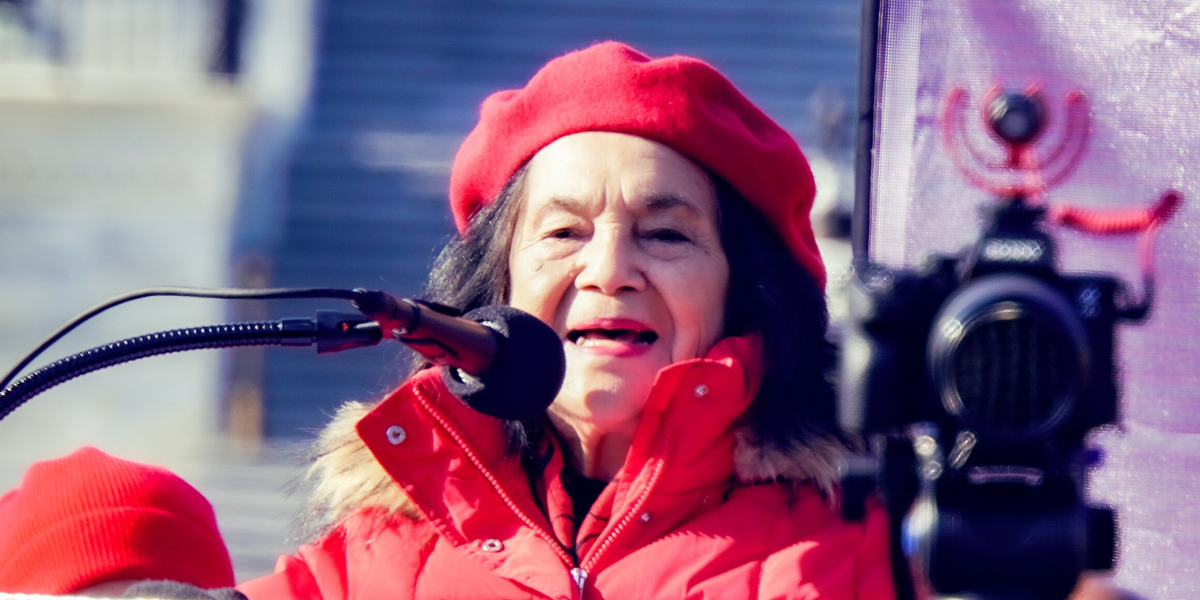
The response has been swift. Calls to rename “Cesar Chavez” streets. Painting over murals and covering statues. Institutions reconsidering who they honor and why. In a matter of days, what once felt fixed suddenly became negotiable. The public decided – collectively, loudly – that we must stop the hero worship of Cesar Chavez. Honoring Dolores Huerta, the woman who co-founded the farmworker movement with him, while also, as we just learned, suffering abuse at his hands, is not just appropriate. It is necessary.
Dolores Huerta is a national treasure. A labor leader, organizer, and strategist, the woman has spent decades pushing against systems designed to exhaust, erase, and outlast women like her. The outpouring of support is not only deserved – it is overdue. But speed reveals something. It reveals capacity. Because if we can mobilize this quickly – if we can shift public sentiment, pressure institutions, and reimagine who deserves to be honored – then we have to ask a harder question:
Why don’t we do this for other women?
We are witnessing some selective solidarity. Huerta is legible to the public. She is recognizable. Historic. She fits – not perfectly, but comfortably – into a narrative we understand: the civil rights hero, the organizer, the icon. We know how to honor her. But what happens when women don’t arrive pre-validated? What happens when they are not icons, but witnesses?
Consider the women whose names we do not chant. The women connected to the Epstein files. The women who have come forward about President Donald Trump. The women who Chavez targeted as children. The women whose stories surface briefly, then disappear beneath the churn of the news cycle.
They do not get streets. They do not get murals. They get scrutiny. Silence. Doubt. And perhaps most tellingly – they get distance. We do not rush to stand beside them in the same way. Why?
It is easy to say that the situations are different. That Huerta represents collective struggle, while these women represent individual harm. But that distinction is a narrative convenience. Because harm is never just individual. When a woman is violated by someone in power, that is not a private incident. It is a public failure. A structural one. It tells us something about who is protected, who is believed, and who is expendable.
So if we can mobilize to honor Huerta, why do we hesitate to defend women whose bodies have been sites of that same struggle?
Part of the answer is discomfort. Huerta allows us to feel proud. The other women force us to feel implicated. Honoring a figure like Huerta affirms our values. It tells us that we recognize justice, that we celebrate resistance, that we are – fundamentally – on the right side of history.
But standing with more anonymous women who accuse powerful men requires something else. It requires confrontation. It requires us to question institutions we rely on, leaders we have supported, systems we benefit from. It requires us to sit with the possibility that justice is not something we have achieved, but something we continue to deny.
And that is a harder story to tell.
There is also the matter of visibility. Huerta’s story has been mediated through decades of documentation, organizing, and public recognition. Her legacy has been constructed in a way that makes her undeniable. But many women never receive that scaffolding. Their stories arrive fragmented. Contested. Vulnerable to distortion. And in a media environment that prioritizes speed and spectacle, complexity becomes a liability. So we default to what is clear. What is already affirmed. We choose the woman whose narrative feels complete. And in doing so, we abandon the ones still in the middle of theirs.
This is not a critique of Huerta. It is a critique of us. Because the question is not whether Huerta deserves this level of support. She does. The question is why our capacity for solidarity seems to stop there. Why it contracts when the woman is less recognizable, less celebrated, less protected. Why can we organize around legacy, but struggle to organize around others’ vulnerability?
There is a pattern here. We honor women once their struggle is no longer threatening. Once it has been historicized. But when the struggle is ongoing – when it implicates power structures that are still very much intact – our response becomes cautious. Measured. Conditional.
And that conditionality is where harm persists. Because it teaches us, collectively, that belief is not a right. It is a reward. Something a woman earns through time, through validation, through survival. Not something she is granted when she speaks.
So yes, let’s rename the streets. Let’s honor Dolores Huerta loudly, visibly, and without hesitation. But let’s also ask ourselves: What would it look like to show up for women who are not yet monuments? What would it mean to extend that same urgency – that same collective force – to those whose stories are still unfolding? What would it require of us to believe women before history tells us to?
The question is not whether we are capable. It is whether we are willing, willing to examine what our selectivity reveals about the systems we claim to challenge.
Dolores Huerta taught us that organizing is not just about changing laws or names. It is about changing conditions. And conditions are not transformed through symbolism alone. They are transformed through consistency. Through showing up, not just for the women we recognize, but also for the ones we don’t.
