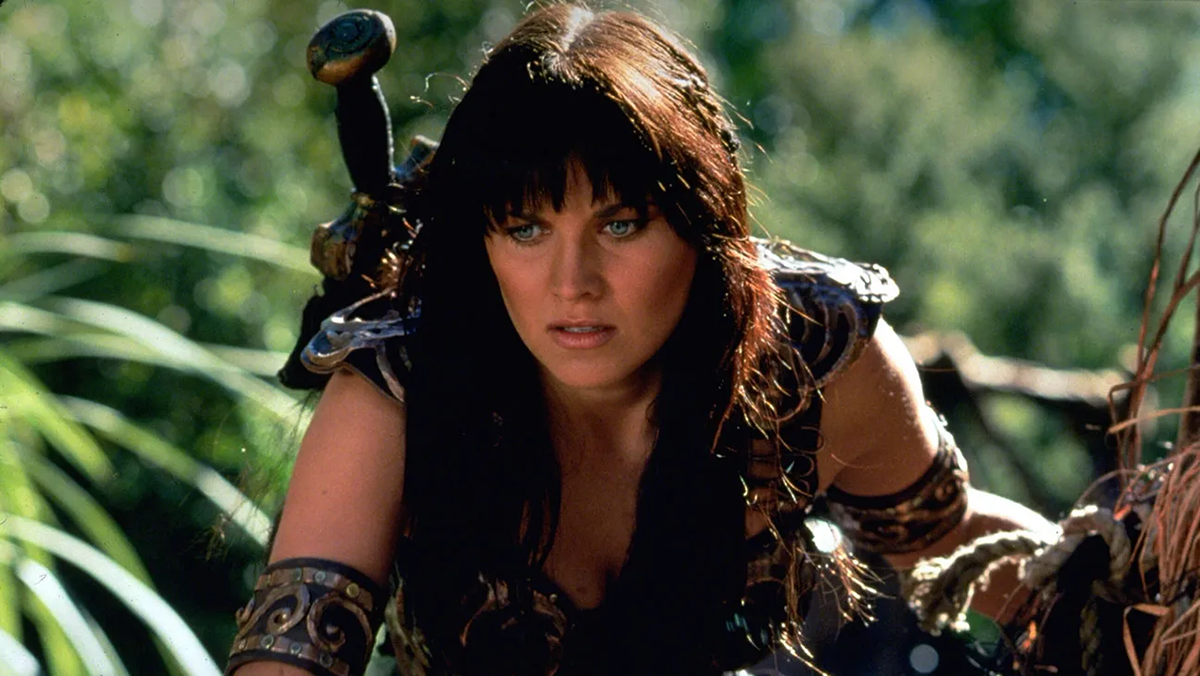
At our long, brown oval table, too big for the kitchen, I sit on a chair with my feet dangling, staring at our small, black box of a television. I impatiently wait for the opening lyrics of a theme song: “In a time of ancient gods and Kings, a land in turmoil cried out for a hero. She was Xena, a mighty princess forged in the heat of power.” Excited, I scream out, “Xena is on!”
On September 4, 1995, the first episode of Xena: Warrior Princess came out, and my seven-year-old self was immediately captivated, watching a woman warrior on television who is independent, strong, and defiant in her journey of fighting evil. The six-season show greatly impacted the millennial generation, including myself, a Nuyorican from Brooklyn.
Women’s Representation in the 90s
You could say the 90s were the decade for women’s representation in media, largely as a result of the second-wave feminism in the 1980s that included the fight to portray women more positively in popular culture. Organizations like the Fairness and Accuracy in Reporting (FAIR) formed in 1986 were part of this fight. However, despite the push forward, nineties media still grappled with stereotypes – hypersexualization, tokenism, and underrepresentation of women of color. On the other hand, it was also the decade that generated the most strong female leads in television, film, and even music compared to decades prior.
Female groups like TLC (who debuted in 1992) and the Spice Girls (starting in 1994) combined with powerful TV leads on shows like Power Rangers, so that female voices permeated media. By the time Xena came out, the world and I were substantially prepared to learn from a strong solo woman character.
Even though the “strong female lead” also plays into a certain kind of tokenism, thirty years later, I’ve come to believe this series (combined with its peers) transformed me, among thousands of others in my generation. These characters did not look like me, but despite their limitations, I was still able to learn a brand of feminine strength from them.
Xena’s Influence on Me
Largely growing up in a machista culture, I often witnessed women submitting to men’s authority, giving them the final decision in child-rearing, how to spend money, and in general how to live her life. In my adolescent life, I rarely witnessed men showing deep respect and appreciation for women, much less following women’s lead (unless it was around “soft power” areas like household chores or providing mental and emotional support for the children).
So shows like Xena helped me develop my own sense of self, raising me to understand that women are also self-sufficient leaders who deserve recognition away from the male gaze and men in general.
Opening Doors for Women and Girl Heroes
After Xena aired, an explosion of other female-centered shows emerged. In 1996, Sabrina, the Teenage Witch series premiered, following a 16-year-old girl raised by her two aunts in Massachusetts who helped her harness her powers. Buffy the Vampire Slayer launched in 1997, starring a 16-year-old girl who fights vampires and demons at night as she deals with the challenges of cultivating her powers while navigating school, relationships, and friendships.
Charmed first aired in 1998, this time about the most powerful witches ever. It followed the three Halliwell sisters living in San Francisco who fought demons and warlocks to protect innocent people from evil. Earlier in the same year, Sex and the City aired, following four independent, career-driven, and sexually liberated female friends as they navigated dating and their identities in the big city.
The common thread of all these shows is the concentration of white-female characters. Although shows like Sister Sister (1994) and Moesha (1996) focused on young Black teenage girls, the premise was about their families – not showing Black girls who can take the lead in making the world a better place, independent of a hierarchical and paternal-led family structure. Women leads in the 90s could be seen as an example of the failure of second-wave feminism that uplifted middle-class white women into positions of power while isolating women of color.
However, the 2000s seemed to benefit from the third-wave feminism movement of the 90s, which called for more diversity in media. Shows like Girlfriends in 2000 about four close Black career-focused friends in their early-to-late 20s is a result of this push. In 2006, we finally got a popular Latina lead in Ugly Betty. Betty is a 22-year-old Latina from Jackson Heights, Queens on her journey to becoming a prominent writer in the fashion industry, but stuck dealing with a paternal family and corporate structure. These two examples, though, were swimming in a sea of more white-female centered shows from the same decade like Gossip Girl, Gilmore Girls, and Veronica Mars, among others.
These shows all shaped my worldview, giving me the freedom to imagine myself as an independent warrior, like Xena. What a legacy.
