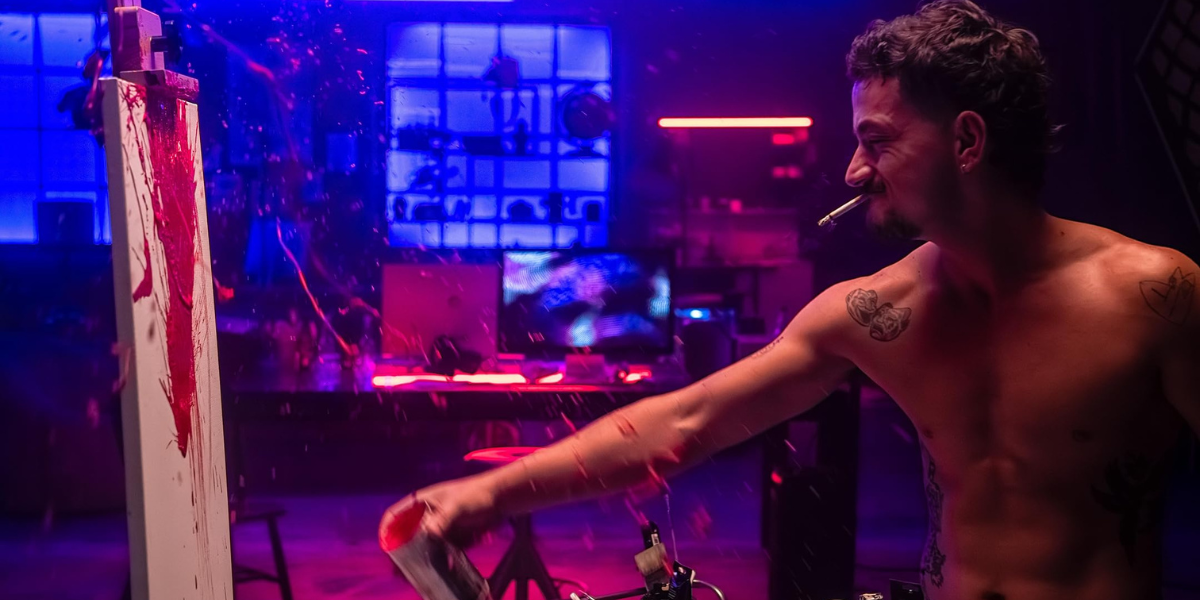
Puerto Rican director Juan Esteban Suarez has dreamt of Un Día de Mayo (Becoming Mayo), his “opera prima,” since 1989. That’s when he began writing the story of a painter/photographer who suffered a devastating trauma in his youth and must confront his past. The result is a visually stunning love story, an ode to Puerto Rico, and a treatise on the island’s cinema, which is struggling to escape from the United States’ colonial shadow and express itself in its natural language and form.
Un Día de Mayo, which opens in cinemas across Puerto Rico on September 25 (and will be in New York in the near future), is Suarez’s directorial debut after 42 years in the business, working on films like Fast & Furious 5, Runner Runner, and 22 Jump Street. He began writing it while working with renowned filmmakers like Puerto Rican director Marcos Zurinaga (La Gran Fiesta) and Mexican writer-director Alfonso Cuarón (Roma, Y Tu Mama Tambien).
Suarez has crafted a deeply emotional and exquisite narrative about a young man, the “Mayo” of the title, who is haunted by unresolved suffering. He must face his demons to rediscover his passion for painting and allow love to make him whole again.
“I started writing Un Día de Mayo in 1989. It suffered several transformations since it was a love story, which was current,” Suarez explained when Latina Media Co asked him about the history of the film. “As time went on, I kept on making it more current, especially with our slang, the way the young people were talking.”
“Because of Mayo’s trauma, he can’t relate emotionally to other human beings. He’s suffering from PTSD. It’s a psychological drama where he achieves his objective – to paint again, which was his passion – and thanks to love, he decides to confront his trauma, leave it behind, and make a life with his beloved,” the director shared.
Puerto Rican actors Paolo Schoene (Verano de Tres, Members State) and Anoushka Medina (Por Amor en el Caserío) are Mayo and Luna – the Romeo and Juliet of Un Día de Mayo. Schoene embodies Mayo as a wiry, restless, and hurting young man, while Medina is the perfect Luna – ethereal in her beauty, solid in her love for Mayo. The chemistry between them jumps out at you from the first frames of the film, marking them as breakout stars.
The film also boasts a soundtrack, the highlight of which is the official song “El amor de mi Patria” by Puerto Rican composer Medina Carrión (who performed as a child with none other than Eddie Palmieri), and the iconic line – “Rompe.” The film’s soundscape was orchestrated by Puerto Rican songwriter and producer Eduardo Reyes.
Un Día de Mayo is a banquet for the eyes and ears in its love of the Island. The colors of the Caribbean bathe the film – purplish azures, reds, lush greens, and turquoise (courtesy of the magnificent eye of award-winning Boricua cinematographer PJ Lopez). And it’s filled with our Caribbean Spanish – complete with street slang – the one made famous by Puerto Rican superstar Bad Bunny.
Art – and in this case film – is a powerful way to portray national identity, to let others see us for who we really are. Starting in the late 1990s, the Puerto Rican film industry has grown significantly, with the number of local productions increasing year after year. Recent films such as La Pecera, nominated in 2024 for Premios Goya (Spain’s equivalent of the Oscars) have garnered international acclaim and even made it to Sundance.
Yet, the Academy of Motion Picture Arts and Sciences has determined that Puerto Rican cinema is not eligible to compete in the Academy Award for Best International Feature Film because the island is a US colony and our films are not “foreign.”
Suarez, and many of his peers, have written letters to request the Oscars governing board reconsider its policy and reinstate Puerto Rico’s eligibility in the Best International Feature Film category.
“This ruling is colonial and unfair,” Suarez said during our conversation about Un Día de Mayo. “Puerto Rico is a nation with its own distinct film industry, language, and cultural identity, separate from the mainland U.S. Puerto Rican films should be treated like those from other nations with unique film industries and cultures.”
“We do not want to have to tell our stories in English to compete,” he said. “This effectively silences the Puerto Rican voice.”
The hope is Un Día de Mayo and films like it – Puerto Rican films in our language – will carry our voices loudly.
