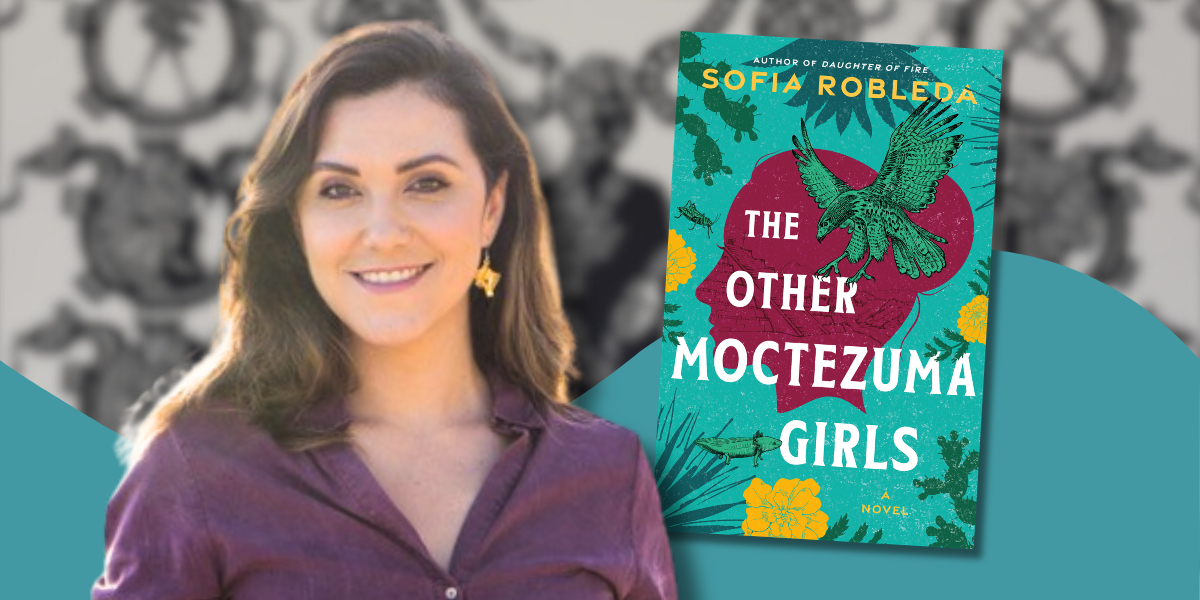
In 2019 or 2020, as I researched my debut historical fiction novel, Daughter of Fire, I came across the story of Tecuichpoch, the last empress of the Mexica (pronounced Meh-shee-ka, more commonly known today as the Aztecs). I was stunned, though perhaps I shouldn’t have been, that I had never heard about her. She was the most important daughter of Moctezuma Xocoyotzin, and later, the primary wife of Cuauhtémoc, both emperors of Tenochtitlan, and incredibly important figures in Mexican history. She too, deserves to have a place by their side, to have her story told – which is what I did in my second novel, The Other Moctezuma Girls.
The little facts we know about her are stranger than fiction. After Hernan Cortés arrived, Moctezuma gave his daughter to Cortés as a “gift,” and the colonizers baptized Tecuichpoch with the Spanish name, Isabel Moctezuma. She then survived the smallpox epidemic that decimated 90% of the population – and made it through a siege, six marriages, and seven childbirths. All of her children survived to adulthood. She also managed to sue the Spanish Crown so successfully that she became the wealthiest landowner in New Spain. And when she died, she left behind a will where she freed all her slaves.
But as it often happens, historians shunned, sidelined, and ignored Tecuichpoch, an Indigenous woman, relegating her to the unnamed role of child, wife, mother, and mistress. Or at least that was the plan, a plan I’m undercutting with The Other Moctezumea Girls.
You see, I could not get her out of my mind. Tecuichpoch followed me through the journey to publish my first novel, and compelled me to find out more, to get to know her, to understand her. How had she lived before and after the conquest? How had she endured every horror she faced? How did the conquest affect her and her family? Why did her children spend decades suing each other, following her death? Why had she encouraged her two legitimate daughters to become nuns and remain unmarried? Why had she emancipated so many people at the end of her life?
It was this powerful gesture that stayed with me the most, a seed that took root and sprouted, vine-like, with leaves and petals and thorns. Was this some sort of legacy she had wished to leave behind?
It is difficult to know, because she was likely illiterate. We don’t have any letters dictated by her, or a diary or journal. Friar Sahagun, famous author of the Florentine Codex, wrote that she was, “revered, esteemed, respected… a protector – one who loves and guards people… and treats others with tenderness.” Interviewed by the Spanish historian Fernandez de Oviedo, her last husband, the conquistador Juan Cano, said, “There is no person better educated or indoctrinated in the Faith… she is a gentlewoman in all things and a friend of Christians, and because of her example, quiet and repose are implanted to the souls of Mexicans.” It would seem then that in the eyes of these Spanish men, Tecuichpoch excelled in the role she was expected to undertake following the conquest, as a model for mestizaje, the mixing of ethnic and cultural groups.
Of course, we can safely assume that Tecuichpoch had very little choice in the matter – or perhaps she wished to take the least painful road, and who can blame her? The law of the time protected Indigenous people who accepted Spain’s “right to rule” as free vassals. If they resisted, they could be imprisoned or enslaved. She had already suffered four years of captivity by the time Cortés murdered her third husband, Cuauhtémoc. Could this experience have prompted her to set her own slaves free?
Certainly, the emancipation of hundreds, if not thousands, of slaves was a controversial move at the time. Mexica noblewomen grew up in a culture where slavery was a normal, daily part of life, even before the arrival of the Spanish. And slavery only grew with the Europeans’ arrival, as the Spaniards enslaved a large percentage of the Indigenous population, and also brought African people as chattel to the Americas. Tecuichpoch’s will was so unusual that it was highly remarked upon in New Spain society. A topic of gossip for weeks in the viceroyal court and abroad.
Now, Tecuichpoch obviously benefited from the labour of enslaved people throughout her life. Yet she still could have chosen to pass them on to her seven children as property, which she did not.
Surely, I felt, this final gesture meant something to her.
It took me a long time to locate a transcript of her will in the historical archives, and when I did, I was struck by the wording. Even though she would not have written it herself, the emancipation was one of the first orders to action: “I wish, and order, and state, that it is my volition, to release all my slaves, born natural people of this land. I order them to be free of all servitude and captivity. If they are slaves, I command them to be free.”
Five hundred years later, we are reeling as the pendulum of power swings further to the right all around the world, towards authoritarianism and tyranny and neo-colonialism. Mass propaganda paints immigrants and refugees as enemies and strips them and other marginalized people of their rights and their basic humanity – something Tecuichpoch experienced herself. Something she endured, survived, and went on to dismantle in one of the only ways she could.
Her resilience, to me, is breathtaking and inspiring. A light to take with me in these uncertain, dark times. A light to share with others. That is why I wrote The Other Moctezuma Girls. It is a historical fiction, an adventure story, a story of love, loss, family legacy, and heartbreak. And it is, I hope, as honest an account of her existence as there ever was. An account to honor this Mexican empress, who earned her place in our hearts long before we even knew her name.
My hope is that you will find her… in The Other Moctezuma Girls.
