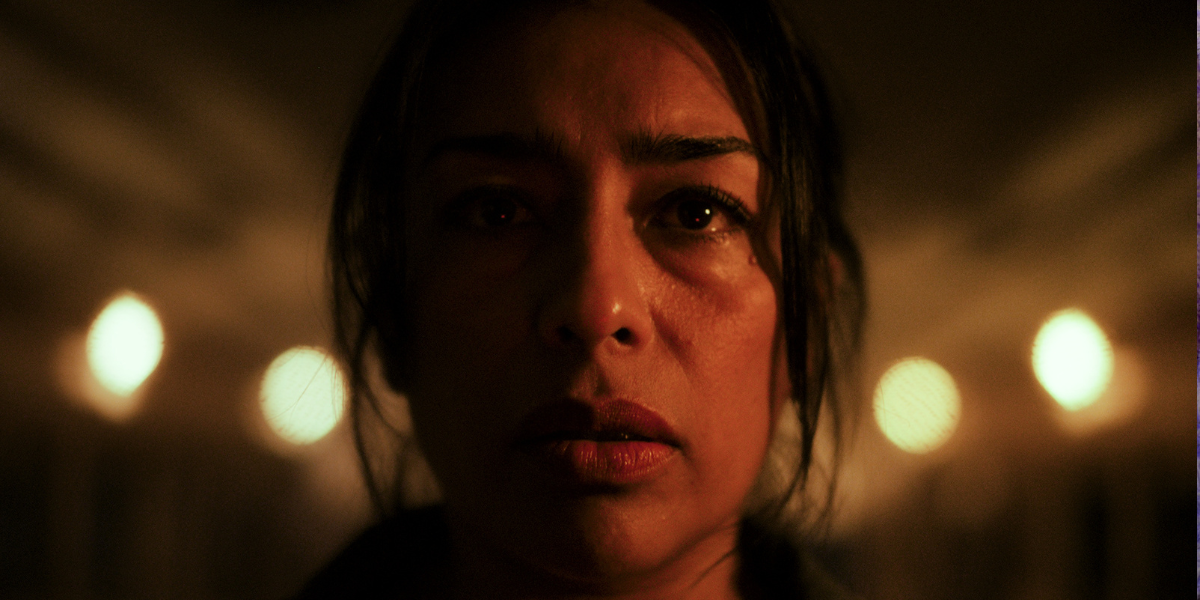
My mother never let me take the bus to school when I was a child. It wasn’t until I was older that she quietly whispered why. Suzanne Andrews Correa’s feature debut, The Huntress (La Cazadora), invokes the mythos of the Goddess Diana (the Greeks’ Artemis), in a fictionalized telling of the real-life bus murders in Juárez, Mexico, in 2013.
In this Sundance 2026 selection, legend becomes as tangible as the desert sand that hides a nation’s dirty secrets. And it strikes as heavy as the shovels of those determined to reveal the truth.
Reporters never nailed down why that mysterious blonde assailant shot those men on those hot August mornings. But an email signed by “Diana – Huntress of Bus Drivers” alleged it was about enacting vengeance against those who harm women and girls, seeking transient refuge in their rickety buses.
‘We have seen so much in Juárez, and it has been so terrible, that almost nothing about killing shocks us any more,’ said Erika, at the back of a No 10, her voice scarcely audible above the mariachis on the radio,” an article by The Guardian written after the murders reads. “But when asked about the drivers, she smiled discreetly. ‘Perhaps they will realise that it is not so easy to abuse women now.’”
Andrews Correa, a former Sundance Directors and Screenwriters Lab Fellow, takes the vigilante and imagines her as Luz (Adriana Paz), a factory worker recovering from her own assault on the Route 4 bus one year ago. Luz is not only consumed by her difficult past, but by the tremendous urge to protect her 14-year-old daughter Ale (Jennifer Trejo), so that she may never know that same pain.
Coming off the accolades she received for her performance in Emilia Pérez, Adriana Paz astonishes as Luz, oscillating between the political gloom of a perilous reality and the personal love a mother has for her daughter. When Luz weeps, you weep. Yet. when she smiles – watching Ale recount a fond memory or shop for food – time stops. There is no sorrow, only pure devotion.
Andrews Correa puts light and movement on dynamic display in The Huntress, as the film centralizes the vehicle that plagues Luz’s nightmares. They’re the same buses she needs to take two of each long day on her way to work and back home. Cinematographer Maria Sarasvati Herrera brilliantly destabilizes notions of safety through her use of darkness and handheld shots, underscoring that a still, empty bus is not inherently an image of peace, and that a car following you in the dark is not always a threat.
When Luz decides to walk home rather than take an empty bus, she gets picked up by Ximena (Teresa Sánchez), who won’t stop searching for her missing daughter. “Between the bus and the desert, I’d also choose the desert,” Ximena tells Luz, before going on to explain that the statue on her rearview mirror is of the Goddess Diana, a fearless deity with a bow and arrow used for justice.
Sánchez poignantly delivers the film’s most significant lines of dialogue, elucidating The Huntress’ thesis in just a few scenes with moving dignity and grace, so it is only fitting that she introduces Luz to the motif, which will reassure her strength. Herrera and Andrews Correa use sunlight to represent the faith and shame we all carry with us during our rote commutes, arguing that everyone would be better and safer if they bore witness rather than turn away from its harsh glare.
Together, the women in front of and behind the camera leave you speechless, praying for the bus doors to pry open so you can take a gasp of fresh air. Still, in desperate times ruled by corrupt law enforcement, these resilient women refuse to let the desert dust settle.
