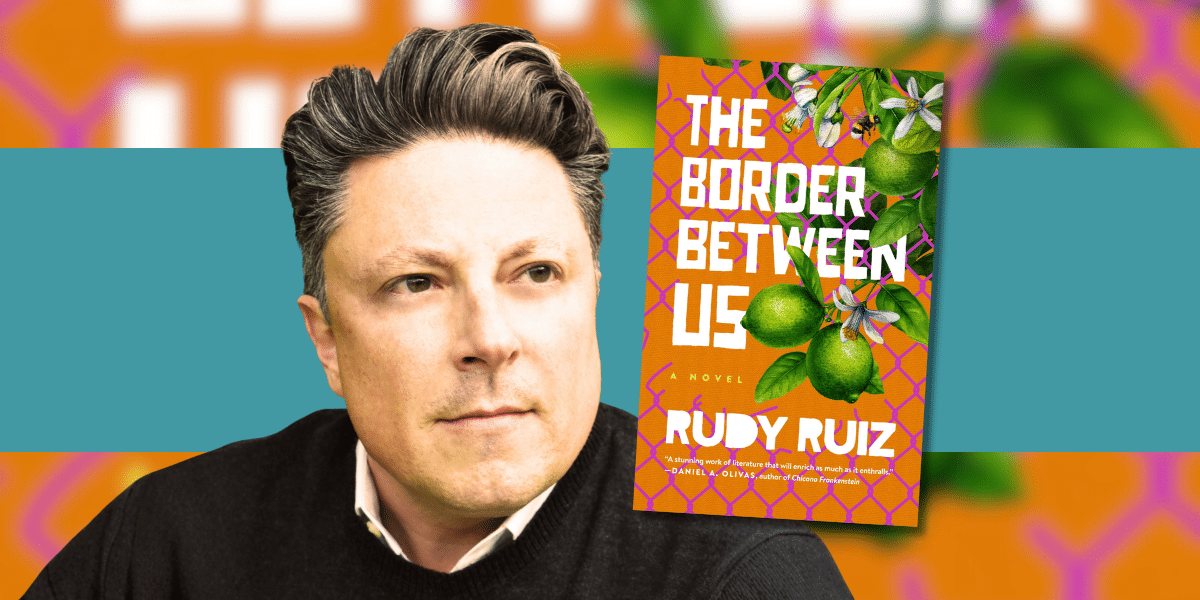
Rudy Ruiz’s The Border Between Us is a coming-of-age story rooted at the intersection of identity, family, and the American Dream. Set between Brownsville, Texas, and Matamoros, Mexico, the novel follows Ramón López as he grows from a wide-eyed boy who idolizes his father into an artist who must reconcile ambition with belonging.
“I wanted to humanize the human experience,” Ruiz told me. “What’s surprising is how hard it is to get the Latine perspective, even though it’s in the news every day. We’re often reduced to polarization. I wanted to tell nuanced stories about what it means to be Latino in the United States.”
That nuance defines the book. Ruiz’s border is not the simplified landscape of crisis often seen in headlines, but a living, breathing community, full of faith, failure, resilience, and love. His characters, especially the López family, reveal the complexity of border life: the cost of striving, the burden of machismo, and the quiet strength of women who hold everything together.
The American Dream, Complicated
At the center of the novel stands Joe López, Ramón’s father, a tire repairman and tireless dreamer. Ruiz describes Joe as inspired by his own father: “The hardest working person I’ve ever known, dedicated, courageous, enamored with the American dream.” Yet Joe’s ambitions, driven by both pride and pressure, gradually fracture his family. His story becomes a reflection on how the same values that inspire hope can also fuel self-destruction.
Through Joe, Ruiz makes a broader critique of the American Dream – how it often demands assimilation at the expense of connection. “The border should not be a wall,” he said. “It’s a place where people come and grow together. We shouldn’t feel we have to abandon our heritage to be American or abandon family for career. We’re most ourselves when we’re crossing those borders.”
Women at the Center
Though the story begins with a son’s admiration for his father, it’s the women – Marisol, Ramón’s mother and Grandma Fina – who emerge as the novel’s emotional core. Inspired by Ruiz’s mother and grandmother, they both embody perseverance amid hardship.
“The story starts with men dominating the narrative,” Ruiz reflected. “But the true center of gravity are the women, the ones keeping the family together, the roof over their heads. The true heroines of the story.”
Marisol’s quiet evolution from long-suffering wife to independent provider upends the gender norms that often confine immigrant women to invisibility. Through her, Ruiz gives voice to generations of women whose strength sustains families when dreams falter.
Borders Within
One of the novel’s most moving relationships is between Ramón and his younger brother Rubén, who lives with disabilities. Ruiz drew on his own life for this storyline: “My brother was born with cerebral palsy. When that happens in a family, everything shifts – the firstborn becomes what I call a ‘glass child,’ someone who becomes invisible because the parents’ attention is elsewhere.”
Through Rubén, Ruiz broadens his meditation on borders. The most formidable boundaries, the novel suggests, are not always geopolitical but emotional, the ones within families and within ourselves. Over time, Ramón learns to see his brother not as an obstacle but as a teacher, someone whose perseverance offers a quieter model of strength.
Art as Resistance
Art, for Ramón, becomes both escape and homecoming. Encouraged by his mentor, Marcela Martínez, he pursues his dream of becoming an artist, even as he grapples with the tension between authenticity and success. Ruiz infuses these scenes with autobiographical insight: “I wanted Ramón to have a creative pursuit that felt authentic. Writing this book over ten years was my way of reflecting on painful truths, and finding beauty in them.”
That creative awakening culminates in one of the novel’s most memorable lines: “It seemed the closer I got to the border the more it blurred, until it disappeared. Who knew what I would do, but I was here now and I could create and I could recycle. And I could reconnect.”
It’s a declaration of artistic and personal liberation, a rejection of binaries, and an embrace of multiplicity. In the end, Ramón’s border isn’t something to cross but something to transcend.
Building Bridges, Not Walls
For Ruiz, The Border Between Us is as much a cultural offering as it is a novel. “For people like me, I hope they see themselves reflected and keep pursuing their dreams without abandoning their roots,” he said. “For others, I hope it reminds them of a time when we built bridges, not walls.”
With grace and empathy, Rudy Ruiz has written a story that redefines what the border can mean. It’s not a dividing line, but a site of creation, connection, and possibility. The Border Between Us invites readers to imagine a more humane U.S., one where the boundaries between us blur not in fear, but in understanding.
